Transfer Function
WEEK 1 - TRANSFER FUNCTION
Aim -
- How Hybrid Electric cars are operated more efficiently by autonomous driving systems?
- Derive Transfer function of a car & convert it to state space format.
- Are the Transfer Functions of RC & CR (output across R) circuits same?
- How Hybrid Electric cars are operated more efficiently by autonomous driving systems?
The Hybrid Electric Autonomous cars are the future of automotive industries.
A self-driving car is a vehicle that can sense the environment and can navigate itself through the environment without a human input.
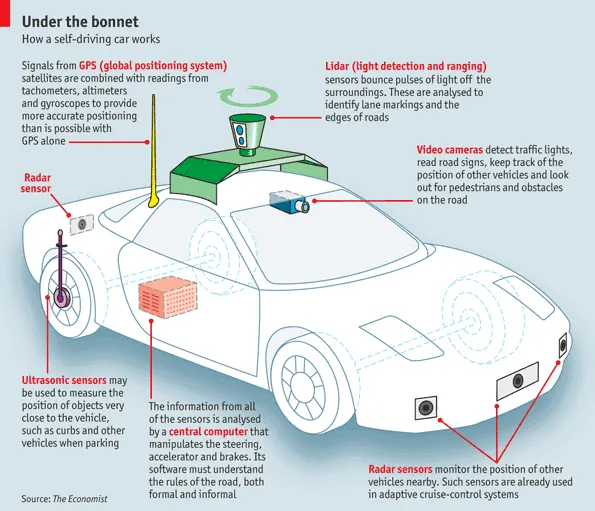
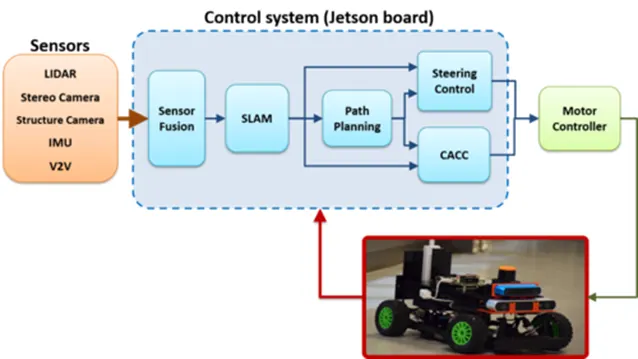
Self-driving cars do have many sensors like RADAR, LIDAR, ultrasonic, GPS Etc. that helps for navigation.
Autonomous Driving cars -
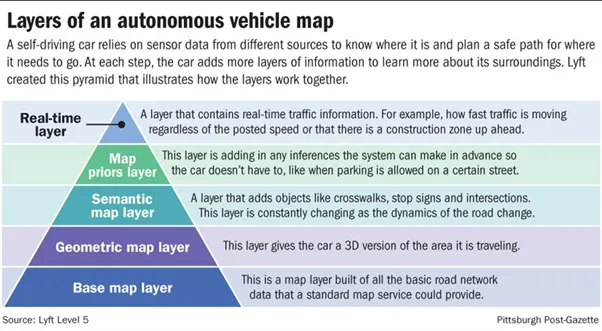
The Society of Automotive Engineers has classified self-driving vehicles into stages which range from level 0 to 5. Let's take a brief look at each stage -
Level 0 - It doesn't feature any self-driving technique at all.
Level 1 - These cars offer at least one system that helps the driver to brake, steer, accelerate, but if there are multiple systems then they are not capable of communicating with each other.
Level 2 - These cars simultaneously control speed 7 steering, even if the driver is not driving for a short period of time. Think lane-centering technology combined with advanced cruise control, as an example.
Level 3 - These vehicles are fully autonomous but require driver’s attention. These cars are not yet available but are being tested by some tech start-ups.
Level 4 - These cars once programmed to destination won’t need driver’s input, but the controls are available for driver’s interference for some instances.
Level 5 - These cars are fully autonomous without driver’s interference at all.
Currently very few vehicles offer Level 3 technologies & no level 4 or level 5 systems have been commercially deployed.
Hybrid Electric Cars -
Hybrid Electric Vehicles (HEV) has 2 different types of energy units, electricity & fuel. Electricity means that the battery is used to store the energy, and that an electromotor will be used as traction motor.
Fuel means that the tank is required, and that an internal combustion engine is used to generate mechanical power or that a fuel cell will be used to convert fuel to electric energy. In the latter case the traction will be performed by the electromotor only. In the first case the vehicle has both an engine and the motor.
Depending on the drive train structure (How motor & engine is connected) we can differentiate between series, Hybrid or Parallel HEVs.
Depending on the share of the electromotor to the traction power, we can distinguish between mild or micro hybrid (start-stop systems), power assist hybrid, full hybrid or plug-in hybrid.
Depending on the nature of the non-electric source we can differentiate between IC engine combustion (ICE), fuel cell, Hydraulic or pneumatic power & human power. In the 1st case the ICE is a spark ignition engine(Gasoline) or Compression Ignition/Direct ignition (Diesel engine). In the 1st 2 cases, the energy conversion unit maybe powered by gasoline, Methanol, CNG, hydrogen or other alternative fuels.
HEVs can be operated more efficiently by Autonomous Driving Systems –
Applying Hybrid-Electric Technology to Self-Driving Cars delivers several benefits, including maximum mileage to keep the vehicle on the road. Plus, hybrid’s help provide the significant amount of electrical energy required for self-driving sensors &7 computing systems without having the significant impact on the mileage.
Computer efficiency is at the top of the mind for everyone involved in the race to develop self-driving cars.
The location is detected by the GPS (Global Positioning System). it is the new & promising technology which uses real time geographical data received from several geographical GPS satellites to calculate coordinates, speed & course to help to navigate the car. GPS integrates the data received from tachometer, gyroscope & altimeters to provide more accurate positioning.
For identifying the lanes marking & the edges of the road – LIDAR (Light Detecting & Ranging) sensors are used. The emitter sends the Laser beam to bounce off the mirror 10 to 15 resolutions per minute. After bouncing-off the objects, the laser beam returns through the mirror to the receiver. The data of such points is stored as a point cloud data (PCD).
RADAR sensors are used as an Adaptive Cruise Control (ACC) system to monitor the position of in-front vehicles. Also, the ultrasonic sensors are used to measure the position of the objects very close to the vehicles such as speed brakes and other vehicle parking. Cameras are also mounted to detect the traffic signals, keep track of the other vehicles & look out for pedestrians and other obstacles on the road. The information from all of the sensors is analysed by central computer that manipulates the steering, accelerator and brakes.
In the autonomous cars the switching of fuel system to battery system and vice-versa can be done by the car only without human assistance, with the help of that car can be worked more efficiently.
Other benefits of the autonomous cars are –
- Reduced accidents.
- Reduced Traffic congestion.
- Reduced CO2
- Increased Lane Capacity.
- Lower Fuel Consumption.
- Transportation Accessibility.
- Reduced travel time & transportation cost.
- Moe effective & affordable taxis.
- More efficient parking.
- Derive Transfer function of a car & convert it to state space format.
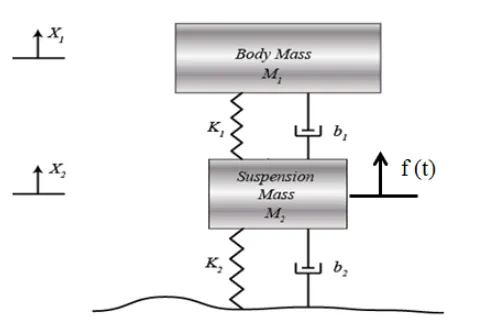
The model consists of two mass bodies, quarter vehicle & wheel, lumped parameters for stiffness & damping, for both suspension & tyre.
m1 (Kg) = The mass of a quarter of a vehicle body.
m2 (Kg) = The mass of the wheel and suspension.
k1 (N/m) = Spring Constant (Stiffness) of the suspension system.
k2 (N/m) = Spring Constant (Stiffness) of the wheel & tyre.
b1 (N-s/m) = Damping constant of the suspension system.
b2 (N-s/m) = Damping constant of the wheel & tyre.
x1 (m) = Displacement of the Vehicle Body. (Output)
x2 (m) = Displacement of the wheel & tyre. (Output)
Transfer Function –
By Newton’s 2nd Law of Motion –

Now applying Laplace Transform (Assuming initial condition = 0) on both side of equation –

From equation {i}
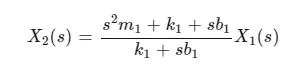
Putting x2 in equation (ii) we get the transfer function –

State-Space Model –
By Newton’s 2nd Law of Motion –

Suppose,

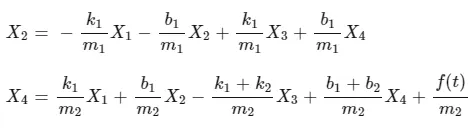
Putting these state variables in equation (iii) & (iv)
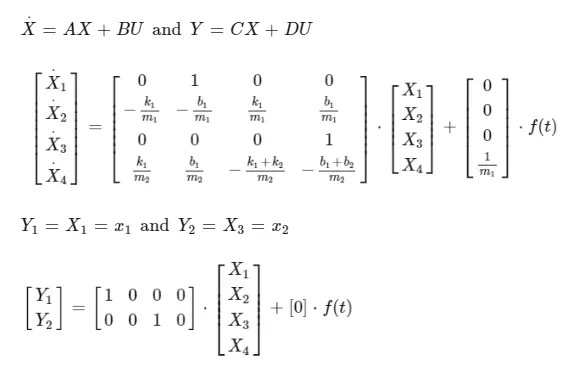
Putting all this in the form of the state space model –
- Are the Transfer Functions of RC & CR (output across R) circuits same?
The transfer function RC output across capacitor –
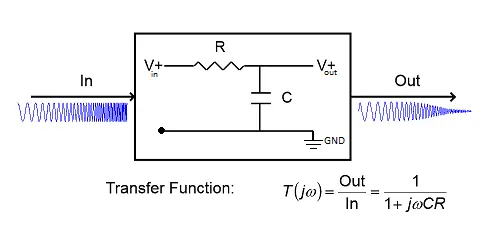
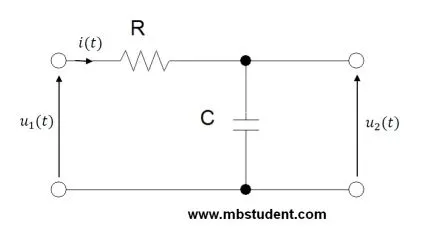
Vi(t) = Input Voltage in the domain.
i(t) = Current in the domain.
VO = Input Voltage in the S – domain.
I(s) = Current in the S-domain.
C = Capacitance of Capacitor.
R = Resistance of the Resistor.
t = Time.
s = Complex Variable.
Vo = Output voltage in time domain.
Vo(s) = Output voltage in s-domain.
Current is flowing in the counter-clockwise direction -
By applying Kirchhoff’s Voltage Law –
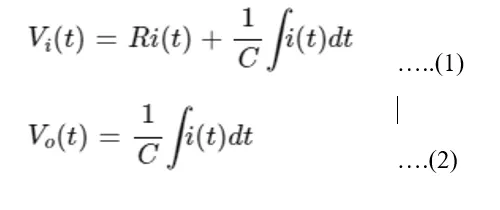
Now applying Laplace transform on both sides of equation (1) & (2)
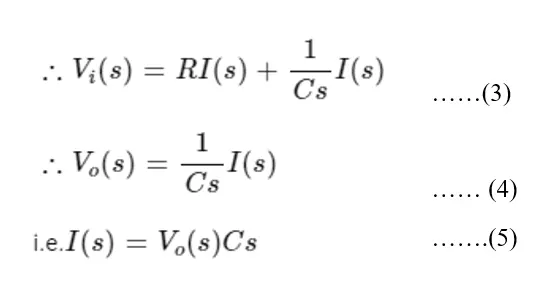
Putting equation (5) in equation (3) we get –
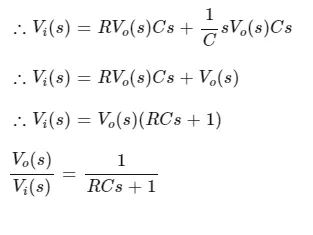
The Transfer Function of CR circuit with output measured across resistor –
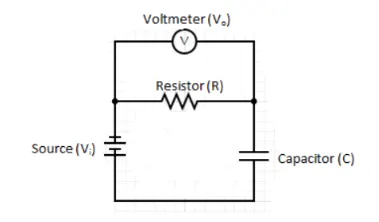
Current is flowing in the counter clockwise direction.
By applying Kirchhoff’s Voltage Law –
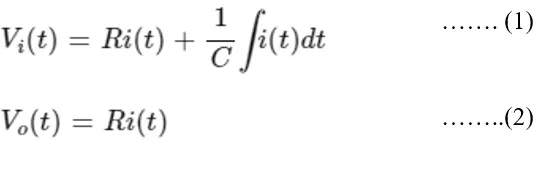
Now applying Laplace Transform on both sides of equations –
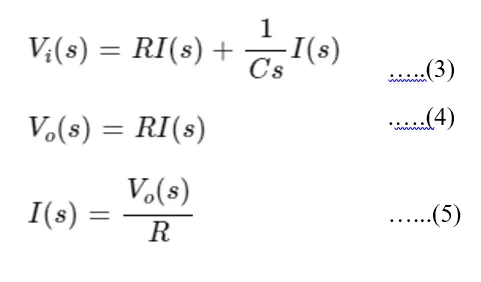
Putting Equation (5) in equation (3) we get,
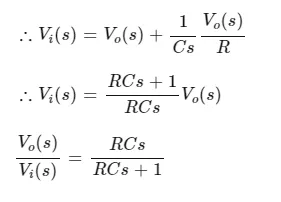
Hence the Transfer Function RC output across capacitor and the Transfer Function of CR output across resistor are not same.