Week 1 Stress Concentration on a Plate with hole
Stress Concentration on a Plate with hole
OBJECTIVE:
To determine the displacement and stress effects generated on a designed plate with a hole model when fixed at one face and subjected to a force of 500N at the other end.
This computed result is then compared with a simulation of similar boundary conditions but with modifications in the model (introducing two smaller holes nearby) and determining which model provides the most feasible solution and better design.
PROCEDURE:
CASE 1: Model with one large hole
- Open a new static structural model and select structural steel as the desired material data under engineering data
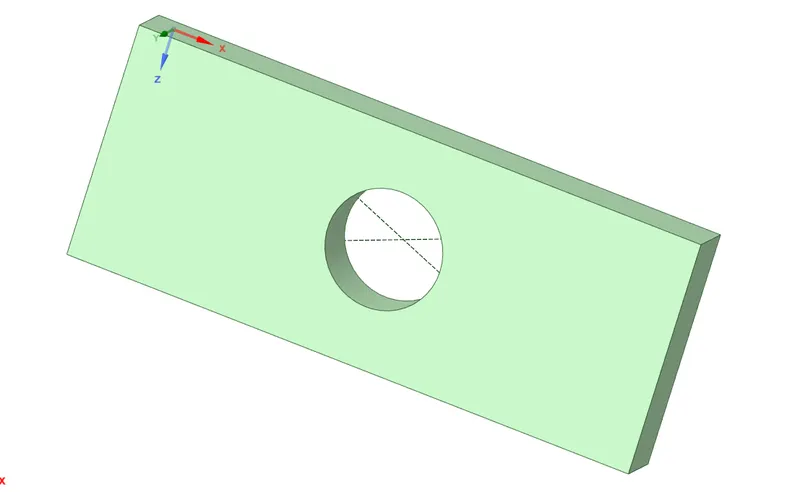
- Create the model geometry on Space claim with the following dimensions
Length=300mm
Height=120mm
Thickness=30mm
Circular Hole at the center: Diameter=60mm
- Update the model in the workbench GUI and open the model
- Make sure the structural steel is assigned to the geometry. By default if only one material is present in the engineering data then this will automatically get added to the component.
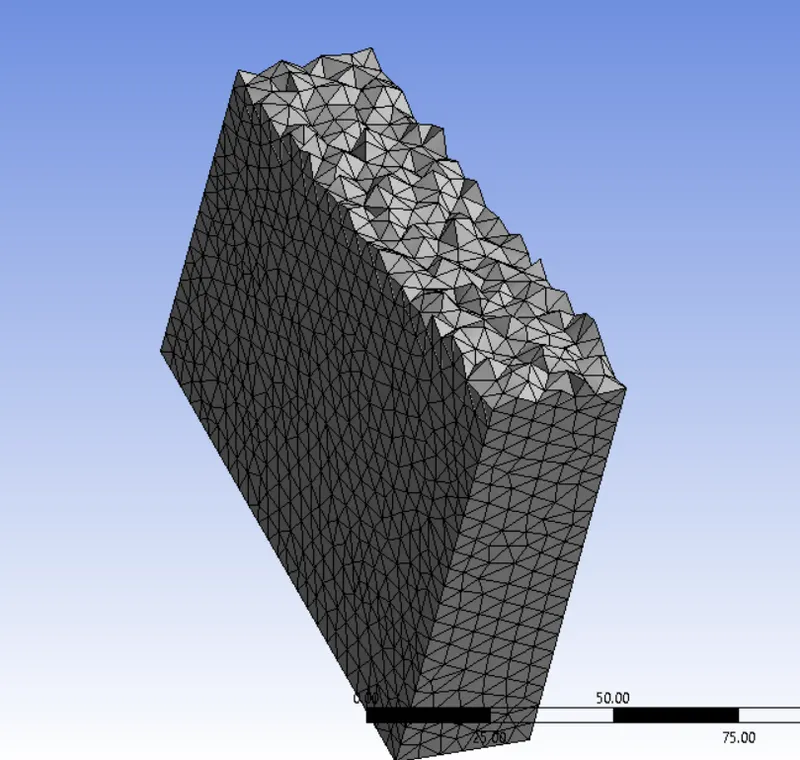
- By default ANSYS creates a very coarse mesh. So generate tetra solid mesh on the component with a sizing of 5mm target length
- Add the fixed support to one end of the model and a force of 500N on the other end using the static structural provided features.
- Specify the required output parameters in the Solutions module. Total deformation and Von mises stress are specified as the result field variables to be computed
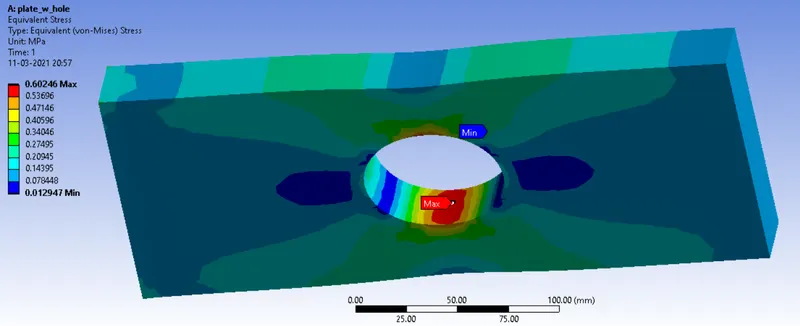
- The result is shown below with a max stress value of 0.6MPa or N/mm.sq
Von-mises stress
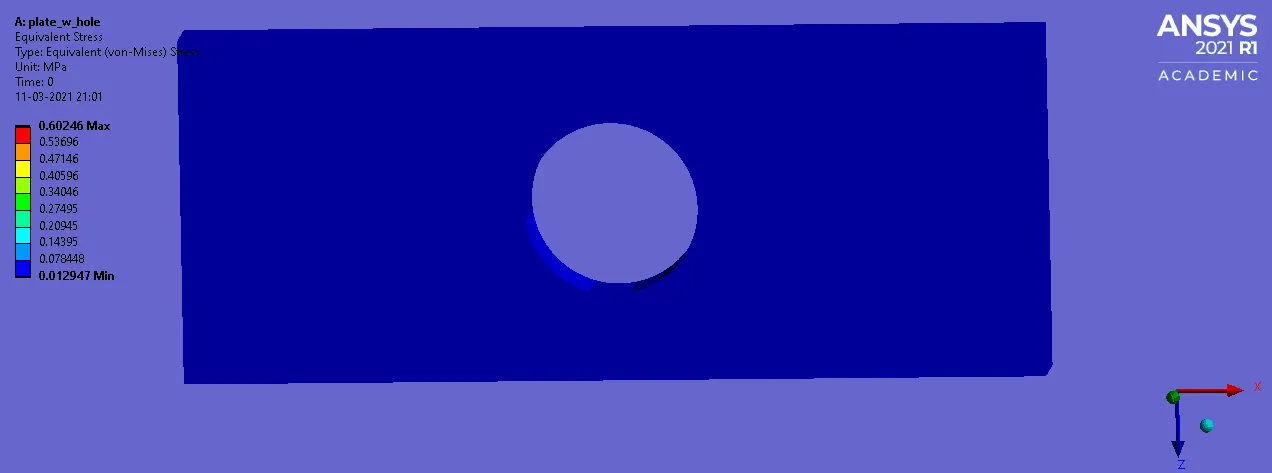
Total deformation
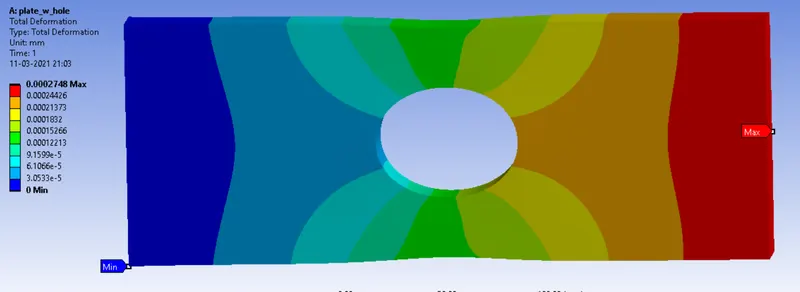
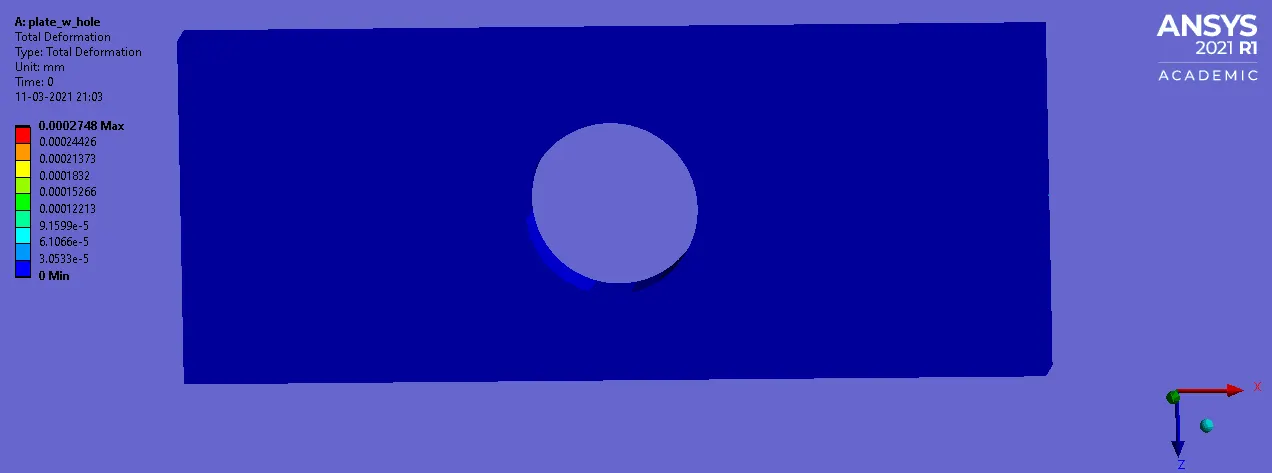
CASE 2: Model with two additional smaller holes
- In the second case the following modifications are made to the geometry.
smaller holes 90mm away from the center: Diameter=30mm
To make the following modifications in spaceclaim
- Enable 3D sketch feature
- Create two construction lines 90mm apart from centre of hole on both sides
- create two smaller holes of dia 30mm
- By draging the smaller holes under the extrude cut option two smaller holes are created as shown below
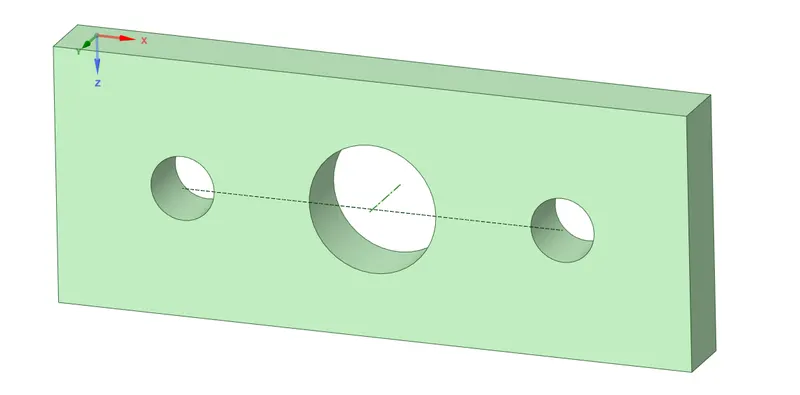
- Update the model and perform the same exact simulation as done before
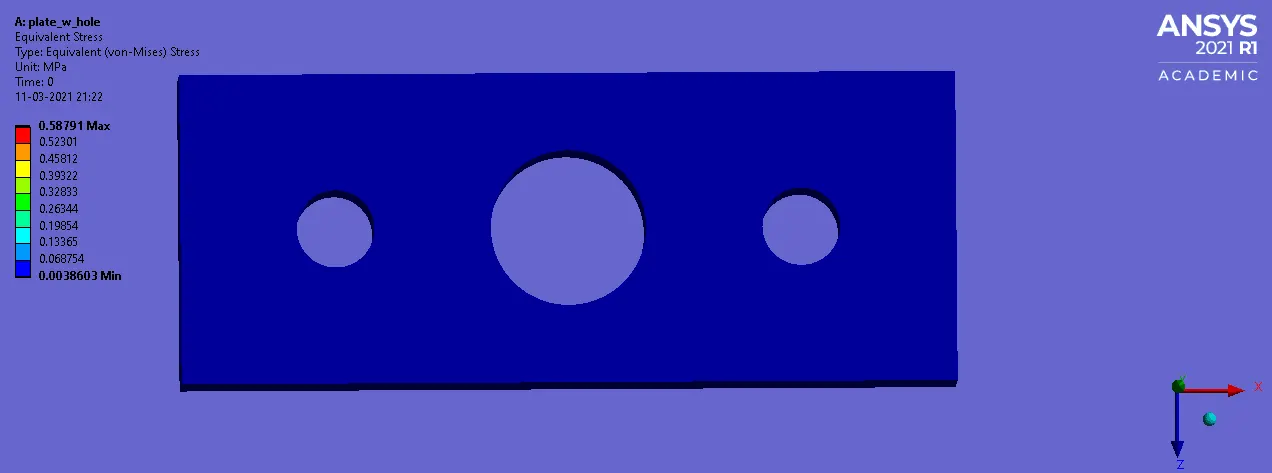
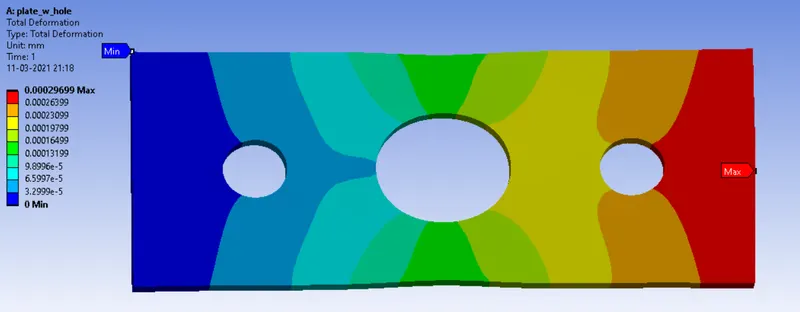
- The following results were extracted
Von mises stress
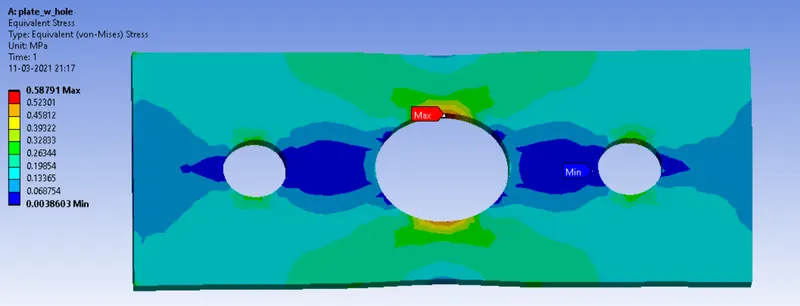
Total deformation
CONCLUSION
From the above results we can conclude that,
- The max stress generated is higher in model 1 compared to model 2. This is because by introducing two smaller holes nearby the larger hole at equidistance significantly reduces the stress concentration over that area. While this isnt the practical application of the required/ manufactured model, it still is preferred during computational analysis.

Alternative ways to reduce such stress concentration on the single hole would be by introducing V-shaped grooves at both ends of the plate along its length.
- It can also be noted that the average stress generated over the entire model would obviously be higher in case of model 2 since while introduction of smaller holes would affect the stress distribution over the areas of discontinities, it also creates a higher stress value at these smaller holes.
- We can also conclude that the total deformation is higher in case of model 2 since (from the first point) it would offer the least resistance as we can see from the stress distribution plot and due to reduction in material volume.
Hence, from an analysis point, the model 2 is preferred over model 1. Since simulations by their very nature are meant to give an approximate result and not the exact result, assumptions and less significant modifications can be made on the model to counter unrealistic values and solver time without causing a significant change in accuracy.
However, from a manufacturing point of view, the first model is preferred since it would save time and effort to impart the required operations on the model. Moreover, it counters material wastage and stiffness in the material.