Stress Concentration on a Plate with hole
Aim : To perform static structural analysis to determine the stress concentration on a plate with holes.
Objectives :
1) Design a plate with a hole model. (Case 1)
2) Design a plate with three holes of different diameter. (Case 2)
3) Determining the maximum deformation and stress developed in both models.
4) Comparing the result of two cases and deciding which cases to select on analysis and manufacturing point of view.
Given :
For Case 1 :
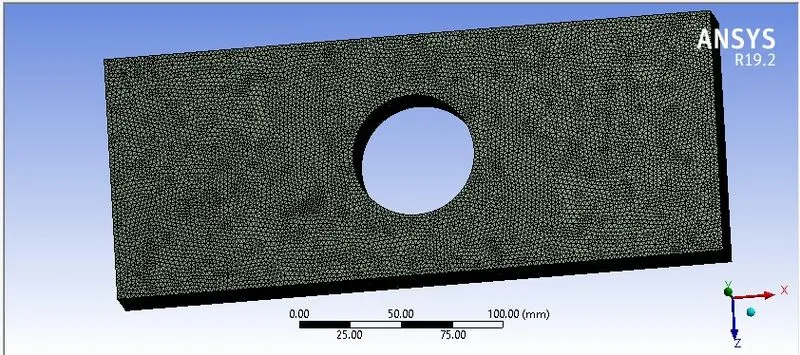
Plate dimensions:
Length=300mm
Height=120mm
Thickness=30mm
Circular Hole at the center:
Diameter=60mm
Mesh
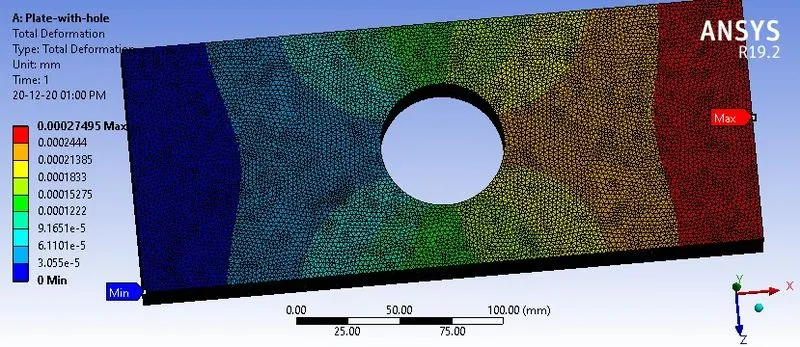
Total Deformation
one side of the plate is fixed and other side is given load of 500N.
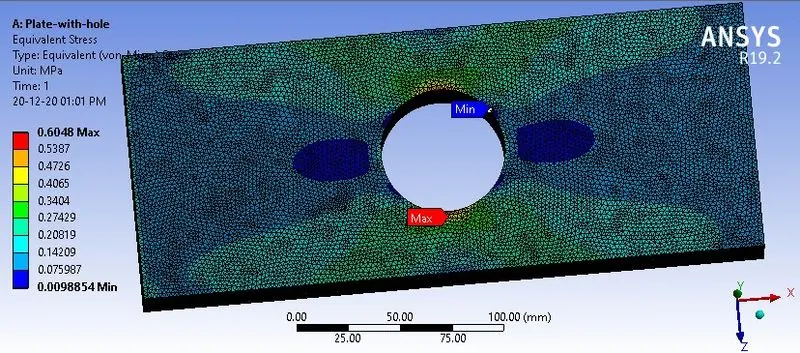
Equivelent Stress
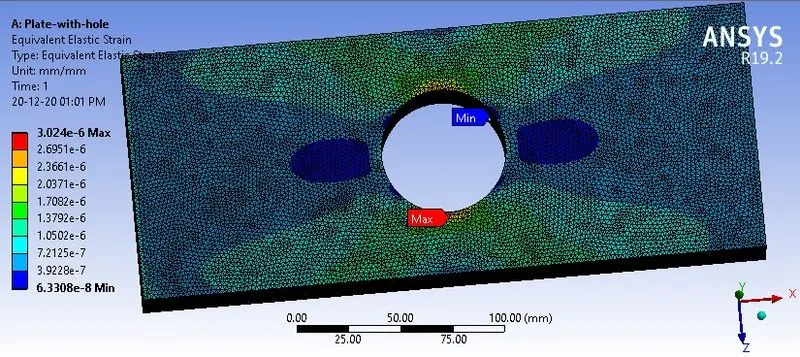
Equivelent Strain
For Case 2 :
Plate dimensions:
Smaller holes 90mm away from the center:
Diameter=30mm
Circular Hole at the center:
Diameter=60mm
Length=300mm
Height=120mm
Thickness=30mm
Boundary Conditions for both the Cases:
Plate fixed at left face.
Load of 500N on the right face
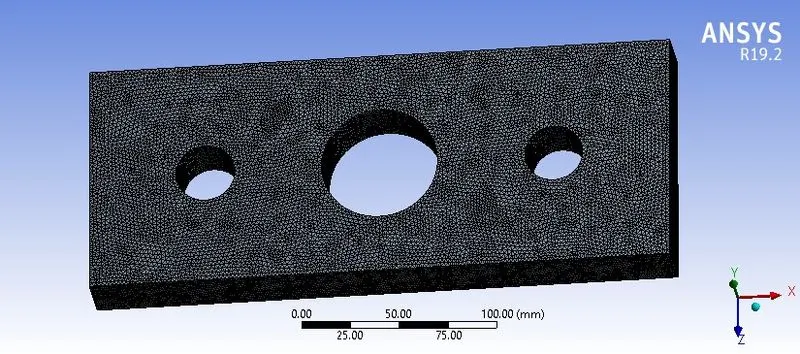
Mesh
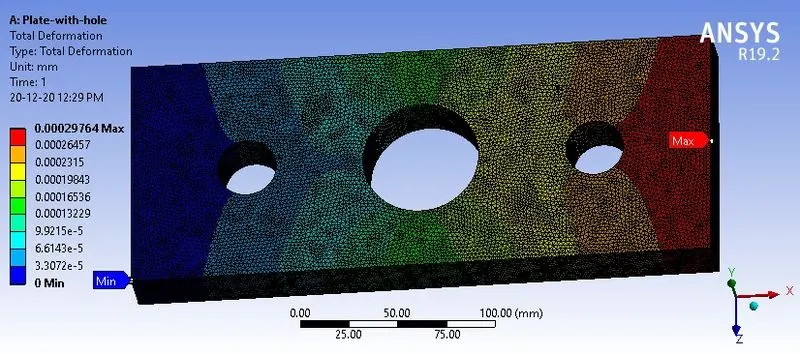
Total Deformation
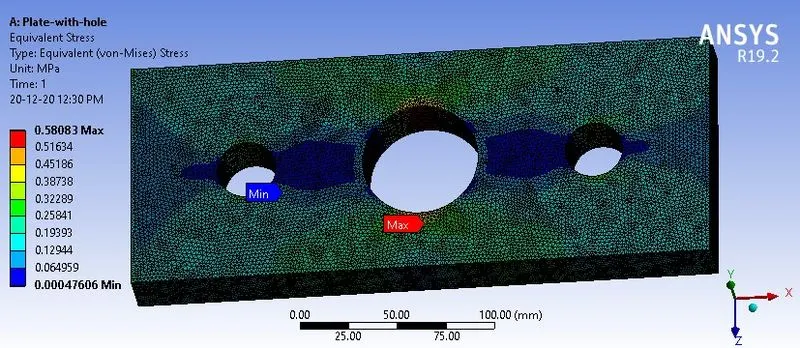
Equivelent Stress
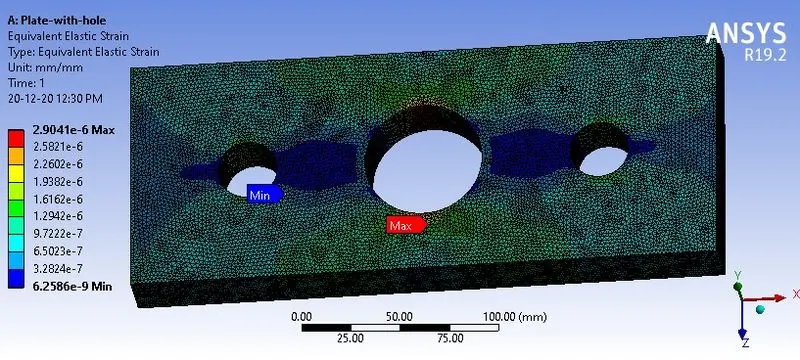
Equivalent strain
Results and Conclusion:
| Solution | Case 1 (Plate with hole) | Case2 (Plate with 3 hole) |
| Total deformation(Maximum) | 2.74e-4mm | 2.97e-4 |
| Total deformation(Minimum) | 0 | 0 |
| Equivalent stress(Maximum) | 0.64Mpa | 0.58Mpa |
| Equivalent stress(Minimum) | 0.0098 Mpa | 0.019 Mpa |
Conclusion :
1) From the results above, we can conlcude that the plate with a hole has less deformation than the plate with three hole.
2)Stress level in plate with a hole has is higher than the plate with three holes.
3)From analysis point of view, we can say that choosing plate with one hole because if we compare the stresses for both cases its minimal level. We can also choose plate with three holes,which is computationally inexpensive at the cost of result which we produced.
4)From manufacturing point of view, we can choose plate with one hole because it has less number of holes which in turn causes less work for applicaton, thus resulting in saving total production cost.