Comparison of Stress Concentration on a Plate with different number of hole using Ansys Workbench.
OBJECTIVE -
To perform static structural analysis on two plates of same dimensions but with differnet number of holes. The main objective is to analyse these plates on basis of stress and deformation generated in them due to same nature of loading, then to select the best design as per analysis and manufacturing standpoint from obtained results.
STEPS TO BE DONE :
(1)Design Plate with suitable geometry using Ansys SpaceClaim modeler.
Case 1: Plate A with same dimension and 1 hole at centre
Case 2: Plate B with same dimension and 3 holes.
(2)Apply material as structural steel.
(3)Generate mesh.
(4)Apply support (left face of plate fixed) and load (right face of plate with load of 500N).
(5)Solving and comparing results.
PROCEDURE -
CASE 1:
- Designing Plate A with single hole.
Software used : ANSYS SpaceClaim.
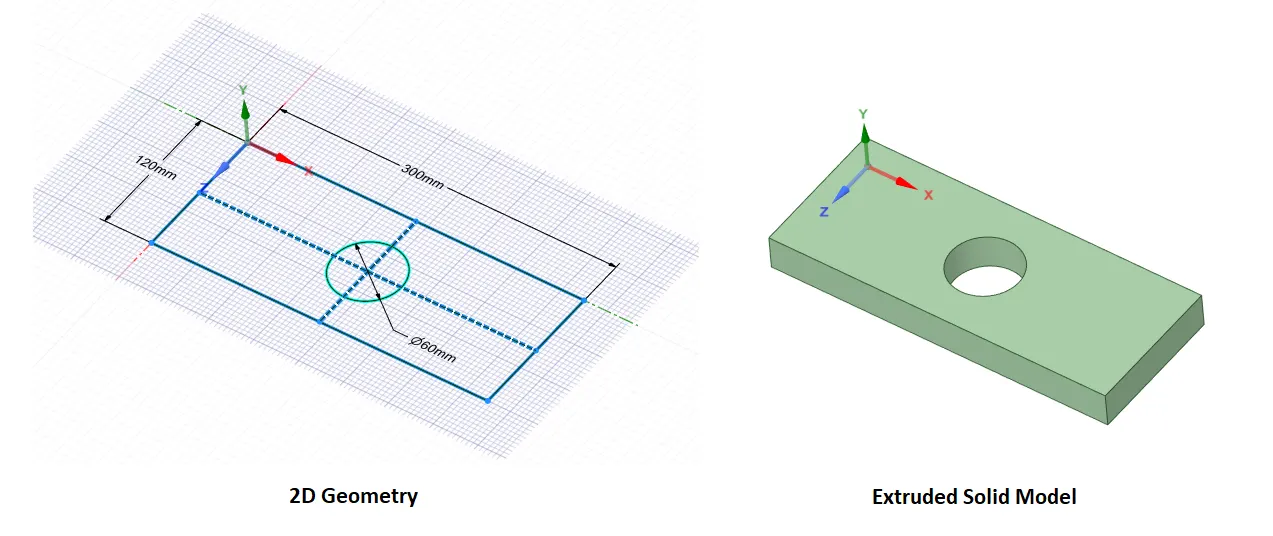
The plate is modelled with following dimensions.
Length = 300mm
Height = 120mm
Thickness =30mm
Circular Hole at the center: Diameter=60mm
The 2D geometry is sketched then extruded using pull command with 30mm thickness to get solid model as shown below.
- Applying Material
For the above model, Structural Steel with below properties is applied.
| Young's Modulus | 2e+05 MPa |
| Poisson's Ratio | 0.3 |
| Bulk Modulus | 1.6667e+05 MPa |
| Shear Modulus | 76923 MPa |
| Tensile Ultimate Strength | 460 MPa |
| Tensile Yield Strength | 250 MPa |
| Density | 7.85e-09 tonne/mm³ |
- Meshing
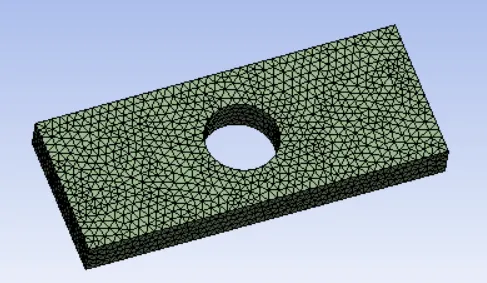
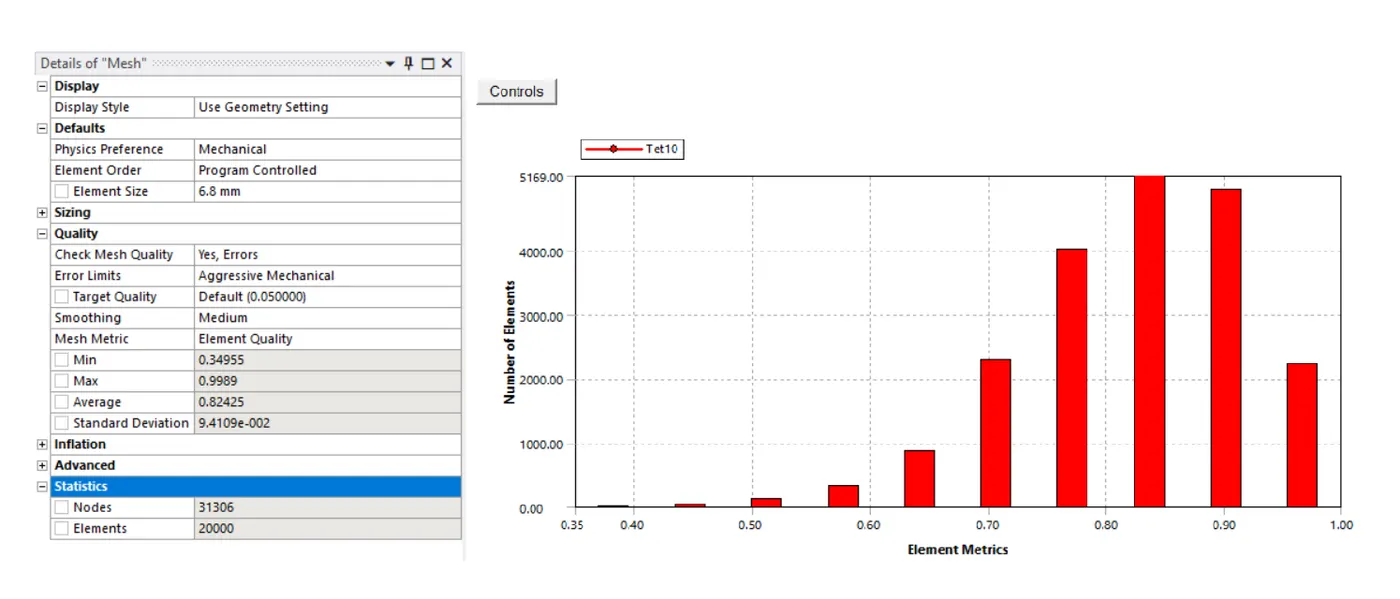
The model is now meshed with Ansys mesher. Tetrahedral element with size of 6.8mm is used. Tetrahedral elements gives refined mesh for the given geometery as we have limited number of nodes and elements.
Key Features
- Element size = 6.8mm
- Number of Nodes = 31306
- Number of Elements = 20000
- Applying Loads
A fixed support is applied to the left end of plate and a load of 500N is applied to right end.
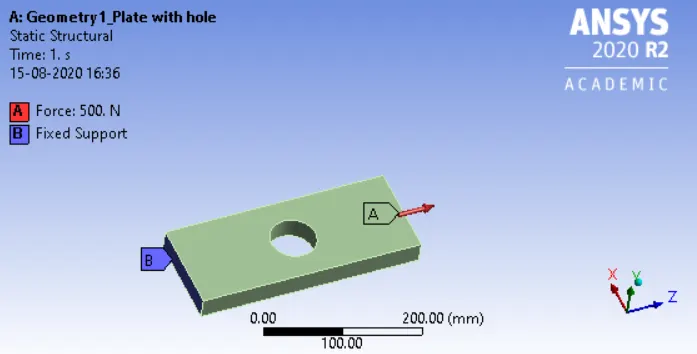
The problem is solved using Ansys solver for Equivalent Stress (Von Mises) and Total deformation with the results to be compared with Case 2.
CASE 2:
- Designing Plate B with 3 holes.
Software used : ANSYS SpaceClaim.
The plate is modelled with following dimensions.
Length = 300mm
Height = 120mm
Thickness =30mm
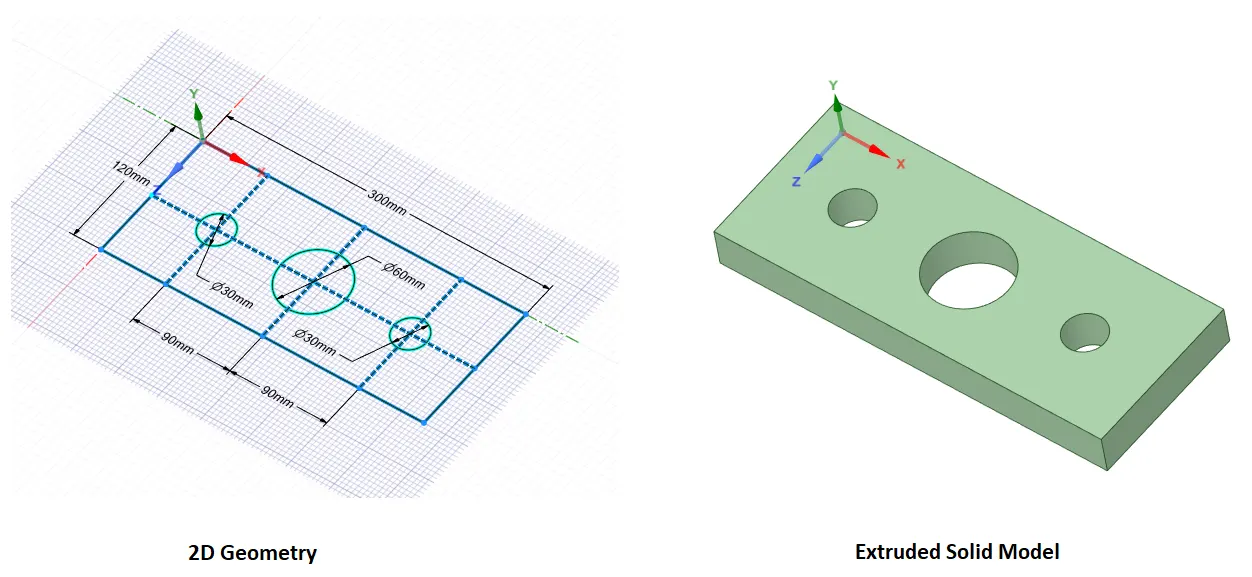
Circular Hole at the center with 60mm diameter and two holes of 30mm diameter offseted at distance of 90mm on each side of centre hole.
The 2D geometry is sketched then extruded using pull command with 30mm thickness to get solid model as shown below.
- Applying Material
For the above model, Structural Steel is used as material.
- Meshing
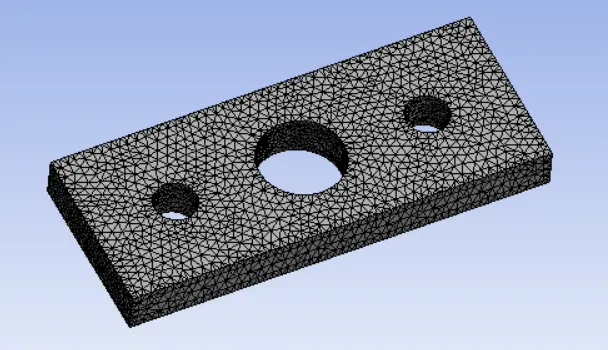
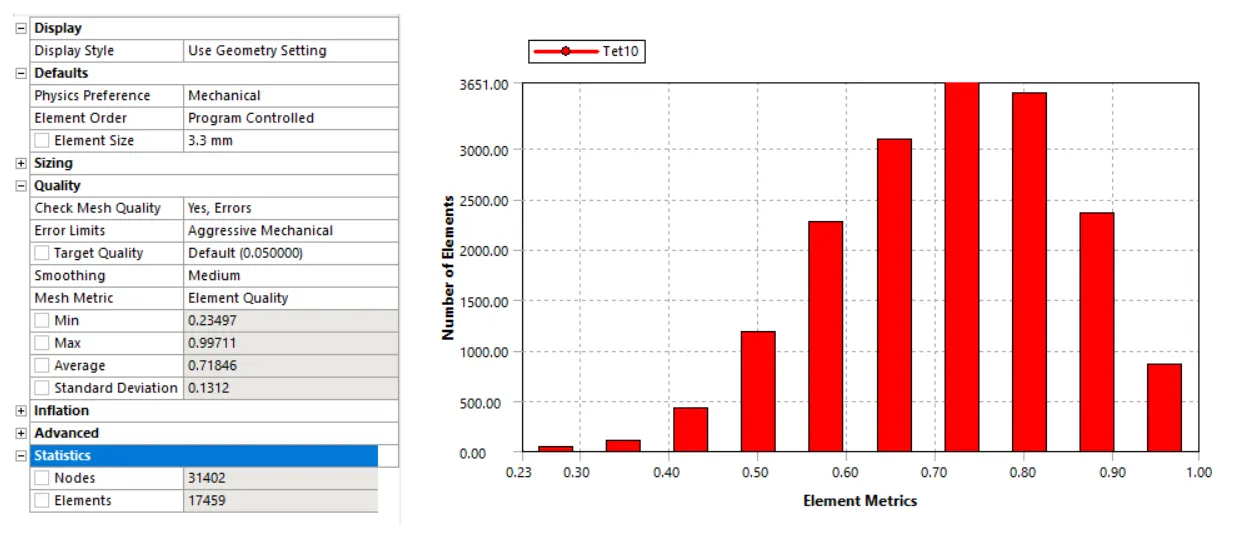
The model is now meshed with ansys mesher. Tetrahedral element with a size of 3.3mm is used to get a refined mesh.
Key Features
- Element size = 3.3mm
- Number of Nodes = 31402
- Number of Elements = 17459
- Applying Loads
A fixed support is applied to th left end of plate and a load of 500N is applied to right end.
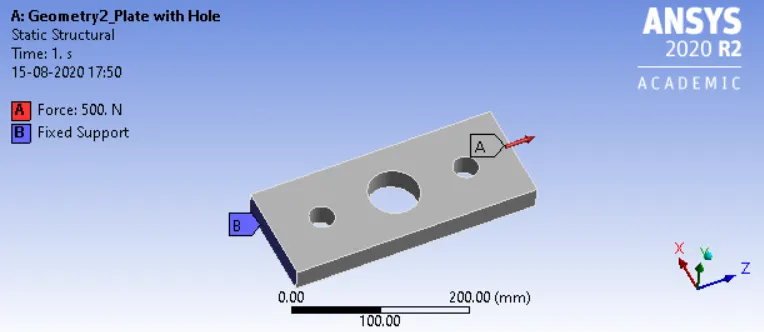
The problem is solved using Ansys solver for Equivalent Stress (Von Mises) and Total deformation with the results to be compared with case 1.
SOLVING AND COMPARING RESULTS -
Solving above cases for Equivalent Stress (Von Mises) and Total deformation
Total deformation for the above two cases are as -
| Total Deformation (mm) | Minimum (mm) | Maximum (mm) | Average (mm) |
| Case 1 | 0 | 2.7489e-004 | 1.3821e-004 |
| Case 2 | 0 | 2.972e-004 | 1.4515e-004 |
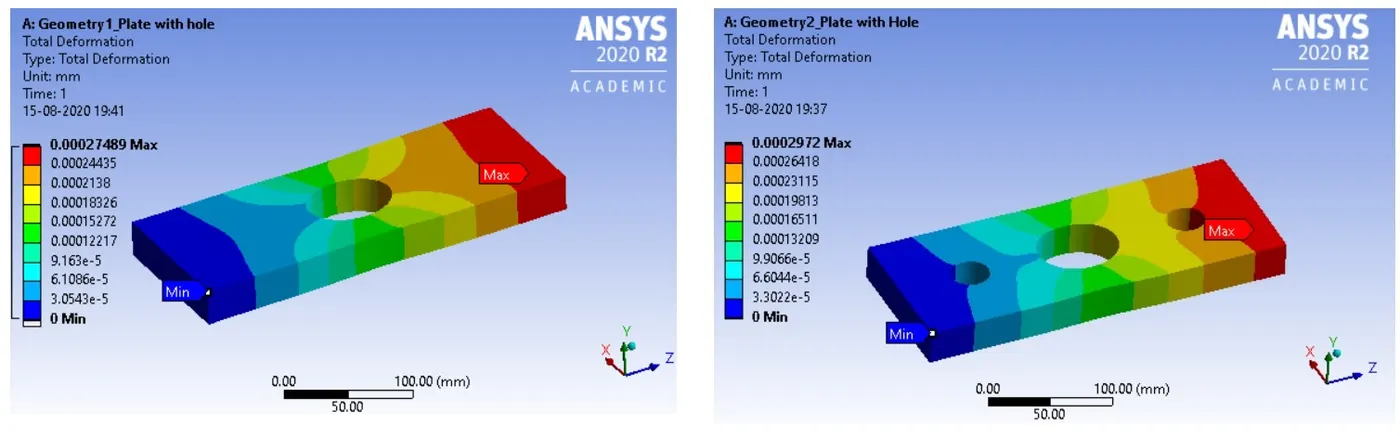
Comparing deformation :
- By comparing total deformation of two cases, there is a small difference in average deformation i.e 0.0694mm. The average deformation is slightly higher in Case 2.
- The difference in maximum deformation is 0.2231mm, deformation being slightly higher in case 2.
Equivalent Stress(Von Mises) for the above two cases are as -
| Equivalent Stress (MPa) | Minimum (MPa) | Maximum (MPa) | Average (MPa) |
| Case 1 | 1.7612e-002 | 0.59419 | 0.15892 |
| Case 2 | 1.5744e-003 | 0.5832 | 0.17028 |
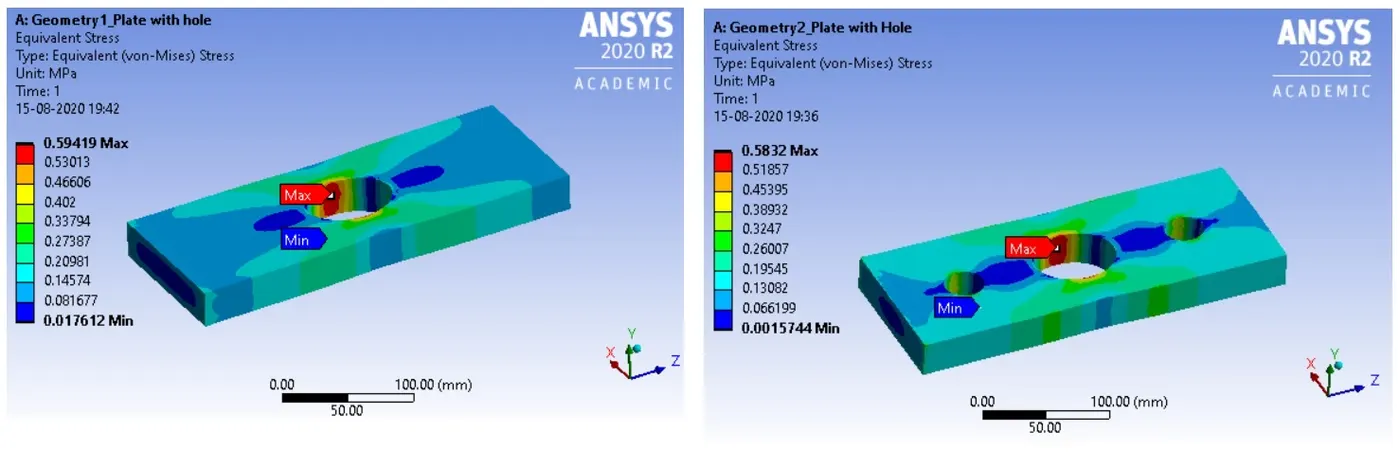
Comparing Equivalent Stress :
- By comparing total Equivalent Stress of above two cases, there is a small difference in average stress i.e 0.01136 MPa. The average stress is slightly higher in Case 2.
- The difference in maximum Equivalent Stress is 0.011 MPa. Here the maxium Equivalent Stress is highest in Case 1 as compared to Case 2.
- The nominal stress as per strength of material equation = 500/(120*30-60*30) = 0.2777 MPa.
- Stress concentration factor for Case 1 = 0.59419/0.2777 = 2.139
- Stress concentration factor for Case 2 = 0.59832/0.2777 = 2.100
CONCLUSION
From comparison of above cases, stress developed is maximum in Case1 which is actually surprising as Case 1 has only one hole and Case 2 has 3 holes. This can be explained on basis of stress concentration. The Case 2 has less material as compared to Case 1 and here stress flow lines are uniformly spaced which causes less stress concentration. The additional 2 holes in Case 2 relieve stress.
The deformation is slightly greater in Case 2 for same value of force, because material in Case 2 is less as compared to Case 1. Due to this load bearing capacity in Case 2 is less.
Selection of design as per Analysis point of view -
As per analysis point of view Case 2 is a better design.
Comparing above results, maximum stress value is less in Case 2 by 0.011 Mpa but here deformation is slightly more i.e 0.2231 mm as compared to Case 1. There is negligible difference in stress and strain values when we compare both the results. But in Case 2 stress concentration factor is less as compared to case 1. This means there is uniform distribution of stress throughout which means less chance of failure. Also two additional holes in Case 2 cause material removal and reduction of weight.
Selection of design as per Manufacturing point of view -
From manufacturing point of view Case 1 is easy to manufacture as it as only 1 hole which required only 1 drilling operation. Where as Case 2 requires 3 drilling operation which add up to manufacting cost. Case 1 is the best suit as per manufacturing point of view. There is slight difference in maximum value of stress which can be neglected. Also deformation of case 1 is less. To add to that less manufacturing cost makes it more economical.