Week 1 Spur Gear Challenge
Aim: To conduct a stress test on spur gear arrangement and then compare the workpiece made with the following materials: cast iron, cast copper, and cast bronze. This is done to arrive at a conclusion for the best material suited for the gear arrangement.
Procedure:
Material: Click on engineering data and add cast iron(ductile)/cast steel/cast bronze material according to the required cases from Granta Design.
Geometry: The geometry is dropped in SpaceClaim and checked if there are any errors in the design. Remove some material from the center of the gear by using the pull tool.
Setup: Go to the geometry in the static structural setup and specify the required material in both the solid gears.
Connections:
- Add a contact setting the grooves in the teeth of both the gears as contact and target. Make sure that the contact is frictional with a coefficient of friction as 0. Set the behavior to symmetric. The formulation must be augmented Lagrange as we want the gears to not move from their position. Also, ensure that the interface treatment is set to "adjust to touch".
- Now we need to add joints. Add two revolute joints on both the gears. This can be done by setting the connection type as body-ground, type - revolute, select the inner circular faces as the scope.
Mesh:
- A mesh method for both the gears is added that ensures the elements are tetrahedrons.
- Then set the element size to 0.67mm
Analysis Settings:
- Set the number of steps as 6.
- Then select all the steps and turn the auto time step on. Make sure it is defined my time. Then turn of large deflection.
Load Settings:
- Add a rotation load to a joint which increases by 30 degrees every second.
- Add moment load to the other joint which is constant throughout the analysis. The value of this load is 10000 Nmm.
Solution: Stress intensity, total deformation, and von mises stress plots were plotted and contours were obtained.
Results and Discussion:
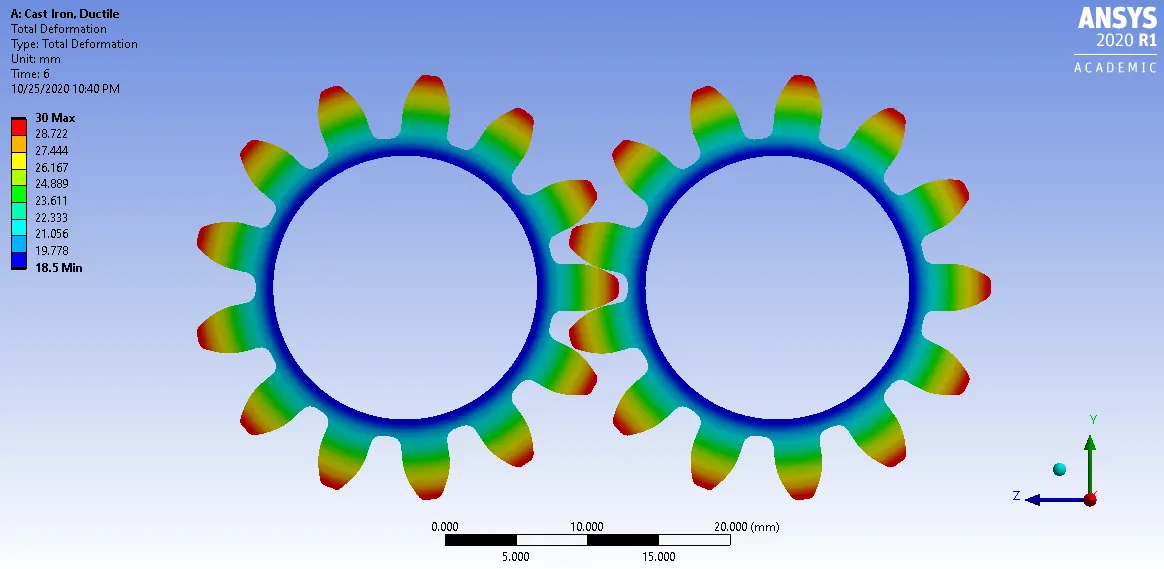
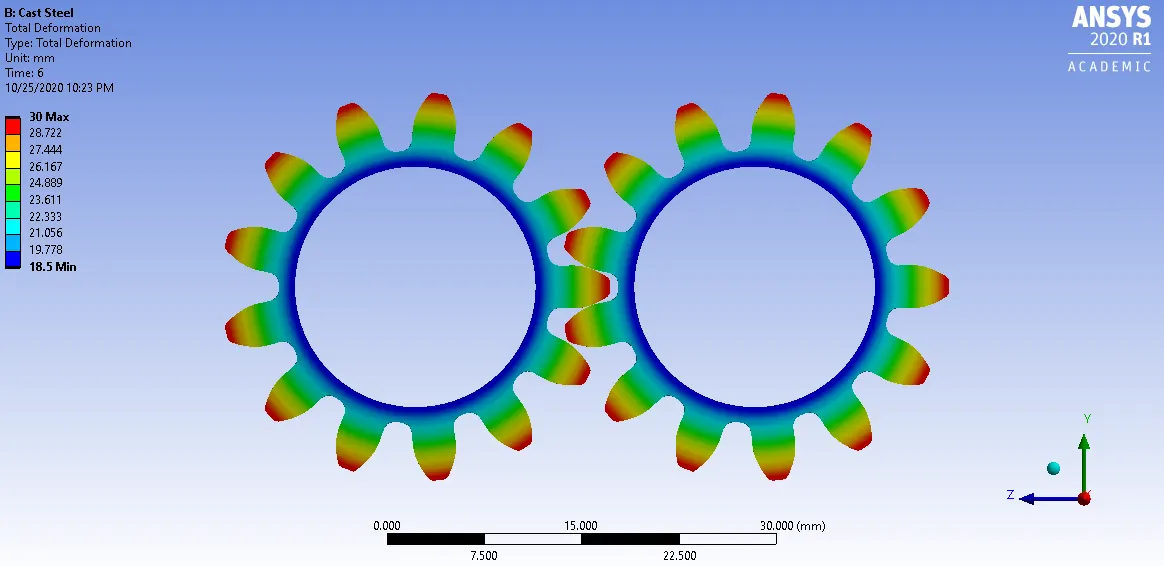
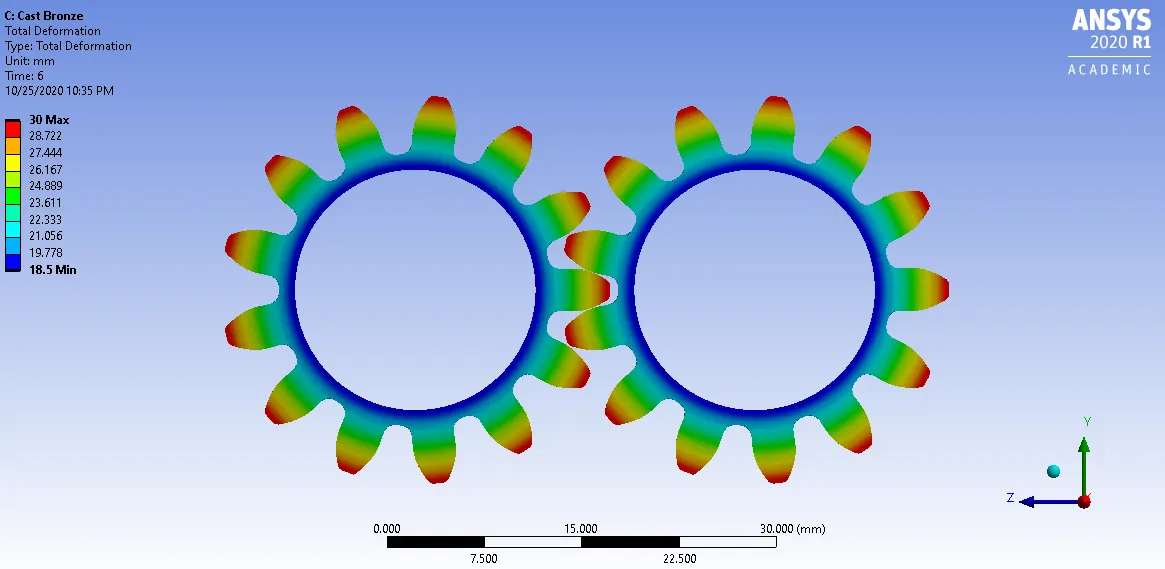
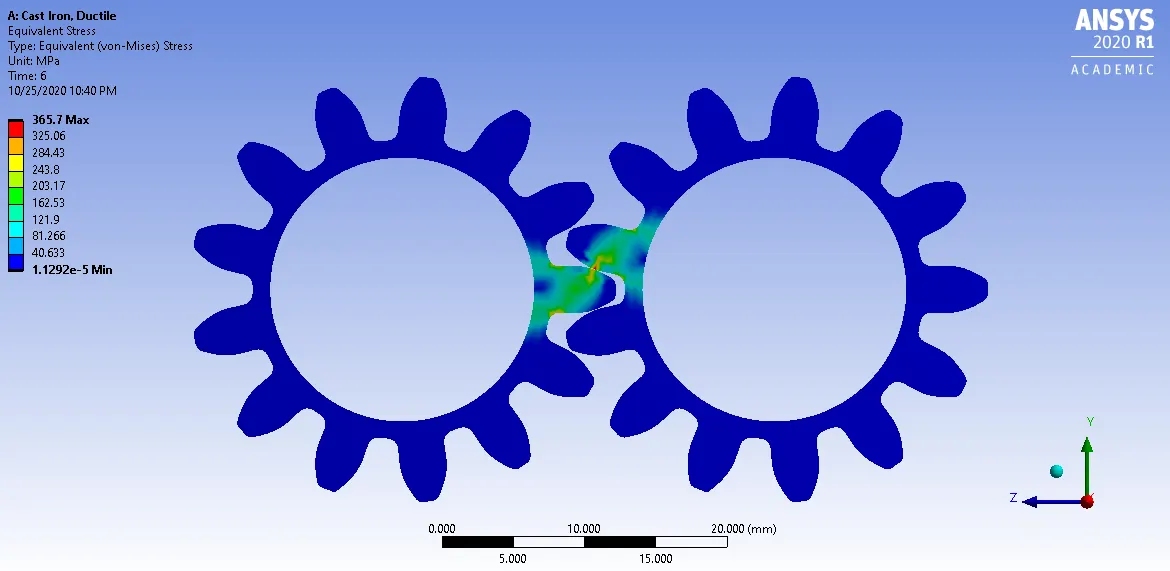
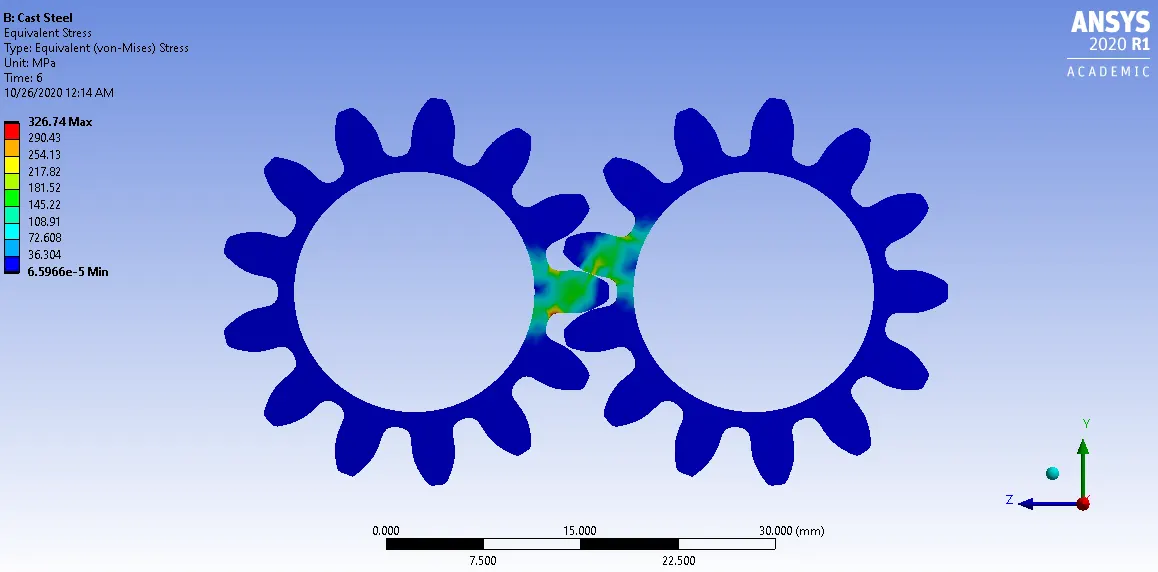
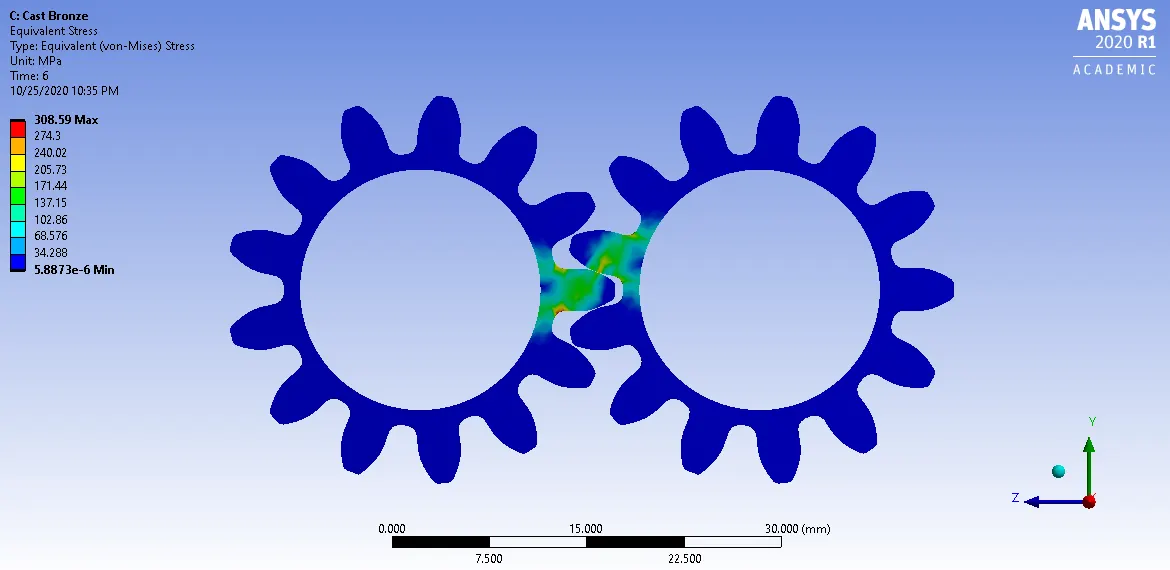
"Note that the sequence of the plot is cast iron (ductile) > cast steel > cast bronze."
Total deformation:
As the rotation and moment applied to all the cases is the same the contours of the total deformation and magnitude of it are the same.
Von-Mises Stress:
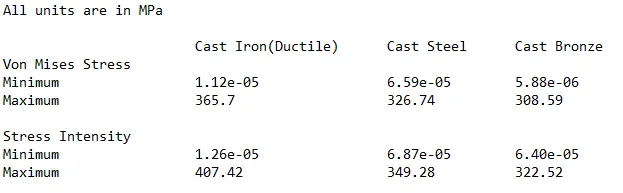
Here we notice that the obtained contours have the same high intensity and low-intensity region. This is because the type of load all the types is the same. The point that's necessary to nice is the magnitude of equivalent stress experienced. The highest stress experienced is by cast iron (ductile), then comes cast steel and the least is for cast bronze. The magnitude of stress experienced by cast iron is 365.7 MPa > cast steel is 326.74 MPa > bronze is 308.59 MPa. When we look at this parameter then bronze is the most suitable material as it experiences the least stress which increases its life.
Stress Intensity:
The same pattern is observed for stress intensity too. However, it's important to observe that the stress intensity experienced by cast iron ductile is significantly higher (by a factor of 60) when compared with the others. Thus the stress intensity of cast iron ductile is 407 MPa > cast steel is 349.28 MPa > cast bronze 322.52 MPa. According to this parameter too cast bronze has proven to be the better material in comparison with cast steel and cast iron.
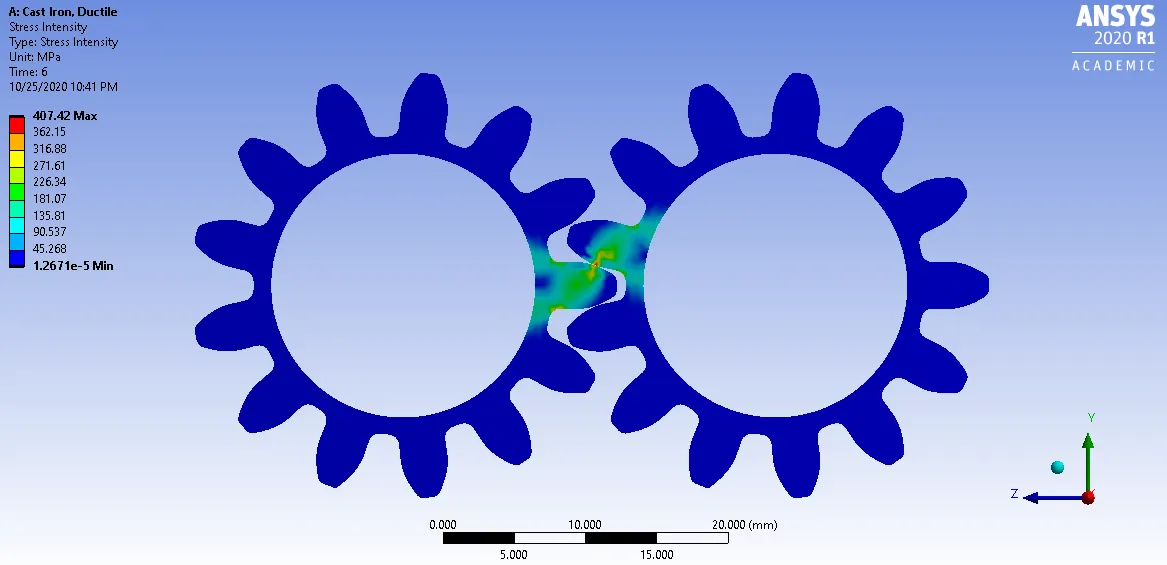
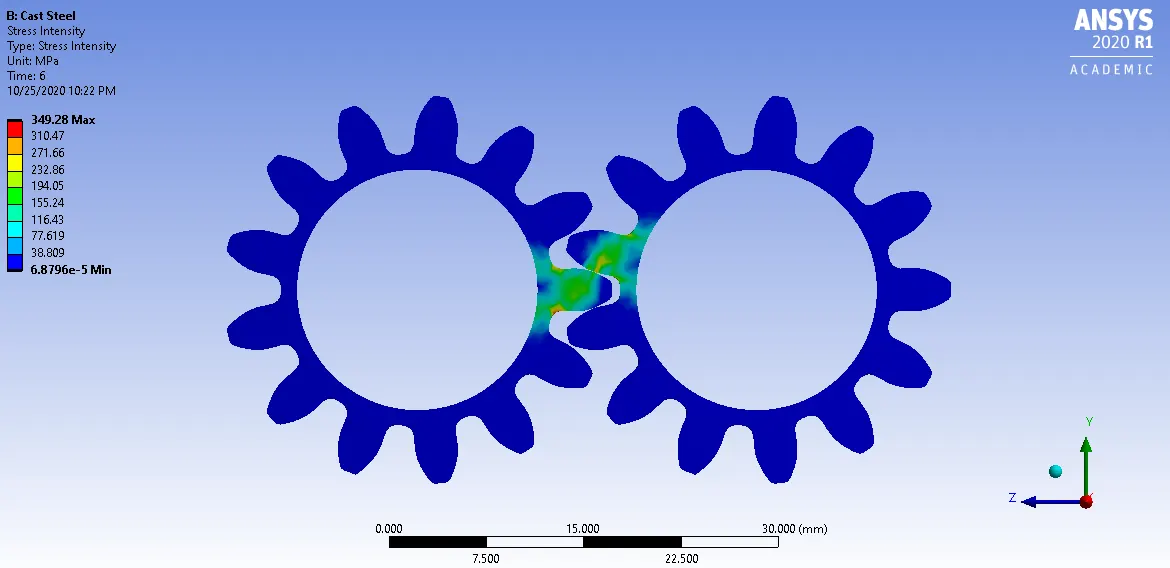
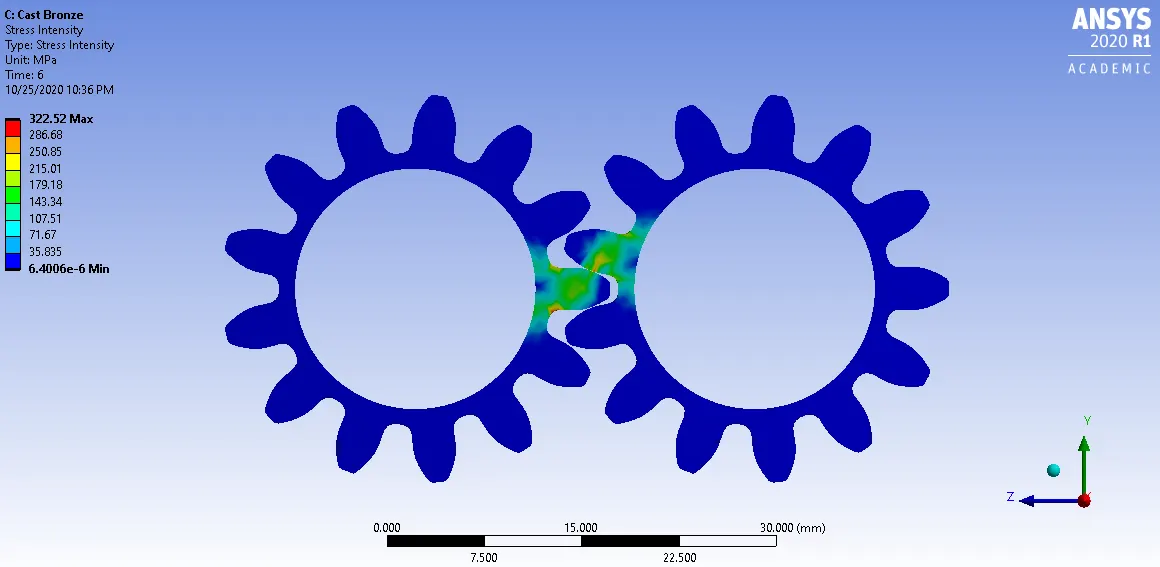
Table:
Conclusion:
From the following test, we can conclude that bronze is the best material to form a spur gear system.
Along with this, it is also important to consider the region for a possible fracture is the region with the highest stress intensity and von misses stress. That region is the region of impact and also the base of the gear teeth.
*The animation files, plots, and contours are available in the provided google drive link.*
LINK: https://drive.google.com/drive/folders/1q5lIi_vaNJ25_D-n41tel0XosSyPQQ8s?usp=sharing