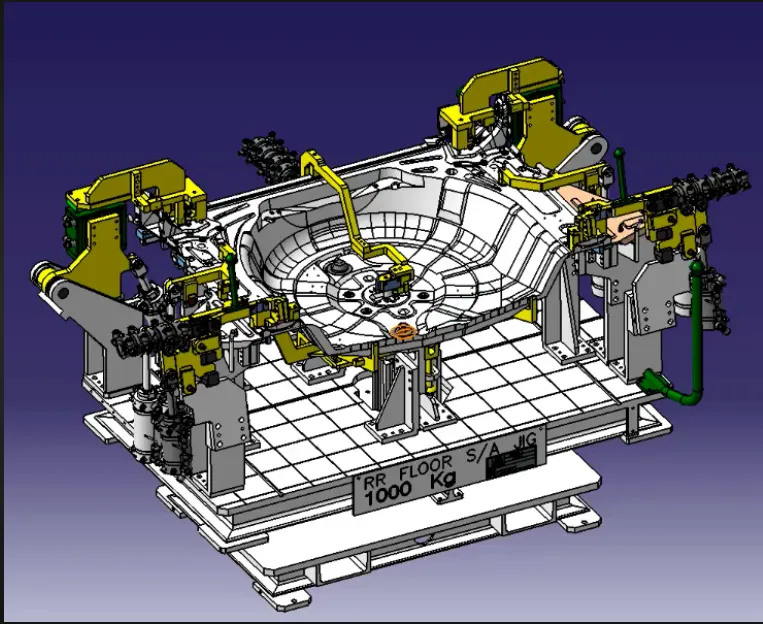
Week 1:- Introduction to BiW and Fixtures Challenge
1.What is BIW & define its parts?
BIW
Body In White(B.I.W) refers to the welded sheet metal components which form the vehicles structure to which the other components will be married.
BIW refers to the stage in automotive design or automobile manufacturing in which the car body sheet metal(including doors, hoods and deck lids) has been assembled or designed but before the components(chassis Motor) and trim (windsheilds, seats, upholstery, electronics etc)have been added.
BIW can be made into two structures: the more common monocoque structure where all body members are carrying load with chassis in-built with BIW and are integrated with each other, and the body-on-frame structure where the frame is the main load-carrying member.
BODY ON FRAME:
It is an automobile construction method by which a seperate body is mounted on a relatively rigid frame or chassis that carries the engine and drive train.
It was the original method of building automobiles and continues to this day.
In the 19th centuary , frames might be made of wood reinforced by steel flitch plates . But in the early 20th centuary steel ladder frames or chassis rapidly became standard.
MONOCOQUE:
It is a construction , in which the 'chassis' is part of and integrated with the metal body.
It provides support to all the mechanical components as well as protection for the vehicle occupants.
Although there is no seperate complete Frame or chassis , many monocoque/unibody designs now often include sunframes.
The construction is now the most common form of car bodywork, although aluminium and carbon may also be used.
PARTS:
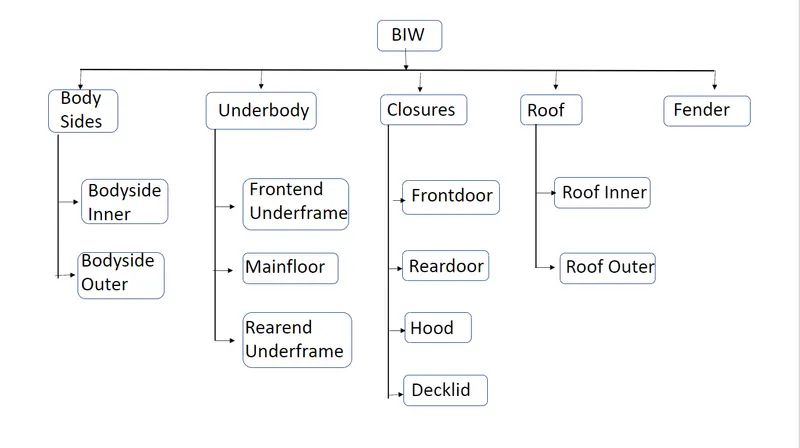
The BIW parts are classified into five categories,
- Body sides
Body Side Outer- The Outer area of the BIW
Body Side Inner - The Inside area of the BIW
- Underbody
Front End Underframe - It is also known as engine compartment where we mount the engine.
Main Floor - Here we mount the seats and other related parts.
Rear End Under frame - Here lies the rear compartment.
- Closures
Front Door - A hinged door , which is used for entering and exiting a vehicle.
Rear Door - A rear door that gives access to the rear seats.
Hood Door - The door through which we can access the engine compartment.
Decklid - Decklid is the cover over the trunk or boot of a motor vehicle.
- Roof
Roof Inner -Inside area of the roof
Roof Outer -Outer area of the roof
- Fender
Vehicle body that frames a wheel well .
Its primary purpose is to prevent sand, mud, rocks, liquids, and other road spray from being thrown into the air by the rotating tire.
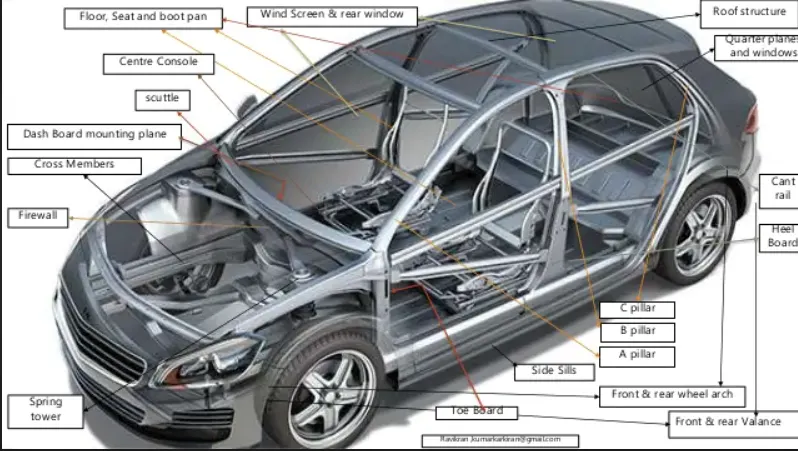
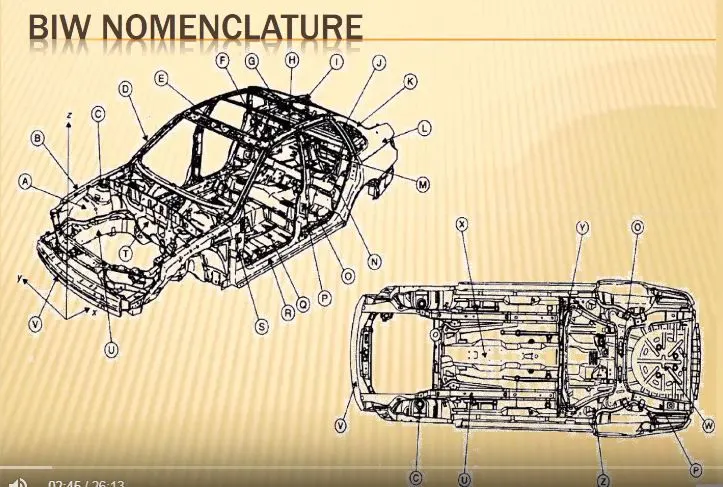
2.What do you understand by BIW nomenclature?
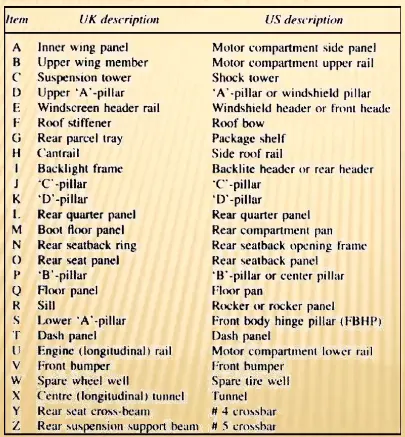
Nomenclature is basically choosing of names for things.BIW have no. of parts in it. All parts have differenent names.
As the Automotive industry is spread worldwide. Every nation has its own language. ...
For example, The one component of the BIW is called suspension tower in Uk & the same component is called shock tower in US.
3.What is fixture & its types?
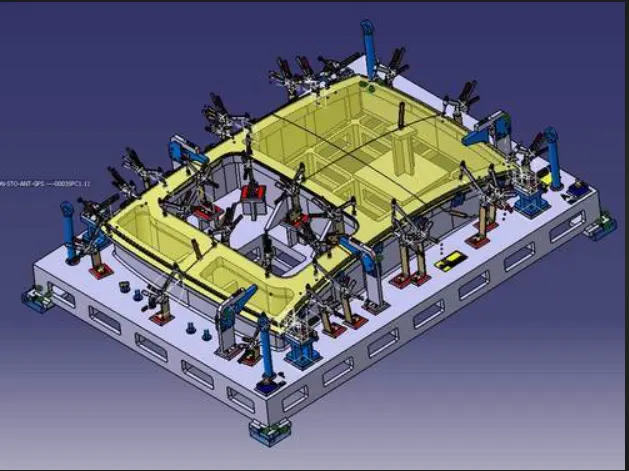
A fixture is a device which holds the workpiece to be processed (welded), by using 3-2-1 priciple.
Welding fixtures are normally designed to hold and support the various components (workpieces) to be welded.
It is necessary to support them in a proper location which is capable of preventing distortions in workpieces during welding.
For this the locating elements need to be placed carefully , clamping has to be light but firm, placement of clamping elements has to clear of the welding area and the fixture has to be quite stable and rigid to withstand the welding stresses.
TYPES:
PREPRODUCTION FIXTURES:
It is the initial batch production used for the study and feasiblity of the mass production features.
A series of inspection should takes place to confirm the quality of the fixture.
Dimensions are measured as per the given drawing.
Any changes should be required are made in this stage itself.
PRODUCTION FIXTURES:
It is used for mass production purposes.
Once the fixture are good at the preproduction level we will go for a mass production
It is the final fixture type that is used to assemble the doors and other features.
Final testing should be done after assembly.
CHECKING FIXTURES:
It is for the sole purpose of inspection or geometric inspection purpose.
Here only inspection will takes place for the assembled parts.
The inspection takes place through the inbuilt gauges.
4.What is the basic principle of fixture design?
We have to locate the fixture in a specific place so that it should not clash with any other features.
For that we have the principle of fixture design..
For any free body there are total of 12 degrees of freedom as below
6 Translational degrees of freedom -X,-Y,-Z,+X,+Y,+Z.
6 Rotational degrees of freedom ,
X axis - Clockwise and Anticlockwise
Y axis -Clockwise and Anticlockwise
Z Axis - Clockwise and Anticlockwise
we should fix all the 12 degrees of freedom inorder to locate the workpiece in the fixture.
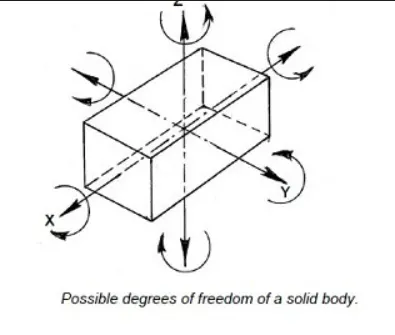
So, 12 degrees of freedom of the workpiece need to be fixed and thus we can acheive zero degree of freedom for the workpiece.
3-2-1 Principle:
Here we have a surface as an example.
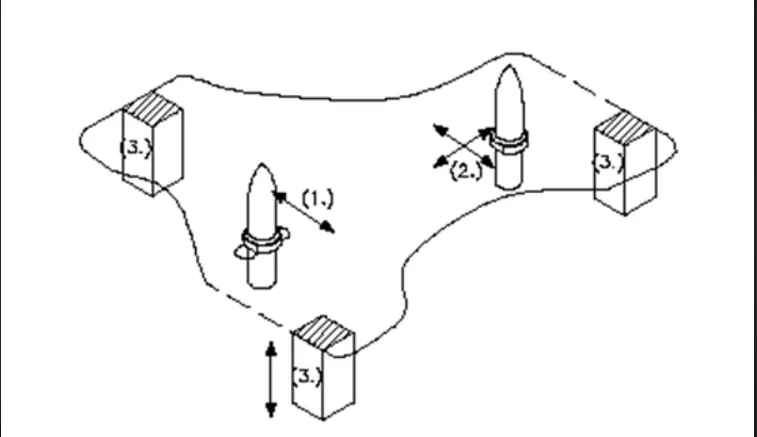
Three locator blocks to establish part plane.
Three locators or supports are placed under the workpiece.
The three locators are usually positioned on the primary locating surface .
This restricts one axial movement and four radial movements.
Together the three locators restrict the five degrees of freedom.
Round locating pin in the hole that defines location in four directions (4-way) perpendicular to the plane previously established.
This restricts four axial movments .
Round locating Pin in a slot that defines two of the directions on the other hole(2 way) restricts two axial movements.
5.Elaborate types of BIW Stations?
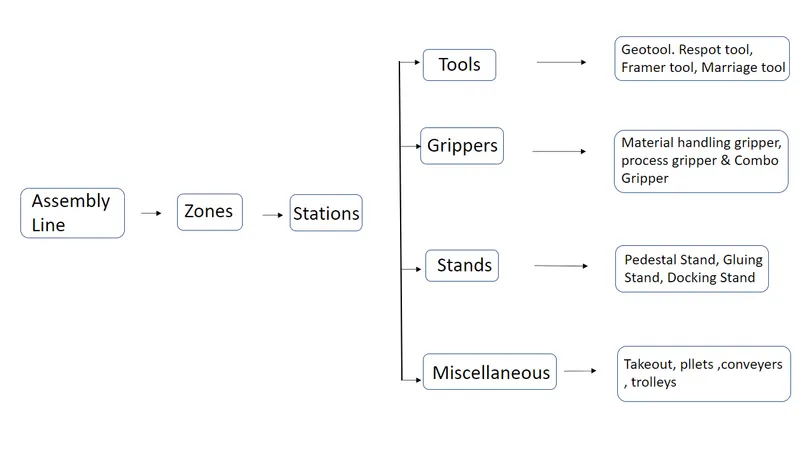
The assembly line is, in where different types of panels are joined together in specified zones.
TOOL
A tool is a fixture which consist of number of units together to hold a car part in general.
TYPES
1)Geotool :
A geotool is a fixture in which the geometry of the panels which are welded together is defined accurately.
The pin tolerance for a geopin will be of closer tolerance.(i.e)-0.15 in general.
For eg - Consider panel hole size 20 mm , the pin diameter should be 19.85.
2)Re-Spot Tool:
A respot tool is a fixture in which the remaining weld spots which are not acheived in geo tool are welded for the prewelded panel from the geotool.
The pin tolerance for the respot pin will be of tolerance with -0.28 in general.
eg- Consider panel hole size 20 mm , the pin diameter should be 19.72.
3)Marriage or Hemming Tool:
A marriage or hemming tool is a fixture in which the inner panel assembly and the outer panel assembly are joined together.
These are done by welding or by hemming incase of closure panels.
4)Checking Stations:
A checking station is a fixture which is used to check the automotive parts or assemblies ensuring all the coordinates , relative dimensions and positions as per the tolerances.
A checking station can be a gauge type and automated checking fixtures.
A checking gauge is a tool where work piece is hold and various measuring gauges are introduced to ensure the dimensions and repeatability.
A fixed type checking feature is used where the workpiece is fixed with clamps and pins , A CMM machine is used which measures the coordinates of different points of the panel or assembly, compares it with the nominal values and gives a report.
GRIPPER
A gripper is a device or a fixture which holds the car panel, and is fixed to the manipulating end of a robot or an end effector.
Also known as EOAT- End Of Arm Tooling.
TYPES:
1.Material Handling Gripper:
These are designed for handling the car panel from one tool to other tool or one station to other station.
2.Process Gripper:
These are designed for handling the car panel from one tool to other tool , and in addition to that it undergoes process like pedestal welding , pedestal riveting , gluing , sealing etc.
3.Combo Gripper :
These are designed for handling the car panel from one tool to other tool, also with combination of welding gun at another side of the gripper for welding.
Gripper + Weld Gun
4.Dual Gripper:
These are designed for handling the car panel from one tool to other , with two sided gripper.
STANDS:
1.Gluing and sealer Stand:
It is fixed to a welded or a standard stand which is grouted to the floor permanently.
2.Docking Stand:
When robots are selected for multitasking like material handling and welding , which cannot carry both due to some limitations(pay load capacity)of the robot or some constraints.
The robot will drop and pick the gripper or gun after completing the respective operation with the help of docking stands.
3.Date Stamp Stand:
The panel will get the date embossed onto it , with the date stamping device mounted on this date stamp stand.
4.Pedestal Gun Stand:
Weld gun is mounted to a fixed stand which is grouted to the floor permanently, where the process gripper carries the car panel to weld the spot with this fixed weld gun.
5.Take Out Trolley:
It is used to take the car panel out of the robotic working cell between the cycle for inspection purpose.
MISCELLANEOUS
1.Conveyer:
To Take the product from one station to another through a cyclic rubber conveyer.
2.Pallets :
To arrange the products after packing.
3.Takeout:
To take out the particular slot for time to time.
6.What are the basic terminologies used in the BIW fixture?
In BIW we have numerous terminologies and some of them are,
1.Mylar/NC/Fingers:
It is a Rest or Clamp block which is used for holding 2/3 BIW sheet metal parts.Mylars are also called NC blocks.
In German language Mylar is called as counter stein. Mylars plays important role in the BIW welded assembly geometrical accuracy. Mylars are made of steel or in plastic material.
2.PLP-Principle Locating Points:
These are the points where we locate the point with the use of small pins.
3.Blade:
The plate which connects Riser to the Clamp cylinder is named Blade. This plate plays an important role in building the unit. The plate can be of any shape.
But we need to keep in mind that the plate should be as compact as possible.
4.Risers:
The part which is mounted on the base plate and holds a clamp or pin cylinder on it, is called Riser.
Riser can be Standard Part or manufactured part, it varies from project to project.
A riser can be a Single part or welded part. Standard risers also have various shapes and sizes.
5.Shims:
A shim is a thin plate to adjust receiving panels. Shims are typically used in order to support, adjust for better fit, or provide a level surface. Shims may also be used as spacers to fill gaps between parts subject to wear.
6.Rough Locators:
It refers to the desired location where you want the workpiece to be when it is getting worked on either by a person, team, or robot.
7.Hardwares:
It is used for installations, repairs, or maintenance tasks in industrial and commercial facilities.
8.CMM:
A coordinate measuring machine (CMM) is a device that measures the geometry of physical objects by sensing discrete points on the surface of the object with a probe.
9.Units:
These are used to locate the objects and fixtures.
10.Number Plate :
Aluminium embossing on each unit to recognize it.
11.Coordinate Plate:
Recognitation of holes that helps in measurement with the use of CMM.
12.Name Plate:
All the data regarding the fixture are embossed on it.
13.Clamp Arm:
Through which the mylars and other features will be mounted.
14.Pivot:
Through the pivot the clamp arm rotates.
15.Class A Surface:
Surfaces which are visible in a product either interior or exterior.
16.Reed Switches and sensors:
The reed switch is an electrical switch operated by an applied magnetic field.
With the use of sensor we can define it wheather it is loaded or unloaded.