Consistency of Units in LS-DYNA - Students Project
ABSTRACT:
The objective of this challenge is to create a consisten system of units for the given input. LS-DYNA doesn't have a default system of units. User needs to input material properties and physical dimensions according to a consistent system of units as per their choice. This warrants that to use LS-DYNA in different circumstances, users has to be conversant with converting quantities from one system of units to another.
PROCEDURE:
Each and every measurement given in the input parametres are converted into respective system of units. The input measurement values are displayed below,
MASS 1kg
LENGTH 1m
TIME 1s
FORCE 1N
STRESS 1Pa
ENERGY 1Nm
DENSITY 1Kg/m3
YOUNG'S Modulus 210GPa
Velocity 56.33KMPH
GRAVITY 9.8m/s2
The above mentioned system of units are converted into the below displayed units. They are
Kg cm ms
Kg cm s
gm mm ms
kg m s
g cm s
g cm us
g mm s
ton mm s
slug ft s
kg mm s
g cm ms
kg mm ms
In calculation part the conversion of values with respect to the units are very important. So that only the results will come as accurate. Each and every problem contains three important factors they are, mass(kg), time(s) and length(m). This the actual representation of the system of units in deriviation problems. They are converted into the above mentioned system of uints.
Conversion:
1 Kg = 1000 g = 0.001 tonne = 0.0685218 slug
1 m = 100 cm = 1000 mm = 3.28084 ft
1 s = 1000 ms = 1000000 us
Force unit conversion:
Force(N)=mass(m)*acceleration(a)
F=ma
`Force(N) = Kg * m/s^2`
It will become,
`Force= g*(mm)/(ms)^2`
Stress unit conversion:
Stress = force/area
`sigma = ((kg*m)/s^2) / (m^2)`
It will become
`sigma = (g/(mm*ms^2))`
Energy unit conversion:
The energy commonlt expressed as in terms of Joule, so the equation for the energy is
Energy = length* force
`J= (m)*(kg*m/s^2)`
It will become
`J = (g*mm^2)/(ms^2)`
Density unit conversion:
Density = Mass / Volume
`rho=(kg)/m^3`
It will become
`rho=g/(mm^3)`
Young's Modulus unit conversion:
In given problem the Young's modulus(E) is given as 210Gpa. This the Young's modulus value for mild steel. So the expression for the young's modulus written as
Young's Modulus(E)= stress/strain
`E=sigma/epsilon`
Since there is no unit for strain the unit of stress only considered.
`E=(210*10^9)*((`N/m^2) / (Strain (no unit)))`
It will become
`E=210000 (g/(mm*ms^2))`
Unit conversion for velocity:
In our problem, The velocity value is given as 56.33kmph and this value is converted into m/s and then to mm/ms. The expression for the velocity is written as,
velocity=displacement/time
For converting km/h to m/s, multiply by 5/18
velocity = 56.33 * (5/18)
`v=d/t`
`v=m/s`
It will become
`v=0.277778(mm)/(ms)`
Acceleration due to Gravity unit conversion:
`g= 9.81*m/s^2`
It will become
`g=9.8*((mm)/(ms^2))`
`g = `0.0098 ((mm)/(ms^2))`
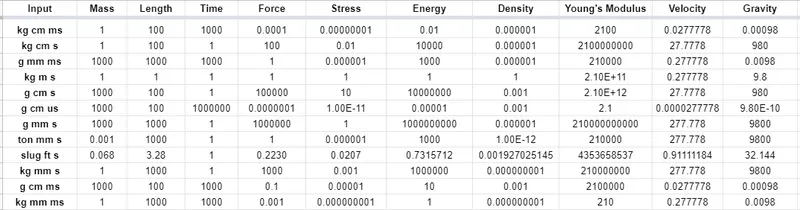
CONCLUSION:
Thus the given input measurements are converted into respective unit systmes and this is used in
LS-DYNA calculation.