Vehicle Ride
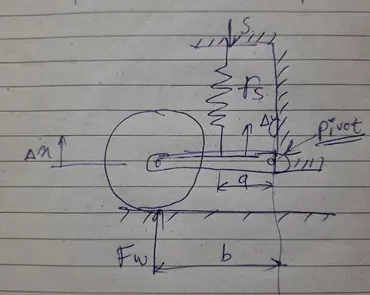
1) Wheel rate is usually different from spring rate because the wheel and the spring are mounted at different distances from the pivot point. Thus, a concept of motion ratio comes into picture. Installation ratio is a geometric measure that relates the change in displacement of force element to a change in vertical wheel centre movement.
The relation of wheel rate and spring rate is given by
Kw = Ks * IR2………. (a)
where,
Kw = wheel rate
Ks = spring rate
IR = Installation ratio = a/b
If the wheel and the spring distances are same from the pivot point i.e. a = b and if the spring is vertical, then the wheel rate and spring rate will be equal. But, this is very difficult to achieve in a vehicle and hence, the wheel rate is usually different from the spring rate.
2)
The wheel rate is given by
Kw = Ks x IR2
where,
Kw = wheel rate, Ks = spring rate , IR = installation ratio
This equation states that the wheel rate depends only upon the spring rate. The ride rate depends upon the spring rate and wheel rate and it is the equal to spring stiffness and tire stiffness attached in series with each other.
Kr = Kw * Ks / (Kw + Ks)
From (a), we have,
Ks = Kw/IR2
Therefore,
Kr = Kw/(1 + IR2).
Since, the denominator will always be greater than 1, Hence, the ride rate will always be lesser than wheel rate.
3)
- No we cannot use same amount of damping at low and high frequency regions.
For low frequency regions, the acceleration levels are quite high at the passenger seat and hence, we require high damping in the low frequency regions. As the frequency increases, the acceleration levels decrease and hence, at higher frequencies we need to provide lower damping.
- No we cannot use same amount of damping for compression and rebound.
Compression damping is lower than rebound damping (by a factor of @ 2) because during compression, the spring absorbs energy and hence, the damping force needs to be lower.
In rebound, the energy is released from the spring. The damper has to control this energy release and therefore rebound damping needs be higher.
4)
There is an out of phase motion of front and rear because the rear hits the bump a little later than the front due to wheelbase separation.
If the front and the rear frequencies are same, the front and the rear suspension are out of phase and this causes pitching. To avoid this pitching, that is to get a flat ride the rear frequency needs to be higher than the front frequency. Typically, the rear frequency is kept 20 % higher than the front suspension frequency.
5)
In a wheel hop region or the region of unsprung mass natural frequency, for better vibration isolation,
- Lower unsprung mass is preferable
- Lower damping is preferable.
6) In heavy vehicles there is huge difference in laden to unladen weights. So suspension travel will be more. and Due to this huge Sprung mass difference the Ride frequency will be more for unladen condition as compaired to laden condition.
Leaf springs have a constant spring rate in all conditions whether the vehicle is unladen or laden. Hence, the natural frequency is much higher in unladen conditions which deteriorates the ride.
Good thing of air suspension is that it maintains constant ride height of the sprung mass constant in all loading conditions and changes spring rate as per load conditions by help of Leveling valves. Thus, the ride frequency of an air suspension remains almost constant in all conditions. This is the reason why are air suspensions beneficial, especially in heavy vehicles.
7)
Sprung mass, ms = 2000 kg
As there is 50/50 weight distribution, at each wheel, ms = 2000/4 = 500 kg
Unsprung mass, mus = 50 kg (each wheel)
Spring stiffness, Ks = 25 N/mm
Tire stiffness, Kw = 250 N/mm
Gravity, g = 10 m/s2
Solution:-
fus = 1/2Π √((Ks + Kw)/mus) = 1/2Π √((25 + 250)/50) = 1/2Π √(275*1000 /50) = 11.8 Hz
fs = 1/2Π √((Kw * Ks /(Kw + Ks))/ms) = 1/2Π √((25 ∗ 250/(25 + 250))/2000) = 1/2Π √(22.73 ∗ 1000/500) = 1.07 Hz
Answer:-
Sprung mass natural frequency = 1.07 Hz
Unsprung mass natural frequency = 11.8 Hz
8)
Given:-
Wheel base = 98.42 = 2.5 m
Speed = 37.42 mph = 37.42 * 1.6 * (5/18) = 16.7 m/s
Now, time lag due to wheel base,
Time = Distance / Speed
Therefore, Time (lag) = 2.5 / 16.7 = 0.15 s
Therefore, Time lag = 0.15 s due to wheel base separation
- i) For the 1st case,
Front ride frequency = 1.2 Hz
Front time period = 1/1.2 = 0.83 s
Rear ride frequency = 0.8 Hz
Rear time period = 1/0.8 = 1.25 s
In order to get a flat ride, front and rear should come to the same point after striking a bump in shortest interval of time.
Thus, T (front) = T (rear) + T (lag)
But, in this case, 0.83 < 1.25 + 0.15
In the 1st case, the rear frequency will not be able to catch up with the front frequency and hence, will not result in a flat ride, it will continue to pitch.
- ii) For the 2nd case,
Front ride frequency = 1.2 Hz
Front time period = 1/1.2 = 0.83 s
Rear ride frequency = 1.45 Hz
Rear time period = 1/1.45 = 0.68 s
In order to get a flat ride, front and rear should come to the same point after striking a bump in shortest interval of time.
Thus, T (front) = T (rear) + T (lag)
In this case, 0.83 = 0.68 + 0.15
Thus, in the 2nd case, the rear frequency will be able to catch up with the front frequency resulting in a flat ride.
In conclusion, the 2nd ride frequency set works best from a flat ride perspective.