Underbody Coating
UNDER BODY COATING
INTRODUCTION
A lot of attention is given to the coating and paintwork of the visible aspects of a vehicle but those unseen places tend to get overlooked. The underbody is one such place. Automotive underbody coating protects a vehicle from everything the road can throw at it and more: they provide a layer of protection between a vehicle’s more vulnerable underside and damaging forces such as corrosion and moisture.
Automotive underbody coatings are applied on the underside of vehicles to provide a protective layer of protection between vehicle’s underside and damaging forces such as moisture, corrosion, stone chip.A car's underbody is exposed to the most wear and tear caused by muddy water, potholed roads, stones and other obstacles on the road. Underbody coating provides long term
protection from corrosion to car's underbody. It also protects parts like internal body panels, frame rails and other inner cavities that are not physically accessible but are prone to corrosion.
Under body protective coating is used to protect the vehicle chassis from external environment, to ensure the integrity and safety of car. The use of underbody coating plays a very important role in the service life of the vehicle.
Automotive underbody coatings are generally applied on areas such as wheel arches, inside wing panels and the undercarriage of the vehicle. They provide a barrier between the metal component and its outside environment; hence, protecting the vehicle from damage and improving its vehicle life.
Automotive underbody coatings not only provide corrosion and damage protection but also offer easy maintenance and reduce noise and vibrations. Some of the desired properties of automotive underbody coatings include good adhesion, fast drying, tough, flexible and corrosion protection.
Automotive underbody coatings may be solvent-based or water-based.
ADVANTAGES
- Prevents stone chip damage – A car underbody coating provides a durable elastic over the underbody and wheel arches which protects the substrate from stones, gravel, salt, and other debris which is thrown up by the road.
- Protects from corrosion – The automotive coating process consists of at least five layers of protective and decorative paint. However, the underbody only receives the first two layers – the layers that provide the corrosion protection. But if that is the case why would another layer of coating be needed to protect from corrosion? The initial two layers provide corrosion protection, but are not very durable. Stone chip damage may expose the metal itself, leading inevitably to corrosion.
- Prevents water ingress – By covering cracks in the paintwork or joints in the undercarriage of a vehicle, moisture or water from humid or wet environments is prevented from creeping into the underbody and causing corrosion.
- Minimises sound – The noise of debris hitting a vehicle, or vibrations from the road can be dampened by the application of a car underbody coating. They prevent vibrations and because they are elastic they make far less noise when struck than the metal underneath.
- Is easy to maintain – Giving the undercarriage of a vehicle a uniform appearance means cleaning it down is simpler and so is identifying possible problems.
TYPES OF UNDERBODY COATING
Automotive underbody coating can be factory-applied or an aftermarket product. Most commonly these coatings are bitumen, resin, and wax based. The most suitable coating type is dependent on the required degree of protection, and the elements the car underside is likely to be exposed to
.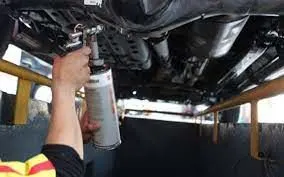
Applying automotive underbody coating to protect the car underside.
- Wax-based: An excellent anti rust coating suitable for all substrates. The wax is applied soft and cures hard, either by brush or spray, and can be layered thickly. It cannot be top coated.
- Bitumen-based: These car underbody coatings provide hard-wearing protection against stone chip damage and corrosion. They also have sound-deadening properties. Suitable across many substrates, but cannot be painted over. Can be applied by brush or spray, high build, and good for very tough conditions such as off-road.
- Resin-based: Polyurethanes and rubber coating are popular because their elastomeric properties provide long-term stone chip damage and corrosion protection as well as sound deadening effects. These also have the benefit of being suitable for a wide range of substrates and they can be painted over. Can be spray-applied, high build, and particularly good for salted roads.
APPLYING METHODS
1. SPRAYING
Spraying an automotive undercoating may be time consuming, expensive, and potentially dangerous, but it's your best option for keeping rust and corrosion at bay.
Perhaps the most common method of undercoating a vehicle, is via the use of a "rubberized" spray-on product. Utilizing a tar-like substance that has been infused with solvents and protectants, spray-on undercoatings stick to whatever they touch.
Once cured they act as a barrier against salt, moisture, oxygen, and any other foreign substance that may lead to rust and corrosion. We'll delve a bit deeper into the grimy details of what makes these opaque products so popular a bit later.
2. ELECTRONIC RUST INHIBITORS
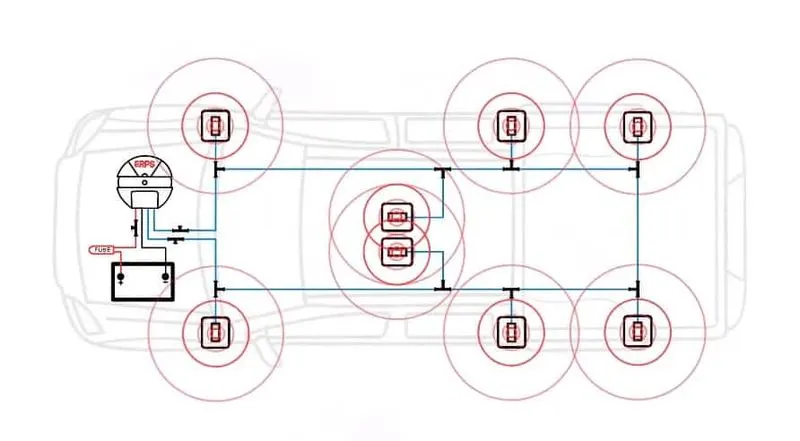
Electronic Rust Protection system makes it possible to protect not only the exteriors but also the interiors of any vehicles from the ravages of rusting. In fact, this system is effective in preventing rust in all those places inside the vehicles that are immune to even the work of various chemical rust prevention agents. Use of this technology can help in keeping your vehicles looking new, and it works well on both old and new vehicles alike.
The Electronic Rust Prevention System or EPRS works by slowing down the rate at which the iron present in any vehicle reacts with the water present in the atmosphere in the form of moisture. This is because rust is simply the product of a chemical reaction between iron and water, and any Rust Proofing technology aims to hinder this reaction.
This method aims to prevent rust formation by interfering with the opposite charges present in the molecules of iron and water. The exceedingly effective nature of this system lies in the use of the proprietary Electronic Capacitive Coupler System, which prevents oxidation of iron by continuously replacing the lost electrons from that metal. Therefore it is unmatched in its efficiency.
The ERPS works through the following few stages –
- The ERPS Power Unit is responsible for transferring an output voltage to the electro-couplers.
- Next, the electro-couplers play an integral role in turning the entire metal surface of the vehicle into an electron-rich negatively charged surface by itself acting as a the positive plate. The paint of the car helps in holding the charge static by acting as a dielectric.
- The negative surface helps in providing a continuous supply of electrons to the iron, and in the process help in rust proofing the vehicle.
The ERPS system has been nothing short of revolutionary in helping car owners in keeping their vehicles in top shape.
3. LANOLIN WAX/WOOL GREASE
When choosing an undercoating, the lanolin approach remains a proven, if not slightly unusual rust prevention solution. Commercially, lanolin are used as both a rustproof coating and as a lubricant, with everything from ship hulls and rigging equipment, to heavy-duty excavation machines and production facilities relying upon this water-repelling corrosion inhibitor.
On automobiles, lanolin fills in all of the nooks and crannies of the chassis with a sticky, wax-like substance that's been derived directly from... sheep glands. It may sound strange, spraying sheep funk across your vehicle's underbelly, but it really does work.
On the downside, curing times will vary depending upon air temperature and how heavy of a coating has been applied. So be ready for some downtime between car rides after this stuff has been sprayed.
4. DRIPLESS OIL SPRAY
The final common undercoating option is dripless oil spray. Once allowed to harden on a surface, this wax-like, colorless substance boasts the ability to repel moisture and corrosion for years on end.
Just note that dripless undercoating oil sprays typically require holes to be drilled into the body of the vehicle at specific points in order for the product to penetrate areas that are prone to rusting-out.
THE PROS AND CONS OF APPLYING AN AUTOMOTIVE UNDERCOATING
UNDERCOATING PROS
The biggest advantage to having an undercoating installed on the underside of an automobile, is knowing that your vehicle is protected from rust and corrosion, to an extent. While there are no guarantees that a rust bubble won't appear where a rogue rock chip hit your freshly applied coating, most vehicles go years without requiring a touch up.\
Another advantage is that undercoatings add an extra layer of sound-deadening insulation to the underbelly of a vehicle. While it may not be as affective as a dedicated sound-proofing product, and won't do much when it comes to repelling heat and cold, undercoatings do reduce road noise.
A car underbody coating provides a durable elastic over the underbody and wheel arches which protects the substrate from stones, gravel, salt, and other debris which is thrown up by the road.
By covering cracks in the paintwork or joints in the undercarriage of a vehicle, moisture or water from humid or wet environments is prevented from creeping into the underbody and causing corrosion.
Is easy to maintain – Giving the undercarriage of a vehicle a uniform appearance means cleaning it down is simpler and so is identifying possible problems.
UNDERCOATING CONS
1. TOXIC MATERIAL
Like many chemical-rich products, the average undercoating is a gateway to organ failure, cancer, infertility, and genetic defects. So spray safely, and always wear a ventilation mask, protective eyewear, gloves, and a painter's suit when working with undercoatings.
Over the years, electronic rust inhibitors have seen a surprising amount of success in both marine and underground structural applications. the effectiveness of these products depends heavily upon a multitude of factors, many of which are not always present in automobiles.
4. THE HIGH PRICE OF VEHICLE UNDERCOATINGS
But perhaps the biggest complaint people have about automotive undercoatings and rustproofing procedures, is how much they cost. This is precisely the reason why many people opt to take matters into their own hands, and attempt to undercoat their automobiles on their own
THE UNDERCOATING PROCESS
1. CLEAN
Surface corrosion will eventually turn into rust, and the longer it is allowed to fester, the harder it will be to remove.
Prior to applying a rust-repelling undercoating, you will need to remove as much corrosion build-up, caked-on road grime, and any other form of contaminant from the underside of the vehicle.
Here are a few of the core steps to completing this process.
Blast- Spray the entire underside of the vehicle with either a pressure washer, or a garden hose that has been outfitted with a heavy-duty spray nozzle. Be thorough, and hit every crevice and corner you can find, especially on higher mileage vehicles.
Degrease- Rinse complete, and undercarriage allowed to dry, it's time to use a commercial grade degreaser to remove any grime or oil lurking beneath the vehicle.
Grind- The next step is to grind any large chunks of rust or hardened contaminants, starting with a mild grinding pad, and gradually moving to more abrasive pads as necessary.
Sand- Corroded crap and contaminants blasted and scraped away, break out the sandpaper and get to hand scrubbing that underbelly. Start with a 200 grit sheet, and after each pass move a milder grit of sandpaper. This will not only remove any stubborn rust patches, but it will smooth out the scratches left behind.
IPA -isopropyl alchohol blend and dry rags to wipe-down what will be getting undercoated. This final prep process helps ensure that the entire undercarriage is devoid of dust and other gunk.
2. PRIMER
Spraying a primer is a crucial step in the undercoating process.
Most DIY undercoating products require a primer of some sort to serve as a basecoat. We've found that the best primers are those with high zinc levels, as this provides an additional corrosion resistance. Just be sure to follow the manufacturer's instructions, for many primers have their own unique prep requirements and curing times.
3. UNDERCOAT
The final step in the undercoating process is the application of the undercoating itself. Most of these products involve a two-stage or dual-layer spray-on procedure.
While the first round of undercoating should be relatively thin, know that it is not there to be the first line of defense, but to serve as a basecoat for the thicker outer coating. Once it becomes tacky to the touch, it's time to move on to the final outer coating.
These final layers should be applied liberally, and in smooth, slow movements. Rushing will only cause uneven coverage and drips to form. Once fully coated, it's time to sit back and let your undercoating cure, which depending upon temps and the product used, may take anywhere from a few hours to a few days.