Underbody Coating
Underbody coating:
As the name indicates, it is a layer of material applied to the underside of an automobile as a preventative measure against possible future damages due to wear and/or corrosion. Most cars come pre-equipped with underbody armour but often they do not cover the entire underside of the vehicle and some parts are left exposed to the atmospheric elements. Some parts like internal body panels, frame rails and other inner cavities are not physically accessible but are prone to corrosion. Hence, underbody coatings are sprayed or painted uniformly to the underside of the vehicle to protect such parts against possible damage and increase the life of the vehicle.
Underbody coating has many benefits as listed below:
- Prevents damage from stones, gravels and dirt
- Protects against water damage and prevents corrosion
- Provides excellent thermal insulation against both heat and cold, thereby preventing damage to any thermal sensitive components.
- Provides sound deadening effect and improves the Noise Vibration and Harshness (NVH) levels
- Makes it easier to maintain the underside of the vehicle with a cleaner and uniform appearance thereby making it easy to identify possible problems
The following image shows the difference between a vehicle without underbody coating on the left and another vehicle with sufficient underbody coating on the right: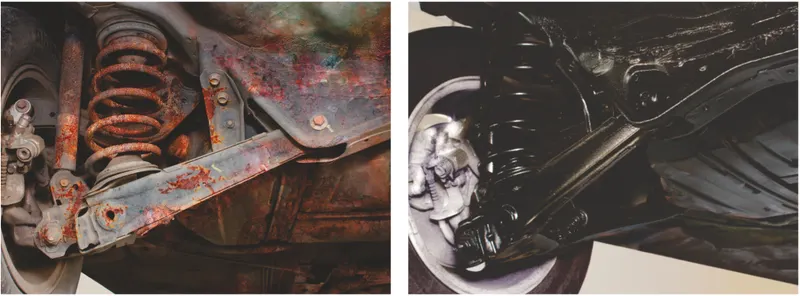
Depending on the degree of protection required and the components exposed, the underbody coating is of various types:
- Rubber based: coatings provide long-term protection to the exposed components from scratches and chipping damage caused by stones, gravel and/or dirt. Due to their elastomer properties, they also provide excellent sound deadening effects and keep the NVH levels low. They also have a benefit of being suitable for a wide range of substrates and are of high build quality. They can be painted over and are spray-applied to the underside of the car and are relatively easier to apply.
- Wax based: coatings are the most economical of all. Despite providing a tough fight against rust, they last only a small period of time. They are applied when soft, either sprayed or painted, and then hardened by curing. They cannot be top coated and can be layered thickly.
- Asphalt/Bitumen based: coatings are high performance coatings often applied to heavy vehicles as they provide great protection against tough road conditions and corrosion. They are of high build quality but take the most amount of time to be applied. They provide sound deadening due to the presence of rubber. They can be painted or spray-applied and are suitable for a wide range of substrates.
The following picture shows the difference between the underside of a vehicle before and after applying an underbody coating: