Underbody Coating
Underbody coating
Underbody coating provides long term protection from corrosion to car's underbody. It also protects parts like internal body panels, frame rails and other inner cavities that are not physically accessible but are prone to corrosion.
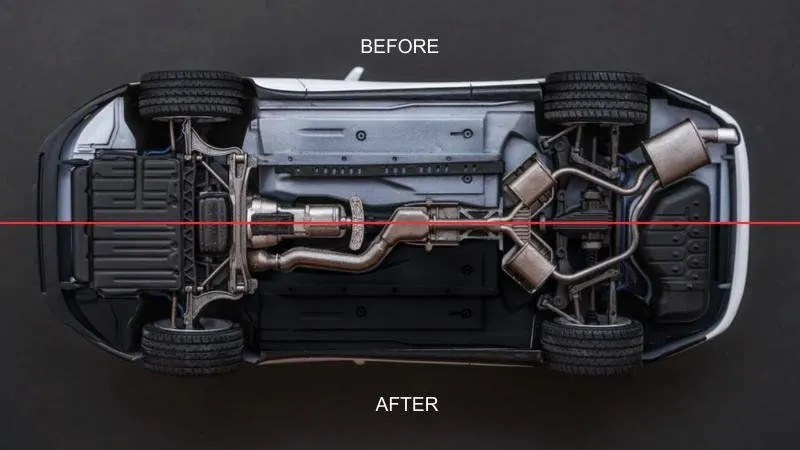
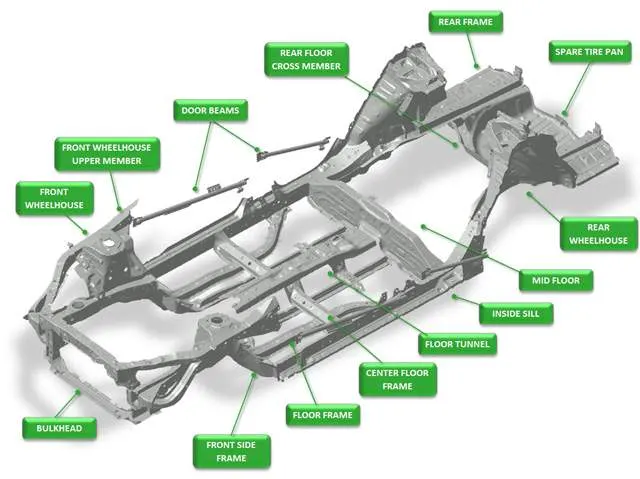
Underbody Components:
Front Bulkhead Comp,Front Wheelhouse Comp,Front Wheelhouse Upper, Front Side Frame Comp,Rear Frame Comp,Rear Wheelhouse Comp,Floor Frame Comp,Center Floor Frame,Inside Sill,Floor Tunnel,Spare Tire Pan,Mid Floor Comp,Rear Floor Cross Member,Door Beams
MODERN AUTOMOTIVE COATING PROCESSES:
Preatrament
Preatrament removes & clean excess metal & forms an appropriate surface structure enabling bonding of a corrosion protection layer. It consists of cleaning the body surface to remove remaining oils from the staming process & welding residues through three primary liquid dip processes of degreasing,conditioning &phosphating
Electrodeposition
E-coating involves dipping automobile bodies into the coating solution & passing an electric current through the body & the liquid ED paint solution. Because of the charged nature of this coating process, the ED paint penetrates intoplaces a spray would not reach.
During operation, a mixture of resin, binder, & a paste containing the pigments is fed into the ED tank. The automobile body is lowered into the tank, & an electric current applied; the solution in the tank consists of 80-90% deionised water & 10-20% paint solids.The resin is the backbone of the final paint film & provides corrosion protection, durability, & toughness. Pigments are used to provide color & gloss.
Rustproof materials (Sealers/PVC)
During this third step, it is also typical to apply a soft tip primer coat that improves the chipping resistance . This layer is applied to the front edge of the hood , which is an area prone to chipping shock, using a high elastic resin that resides between the ED & primer coats. Also, during the third step, the radiator supports, wheel housing, & under rar areas of the body are coated with a relatively dull black pigment called a blackout coating.
Primer
The fourth coating step is the primer. It can be water-borne, solvent-borne, or a powder. The primer fills & smoothes minor imperfections & scratches that may be created during prior steps & by the intermediate sanding or grinding used to remove small imperfections. It also provides additional protection against corrosion & maximizes adhesion between it & the E-coat & basecoat; thereby, the primer incrases paint durability.
Topcoat
The final step in the body coating process is to apply the topcoat, which consists of two layers the basecoat
& clearcoat. Basecoat contains the primary coloring pigments. clearcoat the final coating on an automobile
surface is the clearcoa; it provides durability, environmental etch, & scratch resistance to the overall coating.
Vehicle undercoating pros
- Protection against corrosion and rust
- Extend life of vehicle
- Cover small damages
- Reduce noice inside your car
Vehicle undercoating consi
- its not effective on cars with corrosion
- Does not work so well on old car
- It can be expensive
- It can be damaged