Underbody Coating
1.
Underbody coating:
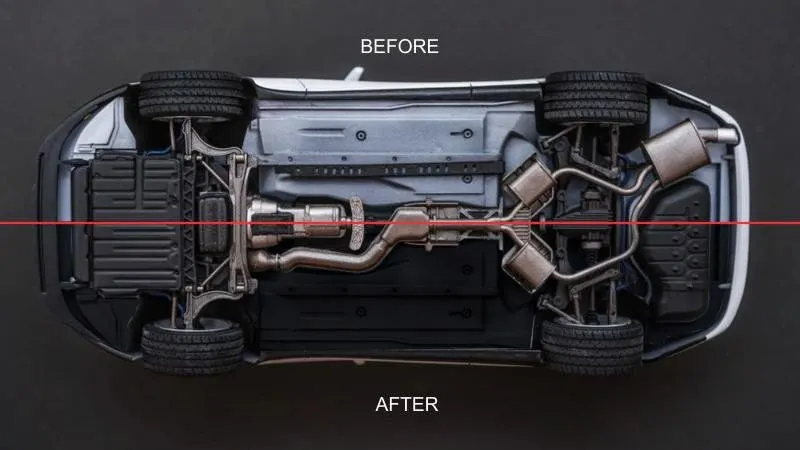
- Most automobiles' underbodies are susceptible to corrosion. The underbody of an automobile is long-term protected against corrosion by underbody coating. It also safeguards inaccessible yet vulnerable to corrosion sections including interior body panels, frame rails, and other inner cavities.
- It is sprayable coating
- The car's undercarriage ought to be our main focus for protection. Particularly during the monsoon, when the roads turn into little rivers due to the excessive precipitation, leaving our automobiles trapped. They are therefore more vulnerable to severe corrosion in the underbody area.
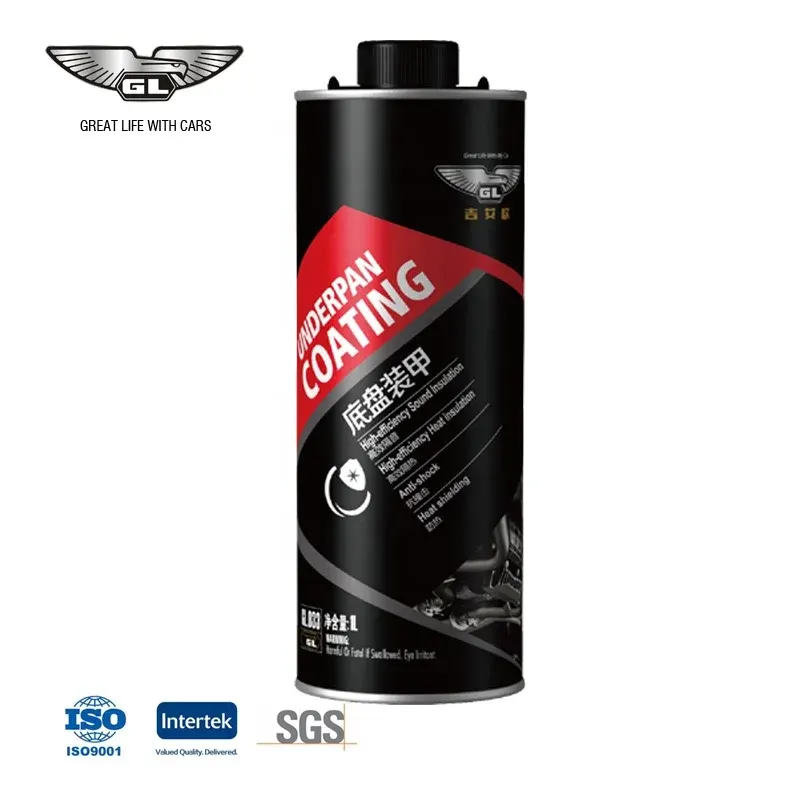
Types of undercoating
- Rubberized Undercoating
Rubberized undercoating makes a barrier of defence that keeps out dirt, filth, and moisture that may otherwise damage the metal parts. This added security is a cheap precaution that might benefit by perhaps prolonging a vehicle's service life.
2. Polyurethane Undercoating
It takes a little less time and effort to apply this kind of car undercoating.
Polyurethane undercoating frequently comes in canisters that may be preloaded into application guns. This kind of sealant functions by bonding with and shielding unoxidized metal by seeping into all seams and cracks, displacing moisture and salt, and oozing around rusty regions. It may also be painted over and sands easily in case bodywork is required.
On the other hand, this kind of automotive undercoating typically needs a little more surface preparation before to application; it is typically advised to sand and apply an etching primer to bare metals.
3. Wax or Paraffin-Based Undercoatings
The simplest and least expensive method for safeguarding your vehicle's underside is a paraffin-based undercoating. However, keep in mind that it must be stripped and reapply at least once each year because it will wear off more quickly than other kinds of undercoating.
Undercoatings made of wax never really harden. They leak or run into seams and fractures during application to offer protective qualities. They often come in an aerosol can or a spray gun canister and provide at least a basic level of protection in fairly humid regions.
4. Asphalt-Based Undercoating
Any of the aforementioned kinds of undercoating are adequate for protecting ordinary autos. Asphalt-based undercoating offers a little bit more resilience against pebbles, chips, and moisture for large vehicles and heavy equipment.
Undercoating made of asphalt frequently includes a small amount of rubberized material that helps it set up securely and reduce noise. This form of undercoating, which is often available in five gallon pails and has a longer cure period than the other three, is best used solely for undercarriages because it cannot be painted.
Process of undercoating
1. PRETREATMENT
Pretreatment is the initial step in preparing the BIW for subsequent coating. Preatrament cleans up extra metal and eliminates it, forming a suitable surface structure that enables the bonding of a corrosion protection layer. Through three basic liquid dip operations called degreasing, conditioning, and phosphating, the body surface is cleaned to eliminate any leftover oils from the staming process and welding residues.
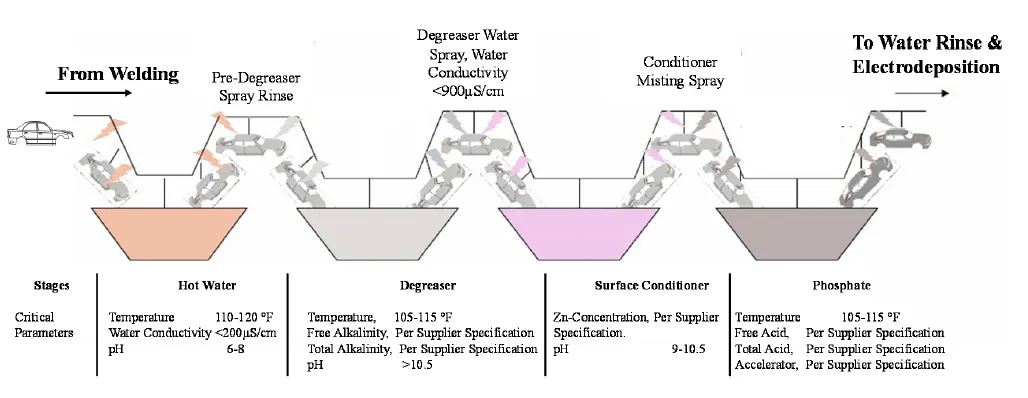
2. ELETRODEPOSITION
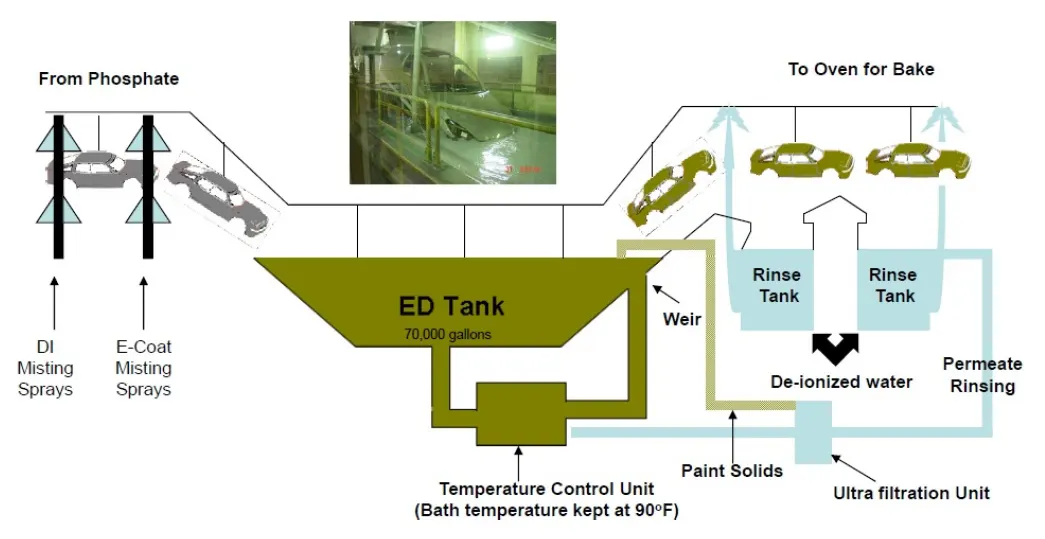
In order to e-coat a car, the body must be dipped into the coating solution and then an electric current must be run through the body and the liquid ED paint solution. The ED paint penetrates into areas a spray would not be able to because of the charged nature of this coating procedure.
During use, the ED tank is fed with a combination of resin, binder, and a paste containing the pigments. An electric current is delivered while the car body is lowered into the tank, which contains a solution made up of 80–90% deionized water and 10–20% paint solids. The resin serves as the structural foundation of the finished paint layer and offers hardness, durability, and corrosion resistance. Color and shine are provided by pigments.
Following E-coat, the car body is placed in a bake oven, where it is heated to 160°C for 10 minutes to enhance film curing and maximise performance attributes. Corrosion protection is less impacted by oven temperature and heating time, which largely improve chip resistance & film adherence to the body. Before the body moves on to the next application stage, some surface sanding is often done to remove or eliminate flaws since surface roughness affects the smoothness and brightness of the topcoat.
3. RUST-PROOF MATERIALS: SEALER/PVC
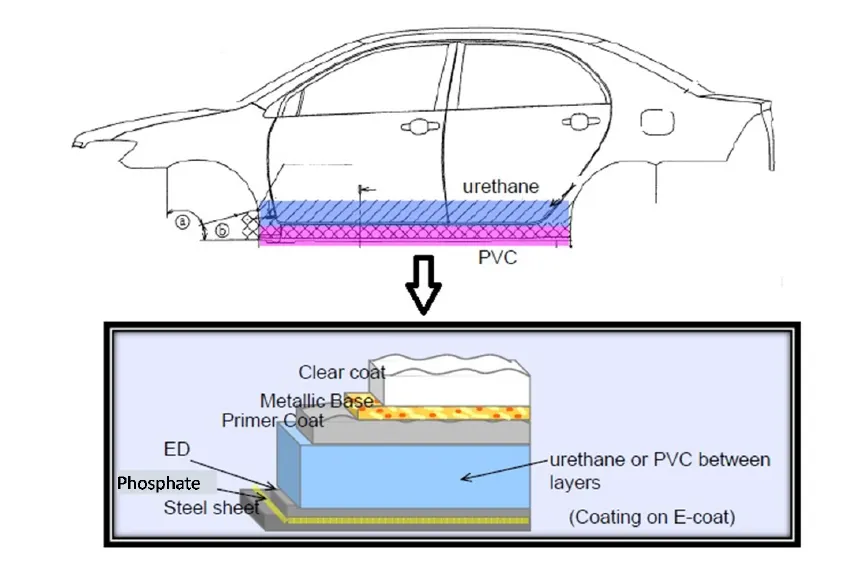
The final phase involves applying PVC to seal seams and coat the underbody. The lower door portions and rocker panel places where PVC or urethanes are placed as an anti-chipping protection are shown in fig. This figure also illustrates the cross section of this layer in relation to the other coatings on the body components.
4. PRIMER
The primer is used during the last coating stage. It might be powdered, solvent-borne, or water-borne. Tiny scratches and defects that may have been made during earlier procedures or by the intermediary sanding or grinding that was used to eliminate small imperfections are filled and smoothed up by the primer. As a result, the primer increases paint endurance. It also offers extra protection against corrosion and maximises adhesion between it and the E-coat and basecoat.
5. TOPCOAT
The application of the topcoat, which has two layers—a basecoat and a clearcoat—is the last stage in the body coating process.
Advantages
- Protection against corrosion
- Protection of vital car components
- Reduces NVH(Noise Vibration Harshness) levels
- Car underbody coating prevents paint from chipping