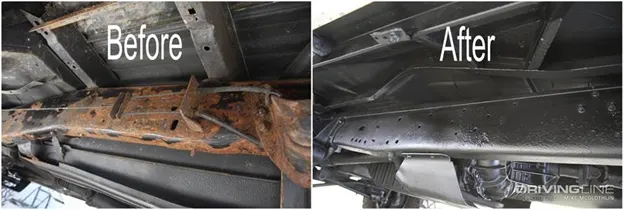
Underbody Coating
UNDER BODY COATING
Underbody coating is usually a dense cladding (often based on rubber) applied uniformly to the undercarriage of the automobile. It is normally sprayed or painted on when the car is just out of the dealership and is clean. But even if you are getting the undercoating applied after a couple of years
Protects Against Rust & Corrosion
The primary objective of getting underbody coating done is preventing metal components that are exposed on the bottom side of the car to damage from corrosion. You can shut out the Adverse effects of corrosion on your car by simply applying a rubberised anti-rust coating all over the belly of your car
Reduces NVH (Noise Vibrations Harshness) Levels
Our country is filled with roads having uneven patches and potholes and while we manoeuvre our cars through such sections, the unpaved crumbs, and pebbles hit the car from underneath or get stuck in the wheel wells. The underbody coating’s consistency is so thick that the layer it creates absorbs all the unpleasant noises and vibrations and marginally improves the driving experience
Prevents Paint Chipping
Running on the highway or while pacing through a city road, you will often encounter sharp gravel or any other unattended object hitting the belly of your car with high momentum. This scrapes and chips off the metal from down below. A thick layer of Underbody Coating definitely comes to aid and minimises the effects of such contacts on the body.
Protects Vital Components
Underneath a car is somewhere a lot of indispensable parts of a car are left exposed like the Engine, silencer, etc. One simply can’t afford to let these parts go bad due to rusting and hence in order to save yourself from a hefty repair bill, a considerably less expensive Anti-Rust Coating is a must.
TYPES OF UNDER BODY COATING
Water- and Paraffin-Based Undercoats
Water-based undercoatings are the most popular for do-it-yourselfers. These undercoatings can be found in automotive parts stores in aerosol formats. Water-based undercoatings are thin set and have quick drying times. The downside to water-based undercoatings is the frequency in which they need to be repeated. Often the smallest abrasion that breaks through the undercoating can result in the need for a new coat. Paraffin-based undercoatings have a wax inclusion that makes them stronger than water-based undercoatings. Paraffin-based undercoatings can be purchased through an automotive store in spray and paint-on formats. This type of coating is also thin set and relatively fast drying. Paraffin-based undercoating needs to be replaced at least once a year at the vehicle owner's expense
Petroleum- and Rubber-Based Undercoats
Petroleum-based undercoatings are made from oil and have greater deflective abilities for road salts and grime. The petroleum base helps repel water and ice better than paraffin- or water-based undercoatings.. This type of undercoating also needs to be replaced once a year at the owner's expense. Rubber-based undercoating is the second strongest undercoating available for vehicles. This type of undercoating allows for more flexibility in the undercarriage and holds up better to rough terrains. Rubber-based undercoatings are available in spray and paint-on applications
Asphalt-Based Undercoats
Asphalt-based undercoating is the strongest undercoating available. It is used on all-terrain and military vehicles. Asphalt-based undercoating will last the longest and is the best option for vehicles that endure heavy road use. Asphalt-based undercoating is the thickest coating with the most damage-resistant properties. It can be bought through professional services and is the only type of undercoating with a limited warranty