Underbody Coating
UNDER-BODY COATING
Under seal (often called undercoating in the U.S.) is a thick resilient coating applied to the underbody or chassis of an automobile to protect against impact damage from small stones, which would rapidly chip ordinary paint, allowing rusting to begin.
The rate at which vehicles corrode is dependent upon:
- Local climate and use of ice-melting chemicals (salt) upon the roads
- Atmospheric pollution, such as acid rain or salt spray, which can cause paint damage
- Quality, thickness, and composition of metal used, often an alloy of mild steel
- Improper use of some dissimilar metals, which can accelerate the rusting of steel bodywork through electrolytic corrosion
- Design of rust traps (nooks and crannies that collect road dirt and water)
- Particular process of rust proofing used
- Plastic/under-seal protection on the car underside
- Exposure to salt water, which strips off the protective paint and also causes rust much quicker than ordinary rain water would
Vehicles for sale in some territories are not undersealed, because the climate is not sufficiently aggressive to warrant it. If such a vehicle is subsequently imported into a country with high rainfall, cold winters and where salting of the roads is common, application of underseal is strongly recommended to ensure the vehicle has a long life.
The underbody coating that is most commonly used on cars in India and supplied by companies such as 3M is a thick, rubberized paint that forms a 2-3 mm thick coating all along the underside of the car when sprayed on. You also get a thinner clear coat underbody coating which is like a lacquer that coats the entire underside of the car. Some even inject rust-preventive coating material into crevices such as the bottom of doors and door sills, to protect them from rust.
TYPE OF UNDERBODY COATING:
- Rubberized underbody coating
- Wax based underbody coating
- Asphalt based automotive undercoating
- Polyurethane underbody coating
On bad roads, flying stones and pebbles can chip off the original underbody coating and leave the metal exposed. Using an aftermarket underbody coating offers extra protection.
A uniform black underbody coating gives a car a clean look. It also makes the car easier to maintain by just hosing the underside down. You can be confident that slush build up won’t lead to rusting easily.
Modern automotive coating methods consist of five main steps. They include the following: ‚ Pre-treatment: removes and cleans excess metal and forms an appropriate surface structure enabling bonding of a corrosion protection layer. ‚ The next step is electrodeposition (ED) of the anti-corrosion or rust prevention layer. ‚ A sealer like Poly Vinyl Chloride (PVC) is applied for anti-corrosion, elimination of water leaks, and minimization of chipping and vibrational noise. ‚ A primer is then applied to promote adhesion between the surface and the basecoat; it also imparts a smoother surface for subsequent layers and has anti-chipping properties. ‚ Finally, the topcoats that include a basecoat and clearcoat are applied; they provide surface properties that are sought after, including colour, appearance, gloss, smoothness, and weather resistance.
Care must be taken while applying underbody coating. This thick rubberized paint if not applied properly, can get into moving mechanical parts and cause premature failure – such as into the U-joint or CV joints in a car’s propeller shaft or drive shafts. They can also hinder smooth movement of suspension components, if applied incorrectly. And there’s also the risk of overspray on to the car’s paint finish on the lower edges of the car.
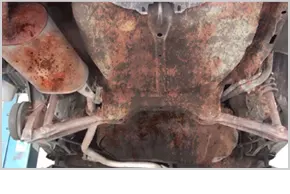
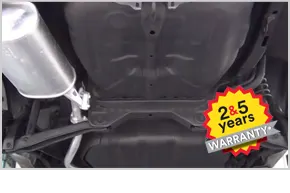
IF NOT TREATED TREATED
ADVANTAGES OF UNDERCOATING
- FIGHTS RUST
- ABSORBS NOISE
- REINFORCEMENT & PROLONG CAR’S LIFE