Underbody Coating
A car’s underbody is exposed to the most wear and tear caused by muddy water, potholed roads, stones and other obstacles on the road. Because it’s not in plain sight, we often do not see the damage.
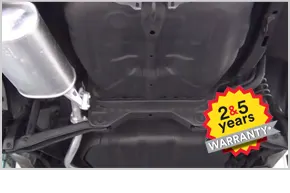
Underbody Treatments offers you a long term solution for issues related to corrosion and rust. First, the car under body is washed and degreased. Hard coating on the underbody of the car, that is fast-drying, paintable, rubberized, non-toxic and chip-resistant. It also minimizes sound from underneath the vehicle and insulates against the heat and cold.
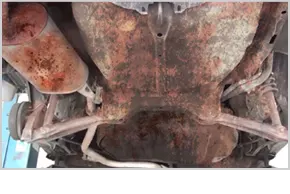
Underbody Treatment protects the car underbody from rust, increasing the longevity of the car and thus enhancing its resale value.
If not treated.
If treated.
Pros:
Rust Prevention
Ideally any additional underbody coating should be applied when the car is brand new and clean. Car manufacturers use thick paints and sealants for the underbody, but adding an underbody coat especially in coastal cities is useful. Salt water tends to corrode cars really badly.
On bad roads, flying stones and pebbles can chip off the original underbody coating and leave the metal exposed. Using an aftermarket underbody coating offer extra protection.
Sound insulation
The thicker underbody coatings used on cars also act as effective sound dampeners. They can reduce road noise and tyre noise and make the cabin seem quieter – due to the sound absorptive nature of rubberized paints.
Easy maintenance
A uniform black underbody coating gives a car a clean look. It also makes the car easier to maintain by just hosing the underside down. You can be confident that slush build up won’t lead to rusting easily. Most underbody coats these days come with a five-year warranty, which is the lifetime of such a coating.
Here are some of the downsides to underbody coating:
High cost
Cost of underbody coating has come down, but is still expensive. This is because underbody coating offered by a car dealer is one way in which they make money off the customer.
Risk of damage during application
Care must be taken while applying underbody coating. This thick rubberized paint if not applied properly, can get into moving mechanical parts and cause premature failure – such as into the U-joint or CV joints in a cars propeller shaft or drive shafts. They can also hinder smooth movement of suspension components, if applied incorrectly. And there’s also the risk of overspray on to the car’s paint finish on the lower edges of the car.
Cons:
A used vehicle may already have residue on the bottom of the car or even have spots of rust and corrosion. Undercoating will not help you if corrosion already exists and the corrosion needs to be removed first before it can be applied, which can be expensive for you.
This is negligible in terms of fuel costs but still something to bear in mind.
This is negligible in terms of fuel costs but still something to bear in mind
1) It’s Not Effective On Cars With Corrosion
If your vehicle already has some corrosion it isn’t as effective.
Applying undercoat over rust means that although you’re stopping more moisture and airflow to the rusted area, the rusting process will still keep happening.
An undercoat will slow down the corrosion rather than reverse or stop it. You should attempt to remove the rust before applying an undercoat.
This isn’t always easy though, since rust can penetrate deeply into the metal, so encapsulating the rust and then applying an undercoat could be a waste of money.
2) Doesn’t Work So Well On Old Cars
Undercoating doesn’t work so well on old cars because the residue from under the car has to be removed before the undercoating is applied.
If you don’t remove the debris first, the already-present debris will be sealed in.
3) It’s Useless On New Cars
Undercoating might not be wise if you tend to change cars every few years, since it takes between 3 and 5 years before rust starts to show.
In fact it might be 10 years before your car is affected in any way at all by corrosion.
This means if you get a new car every few years then undercoating it would be a waste of money because it simply isn’t required.
4) Your Vehicle’s Warranty Might Be Voided
Your vehicle’s warranty might be voided if you opt for a third-party undercoating treatment.
Some new cars already come with undercoating so adding anything else risks your warranty.
5)It Makes Your Vehicle Heavier
It makes the vehicle 10 to 20 pounds heavier which affects fuel economy (how far you can travel on one tank of gas).
This is negligible in terms of fuel costs but still something to bear in mind.
6) It Can Be Damaged
Undercoating can be damaged.
Although you can expect a hard layer of protection against debris, driving on dirty or gravel roads often means the protective layer’s integrity will be reduced over time.
7) It Can Be Expensive
Reapply it every 3 to 5 years. This is the only way to ensure your vehicle is protected properly.
Since it can cost $1500 to get the undercoating professionally applied, this is quite a big cost to do it regularly.