Thermal Management of battery
Objective:
1. Prepare a report summarizing thermal management techniques for electric car battery packs (not more than 500 words)
2. create a simple simscape model with a battery and show the temperature dependence in the performance. Also, connect a resistor load of 10 Ohm
(Hint: Table based battery, Temperature source)
3. Compare the resultants graph for different areas of contact of heat
Solution:
1. Prepare a report summarizing thermal management techniques for electric car battery packs.
| Anode/Cathode | Specific energy | Specific power | Discharge voltage | Thermal stability | Safety | Lifetime | Cost/Cycle |
|---|---|---|---|---|---|---|---|
| C/LiCoO2 | 5 | 3 | 5 | 3 | 3 | 3 | 3 |
| C/LiMn2O2 | 4 | 4 | 4 | 3 | 4 | 3 | 3 |
| C/LiFePO4 | 3 | 4 | 2 | 4 | 4 | 4 | 4 |
| LTO/LiCoO2 | 3 | 4 | 3 | 4 | 5 | 4 | 5 |
| LTO/LiFeO4 | 2 | 3 | 1 | 5 | 5 | 5 | 5 |
The major concern with Lithium-ion batteries is that during the charging/discharging process, the battery produces lots of heat, which causes an increase in battery pack temperature, especially in the cases of higher operating current conditions. Heat originates from the electrochemical reactions, mixing and the phase change occurring in the lithium-ion cell. Heat is also generated due to Joule's heating effect. The battery pack used in EVs comprises battery modules and each module consists of a large number of cells/batteries connected in series and parallel, which are installed in a confined space. The heat generated due to internal resistance and electrochemical reactions inside cells at high discharge rate cannot be dissipated to the ambient promptly by self and is accumulated in the modules, resulting in a shoot up of batteries temperature and thermal instability across the module and it is the same scenario at high charging rate. If the temperature of the battery rises then the degradation rate of the battery increases exponentially, battery life decreases and could result in thermal runaway. Hence, cooling of batteries is essential to maintain the batteries in a specific temperature range which is presented in Figure 2.
The other problem is the uneven temperature distribution across the battery pack which is due to the manufacturer's defect and non-uniformity of the cell. The uneven temperature distribution reduces cycle life significantly. Ambient conditions play a crucial role in the performance of batteries. Table briefs the scenario at low and high operating conditions.
Battery Thermal Management System.
BTMS embraces software, hardware, and other paraphernalia. To enhance efficiency without compromising on reliability, a cyber-physical perspective of battery management is inevitable. The prime objective of BTMS is to maintain the temperature of battery cells in a pack at an optimal range by sustaining the temperature gradient within a relatively narrow range.It helps to augment the battery life while ensuring the safety and consistency of the battery pack. The figure shows the essential functions of the BTMS. Some of the other extensive functions of the BTMS are cell protection, charge control, SOH (state of health)/SOC (state of charge) estimation and monitoring, cell-balancing and interface.
Figure 3
Air cooling based BTMS
Air-based cooling techniques are one of the most commonly employed battery cooling approaches and are widely used in electronics and vehicles due to their low cost and simple setup.
Its is examined the effects of gap spacing and airflow rate for an air-cooled lithium-ion battery module and found that temperature rise can be lowered by reducing gap spacing between the neighboring cells and the temperature uniformity can be improved by increasing the flow rate with moderate spacing. One of the studenst employed tapered manifold and pressure release ventilation in a forced-air cooling system to enhance the cooling performance of the system without changing the design layout. They developed a multi-dimensional numerical model and an analytical model for air-cooled flat plate and cylindrical lithium-ion battery packs and showed that a better cooling performance and more evenly distributed temperature pattern are achieved by the counter-flow arrangement of the cooling channel or by frequently changing the flow direction in the counter flow arrangement. Yu et a designed an air-flow integrated thermal management system consisting of two independent air duct channels. One channel is to cool the batteries and the other one is to minimize the heat accumulations in the middle of the battery pack through jet cooling. Simulation and experimental results indicated that the maximum temperature reduced to 33.1°C compared to 42.3°C with the traditional cooling method and the temperature uniformity of the battery pack improved significantly.
Liquid cooling based BTMS
Air cooling systems have performed efficiently in thermal management of battery packs operating at low charging/discharging rates and nominal ambient conditions. However, at higher operating conditions like high charging/discharging, high ambient temperature, and so forth air cooling systems were unable to maintain the battery within the desired operating temperature range. This method was effective in curbing the non-uniformity of the pack. Adhering to these methods could cut down the number of sensors and the control system complexity of the BTMS.
Phase change based BTMS
Liquid cooling systems have shown better thermal management compared to air cooling systems at adverse operating conditions however, the liquid cooling systems present some disadvantages: complicated and bulky components, depleting battery energy, and difficult sustainment. Besides, the leakage of coolant in the liquid cooling systems has always been a concern since it can cause a short circuit failing the cooling system eventually ending up in a misfortune. Hence there exists a necessity for a better cooling strategy in BTMSs in pursuit of weight reduction, power consumption reduction, temperature reduction and to achieve a higher temperature uniformity.
In this regard, various researchers have adopted techniques involving the phase change phenomenon. Phase change BTMSs are of two types, solid to liquid cooling and liquid to gas/vapor cooling. The former is known as Phase Change Material (PCM) based BTMS. Heat pipe-based cooling and water evaporation strategies are considered as the latter type.
In studies related to the thermal management of electronic devices by using PCMs, it was shown that PCMs performed efficiently. The thermal management using PCM is based on the extremely high endothermic melting (Latent heat of fusion) of PCM over a small temperature span which reduces the temperature rise inside the cells.With PCM cooling, the heat generated during the battery discharge can be stored as latent heat in the PCM and transferred back to the battery module during the relaxation and thereby maintaining the battery temperature above the ambient temperature, which can boost the overall energy efficiency of the battery system
2. Create a simple simscape model with a battery and show the temperature dependence in the performance. Also, connect a resistor load of 10 Ohm
the following shows the simscape model of the battery and its temperature dependence performance.
The available driving range of electric vehicles is strongly affected by environmental temperatures. The primary cause is the poor performance of the battery pack at low temperatures. This paper focuses on the study of the temperature-dependent performance of lithium-ion (Li-ion) batteries. The battery of one major commercially available electric vehicle is examined. A series of tests including the Electrochemical Impedance Spectroscopy test, dynamic driving schedule test, and others are conducted under controlled temperatures. The temperature influence on the performance and characteristics of the battery is discussed and analyzed. Based on the experimental results, the temperature-dependent battery model can be developed for the prediction of available driving range as well vehicle control development for EV and PHEV.
A simple model of a battery config:
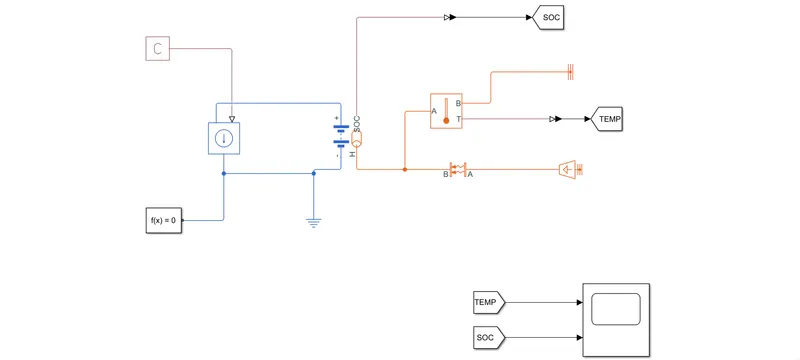
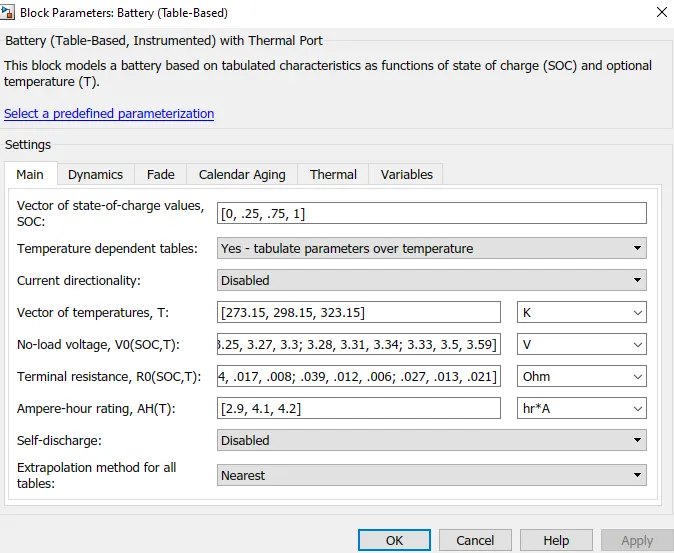
apparently, first, we need to set up the battery model with its features. It's a table-based model so it has a lot of different options. as you can see from the below pic.
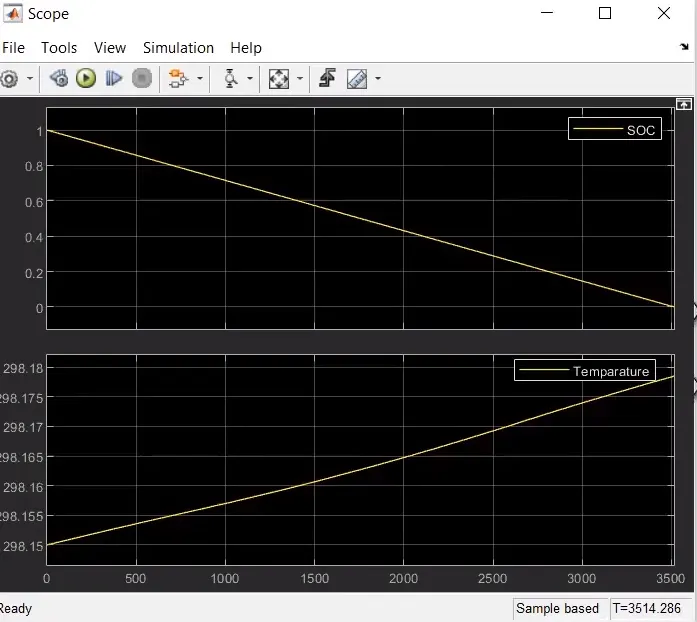
The battery is discharging a fixed amount of current whilst being heated by a temperature source
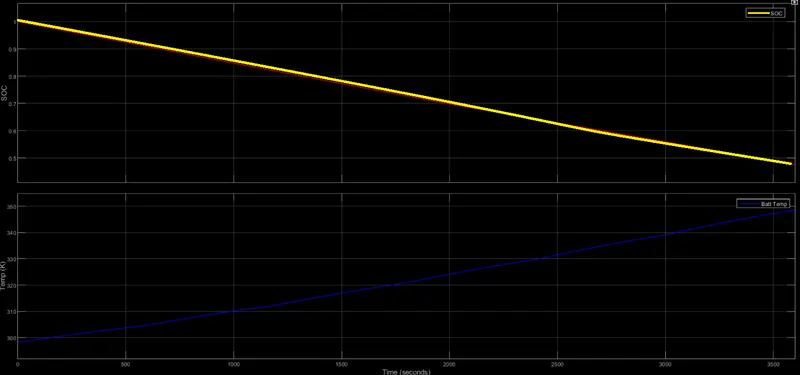
The discharge current remains the same and every 1o minutes 10-degree increment is observed
the surface of the battery has a default setup m^2.
Output:
Simscape model of battery config with resistance:
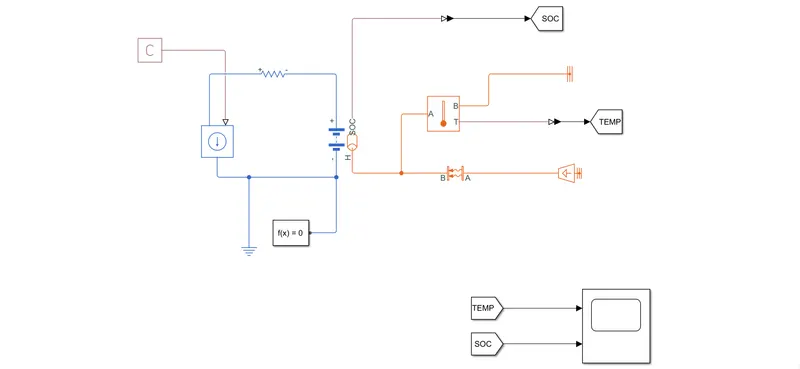
we added the resistance of 10 ohms in the setup so this is what the options look like.
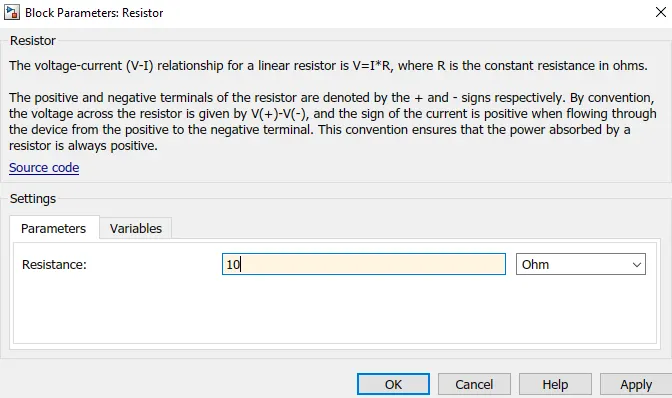
There was no change in battery temperature or SOC by adding the 10 ohms.
The main reason is the resistance value is too low to extract enough power from the circuit to affect the battery performance.
with 10 ohms it omes with less voltage, power, and lower capacity.
Output: