Supervised Learning - Prediction Week 3 Challenge
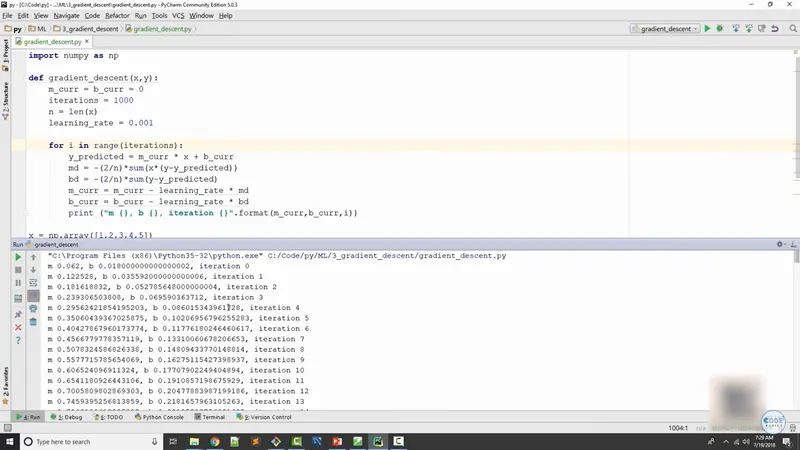
Ans 1 in the attachment
Ans 2
L1 tends to shrink coefficients to zero whereas L2 tends to shrink coefficients evenly. L1 is therefore useful for feature selection, as we can drop any variables associated with coefficients that go to zero. L2, on the other hand, is useful when you have collinear/codependent features.
Ans 3
- Mean Absolute Error (MAE).
- Mean Absolute Percentage Error (MAPE).
- Mean Squared Error (MSE).
- Root Mean Squared Error (RMSE).
- Huber Loss.
- Log-Cosh Loss.
Ans 4
The learning rate controls how quickly the model is adapted to the problem. Smaller learning rates require more training epochs given the smaller changes made to the weights each update, whereas larger learning rates result in rapid changes and require fewer training epochs.
Ans 5
- R Square/Adjusted R Square.
- Mean Square Error(MSE)/Root Mean Square Error(RMSE)
- Mean Absolute Error(MAE)
Ans 6
The fundamental point is that when you add predictors to your model, the multiple Rsquared will always increase, as a predictor will always explain some portion of the variance. Adjusted Rsquared controls against this increase, and adds penalties for the number of predictors in the model.