Study of EV Drivetrain
1. Which types of power converter circuits are employed in electric and hybrid electric vehicle?
AC-DC converters:
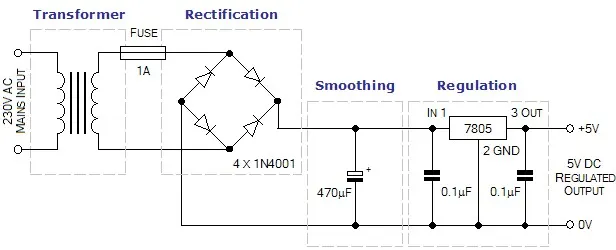
These are Rectifier circuits, which converts AC voltage into DC voltage.
Example: Chareger of an eV where AC power supply has to be converted to DC supply to recharge battery pack.
A typical rectifier circuit diagram
DC-AC Converters:
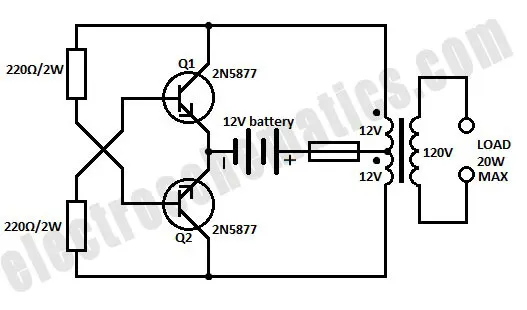
These are Inverter circuits, which converts DC supply into AC supply.
Example: Motor drive, where the eV using AC induction motor, the power output from the battery is DC and has to be converted into AC in order to drive the motor.
A typical inverter circuit diagram
DC-DC Choppers:
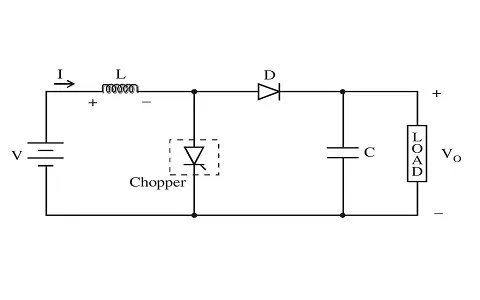
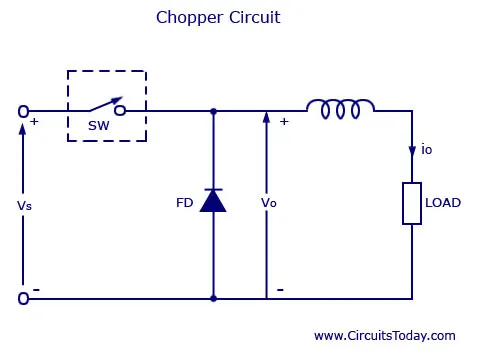
These are used for step-up and step-down operations.
for example, headlamps of a car requires 12v dc supply where as battery pack is 24v dc to match the required voltage step-down chopper is used, and vice versa.
Step-up chopper
Ste-down chopper
2. An Electric Vehicle's powertrain with 72V battery pack in shown in the diagram below. The duty ratio for acceleration operation is 'd1' and for the braking operation the duty ratio is 'd2'.
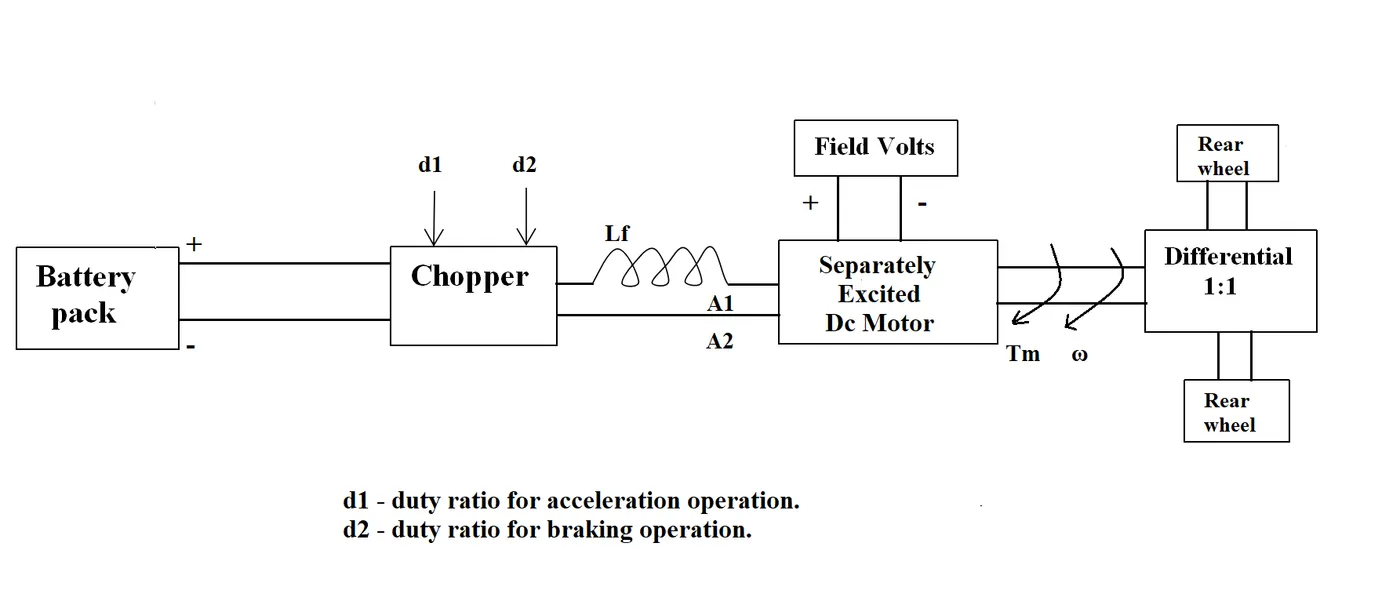
The other parameters of the electric vehicle is given below,
Motor and Controller Parameters:
Rated Armature voltage= 72 V
Rated armature current= 400 A
Ra= 0.5Ω, KΦ= 0.7 Volt second
Chopper Switching frequency= 400 Hz
The vehicle speed-torque characteristics are given by the below equation

What is EV steady state speed if duty cycle is 70%?
hence,
We have standard torque formula:
`T=V(Kphi)/R_a-omega(Kphi)^2/R_a`
To calculate `omega` for given duty cycle 70%
V=72*0.7=50.4
Subsituting the values in the standard torque equation we get
`T=70.56-0.98omega`.....(1)
also given,
`T=24..7+0.0051omega^2`.......(2)
solving (1) and (2)
we get positive and negative values for `omega`
Positive value is consider beacuse speed will never be negative.
therefore `omega=38.85`rad/sec
3. Induction vs DC brushless motors article by Wally Ripple, TESLA
- There is no one best engine type, rather there are different types of engines to suit personal requirements, such as price and performance.
- Today Lead has been replaced by lithium and DC by either DC brushless or Induction motors.
- Without inverter a brushless motor is useless
- Both DC brushless and induction drives use motors having similar stators. Both drives use 3-phase modulating inverters. The only differences are the rotors and the inverter controls. And with digital controllers, the only control differences are with control code.
- One of the main differences is that much less rotor heat is generated with the DC brushless drive. Rotor cooling is easier and peak point efficiency is generally higher for this drive.
- Permanent magnets are expensive, something like $50 per kilogram. Permanent magnet rotors are also difficult to handle due to very large forces that come into play when anything ferromagnetic gets close to them.
- Induction machines are more difficult to control. The control laws are more complex and difficult to understand.
- DC brushless drives will likely continue to dominate in the hybrid and coming plug-in hybrid markets, and that induction drives will likely maintain dominance for the high-performance pure electrics.