Structural dynamics
1.The main difference between static and dynamic analysis is TIME! If the load is applied so slowly, that inertia effects won’t play a role, all you need is static analysis. Dynamic analysis handles impacts and other “fast” happening situations, but also vibrations (which happen in time).
Static analysis :
- It doesn’t matter how you apply the load. Solver assumes that this is happening extremely slowly. This means that the way you apply the load has no impact on structural behavior.
- The load is not changing in time – it is just there… and that’s that!
- Structural response to the static load CAN differ in time (you know, things like creep, relaxation, etc.). Engineers usually view such analysis as more specialistic, and not “simple static”. Still, structural response changing in time is an option in static design.
- The fact the load is not changing doesn’t mean that the structural response is linear! All sorts of fun things can happen! If the load is high enough it can cause buckling, yield and all sort of other cool things. This, however, doesn’t change the fact that the analysis is “static” in nature!
Static dynamics :
This is where things start to be a bit more interesting. I think it’s obvious that “vibrations” are a dynamic thing. But, you most likely won’t need all the fancy stuff to analyze vibrations! This is the realm of “linear dynamics”.
In essence, you can use modal analysis to predict vibration modes of your structure (as long as the structure itself behaves in a linear way). And what is interesting is, that loads in this analysis don’t change in time. In fact, the solver will “change” the loads you select into the mass of your model. It will simply ignore the rest of the loads! So there is no “load changing in time” component yet!
You may think about modal analysis as about Linear Buckling Analysis (LBA) of dynamics! It’s there, it does help, but it’s not the pinnacle of human achievement in the field.
2 a.Elastic Behavior :
Elastic behaviour is the ability of a material to recover original shape after the force is removed. in a spring this occurs when the force is lower than the elastic limit. loading and unloading force extension curves can be different as long as it returns to its original shape.
b.Inelastic behavior :
The term, “inelastic” is used to define the material response in relation to the stress-strain diagram that is non-linear and that retains a permanent strain or returns to an unstrained state on complete unloading.
c.Plastic behavior :
For stresses beyond the elastic limit, a material exhibits plastic behavior. This means the material deforms irreversibly and does not return to its original shape and size, even when the load is removed. When stress is gradually increased beyond the elastic limit, the material undergoes plastic deformation.
d.Non-linear Inelastic behavior :
Materials have elastic behaviour usually only up to a certain load, which is called the 'yield point'. After that, the deformations are plastic. Rubber, for instance, has an elastic stress–strain curve, but the relation is not linear − in such cases nonlinear elastic models are required.
3. Mass :
A Tuned Mass Damper (TMD), also called a "harmonic absorber", is a device mounted to a specific location in a structure, so as to reduce the amplitude of vibration to an acceptable level whenever a strong lateral force such as an earthquake or high winds hit.
Stiffness:
Stiffness describes the ability of a body to resist elastic deformation. The transmission of power would not be possible without stiffness. However, there are events which should not be transmitted, such as torque peaks and shock loads. In order for a system to withstand such loads, it is damped.
Damping :
The restraining of vibratory motion, such as mechanical oscillations, noise, and alternating electric currents, by dissipation of energy. Unless a child keeps pumping a swing, its motion dies down because of damping.
tion of energy. Unless a child keeps pumping a swing, its motion dies down because of damping.
3.Natural period:
Natural Frequency :
Natural frequency, also known as eigenfrequency, is the frequency at which a system tends to oscillate in the absence of any driving force. The motion pattern of a system oscillating at its natural frequency is called the normal mode (if all parts of the system move sinusoidally with that same frequency).
Relationship between Natural period (Tn) & Natural frequency (f) :
The frequency (f) of a wave is the number of full wave forms generated per second. This is the same as the number of repetitions per second or the number of oscillations per second.
Time Period (T) is the number of seconds per waveform, or the number of seconds per oscillation. It is clear that frequency and time period are reciprocals.
That is, T=1/f.
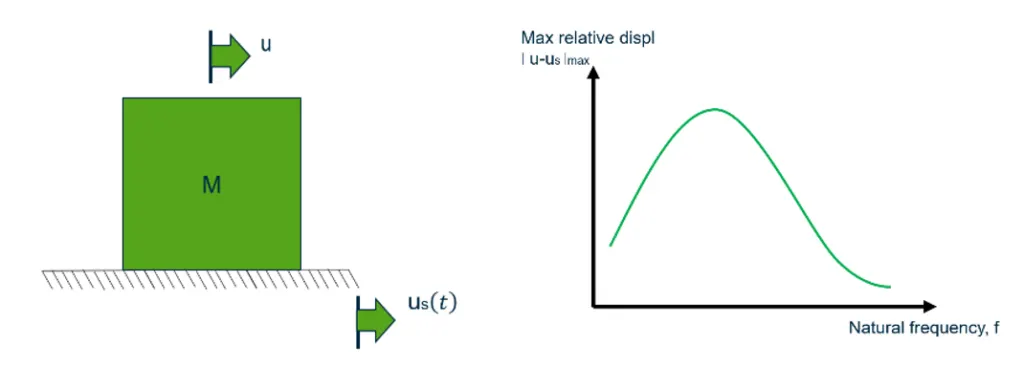
5.A response spectrum is a graphical plot of the frequency of an oscillator and its damping. The response spectrum plot represents the peak or steady-state response (velocity, displacement, or acceleration) of a series of oscillators of varying natural frequency. In vibration analysis of any system, the response spectrum is very useful as the resulting plot can provide the response of any linear system with respect to its natural frequency. The response spectrum finds its usage in interpreting seismic or earthquake events and slug flow events.