Steady Vs Unsteady flow over a cylinder
- Introduction
The aim of this challenge is to simulate the flow over a cylinder in order to capture the Von Karman vortex street. A Karman vortex street consist of continuous pattern of rotating structures (vortices). This pattern is a periodically oscillating flow, known as vortex shedding, and takes place downstream of a bluff body within a range of Reynolds numbers which depends on its shape. Reynolds number is a dimensionless number which measures the ration of inertia to viscous forces and is defined by the following equation.
Re = ρVD/μ
where ρ: density
V: velocity
D: characteristic diameter (cylinder diameter)
μ: dynamic viscosity
- Geometry
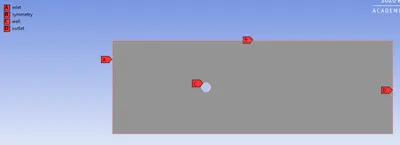
With regards to the geometry, a 2m-diameter cylinder is generated in a 60m x 20m computational domain. The cylinder is located 20m downstream the inlet (x-wise) in the middle-height of the computational domain. The next figure shows the tested geometry and the definition of the boundary edges.
- Meshing generation
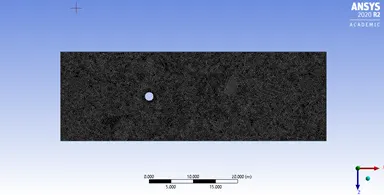
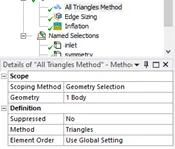
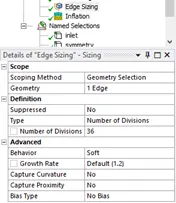
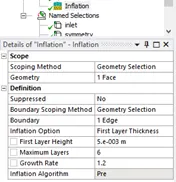
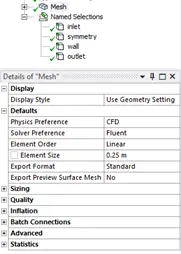
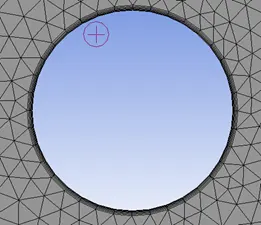
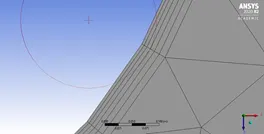
To generate the mesh-grid, ANSYS fluent meshing is used. Three meshing tabs are created to reshape the grid. In the first one, called All Triangles Method, the cells are determined to be triangles. In the second one, called Edge Sizing, the number of nodes in the cylinder edge is increased in order to improve the cylinder representation. Finally, the last tab, called Inflation helps to add mesh-layers around the cylinder. In the mesh object, element size is adjusted to 0.2m. In the following figures, we can see all the mesh settings.
- Case set-up
The following figures give us information on the solver set up.
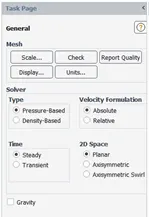
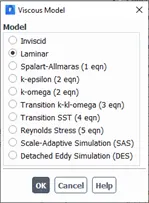
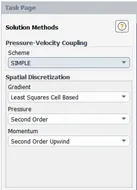
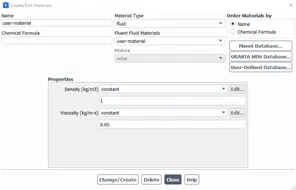
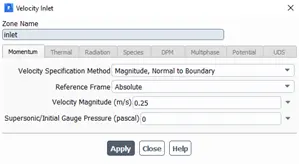
In order to vary the Re number, inlet velocity need to be changed according to the following table:
|
Re number |
Viscosity (kg/m-s) |
Inlet velocity (m/s) |
|
10 |
0.05 |
0.25 |
|
100 |
0.05 |
2.5 |
|
1000 |
0.05 |
25 |
|
10000 |
0.05 |
250 |
|
100000 |
0.0005 |
25 |
To monitor the solution, a monitor point is added and drag and lift coefficients are calculated using the force report.
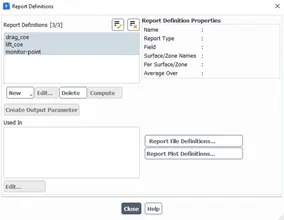
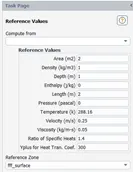
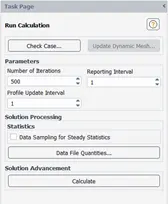
With regards to the initialization method, Hybrid is chosen for the steady-state cases and standard for the unsteady-state case. Moreover, reference values are updated depending on the case that is tested, and the simulation is run for 500 iterations.
- Transient simulation settings
In the transient case, Timestep is 0.1 sec for 1200 iterations and after this, the simulation run for 320 more iterations.
- Results
PART I
Steady State at Re = 100
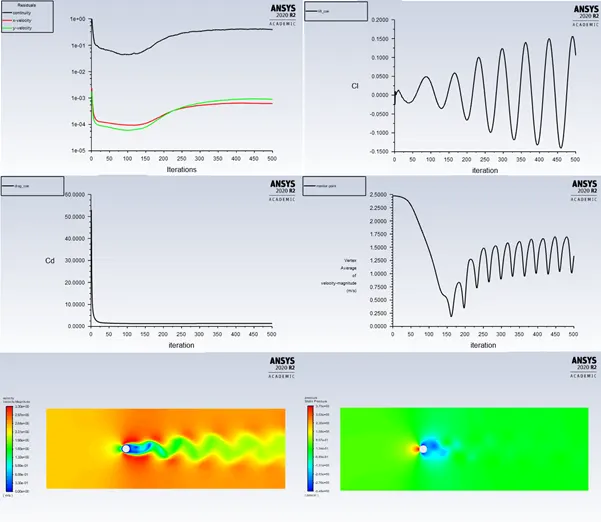
Transient at Re = 100
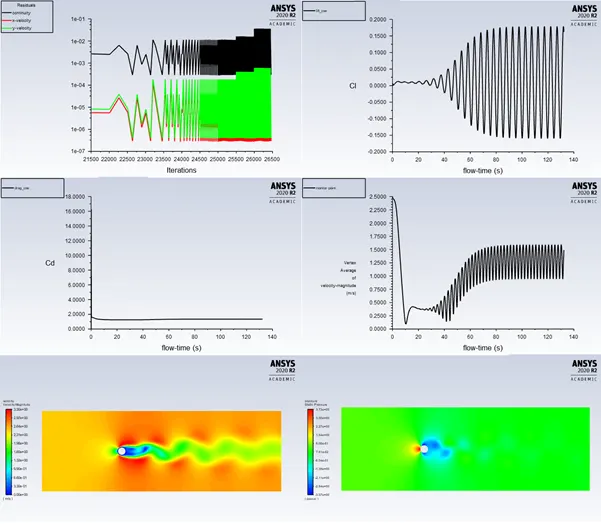
|
Re Number |
Inlet Velocity (m/s) |
Cd |
Cl |
Vertex Average Velocity (m/s) |
|
100 |
2.5 |
1.34 |
0.16 |
1.473 |
Because this is a transient simulation, Strouhal number can be calculated.
St = fL/U
Where f: frequency of the vortex shedding
L: characteristic length
U: flow velocity
f = 5 peaks / 20 sec = 0.25 Hz
St = 0.25*2/2.5 = 0.2
Based on literature on vortex shedding, vortex shedding should be appeared between St = 0.2-0.3, which is the case.
PART II
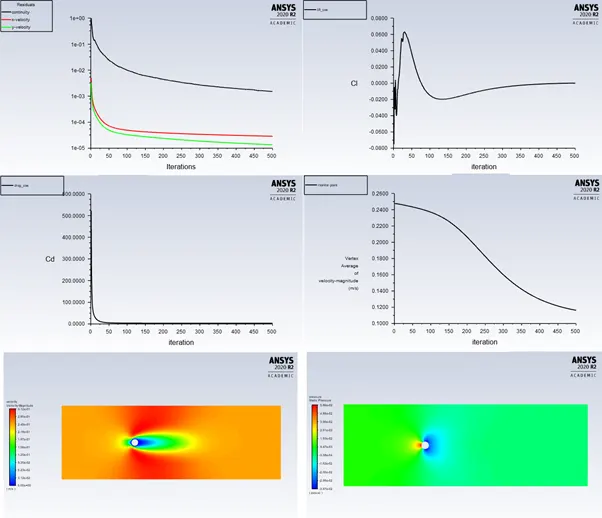
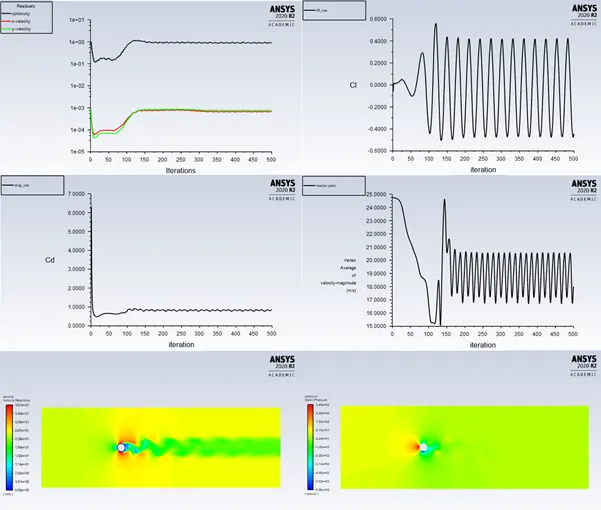
In this section, the steady-state flow results over a cylinder for different Re numbers is presented.
Re: 10
Re: 100
Re: 1000
Re: 10000
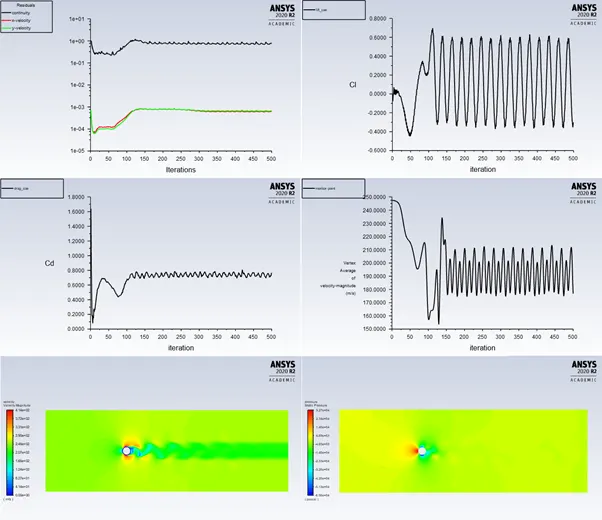
Re: 100000
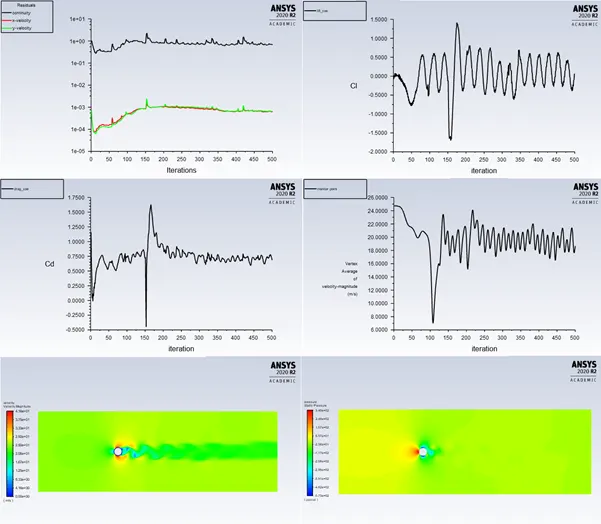
The next table shows the results from the tested cases. We can observe that the higher the Re number, the lower the drag coefficient.
|
Re Number |
Inlet Velocity (m/s) |
Cd |
Cl |
Vertex Average Velocity (m/s) |
|
10 |
0.25 |
3.35 |
9e-05 |
0.1162 |
|
100 |
2.5 |
1.35 |
0.10 |
1.337 |
|
1000 |
25 |
1.11 |
-0.44 |
18.02 |
|
10000 |
250 |
1.05 |
-0.30 |
176.87 |
|
100000 |
25 |
0.94 |
0.05 |
18.658 |
The following table has Cd results from literature, validating the simulated results.
|
Re |
Cd |
|
10 |
3.355 |
|
100 |
1.347 |
|
1000 |
1.193 |
|
10000 |
1.028 |
|
100000 |
0.953 |
|
1000000 |
0.651 |
- Conclusion
The flow field around the cylinder is successfully simulated for all the required cases, steady and transient cases. The stagnation point at the front of the cylinder, the boundary layer over the cylinder surface, the separated flow, the von Karman vortices and their convection can clearly be observed. Strouhal number is 0.2 at Re = 100. The behaviour of Cd coefficient vs Re number has successfully investigated. At Re = 10, no vortex shedding is observed due to low velocity. All the cases are validated against data available in literature.