Section Modulus calculation and optimization
Section Modulus calculation and optimization
Section Modulus:
- SECTION MODULUS is a geometric property for a given cross-
section used in the design of beams or flexural members.
- Other geometric properties used in design include are for
tension and shear, radius of gyration for compression, and
moment of inertia and polar moment of inertia for stiffness.
Any relationship between these properties is highly dependent
on the shape in question.
- There are two types of section modulus, the elastic section
modulus and the plastic section modulus.
The elastic section modulus is defined as S = I / y, where
S = Section Modulus
I = Moment of Inertia
Y = distance between the neutral axis and the extreme and of
the object.
Section Modulus Calculation:
Case 1:
Calculating the section modulus for the hood design.
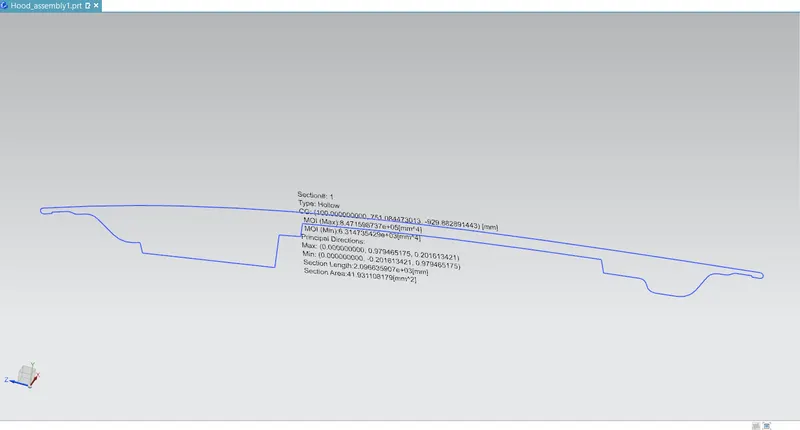
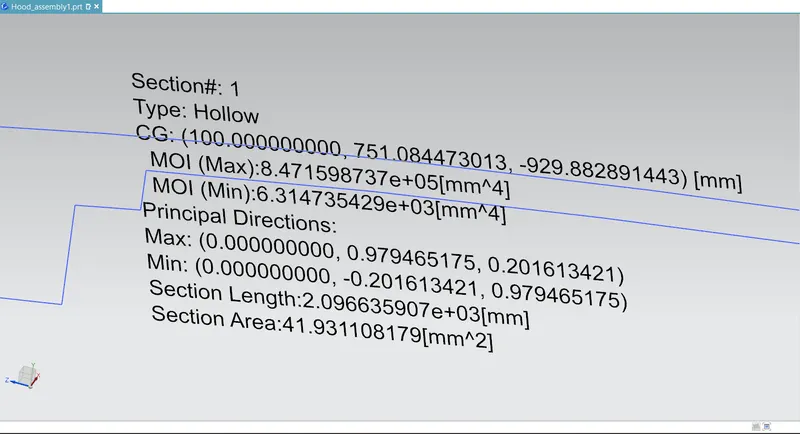
Maximum moment of inertia = 8.471598737e+05[mm^4]
Minimum moment of inertia = 6.314735429e+03[mm^4]
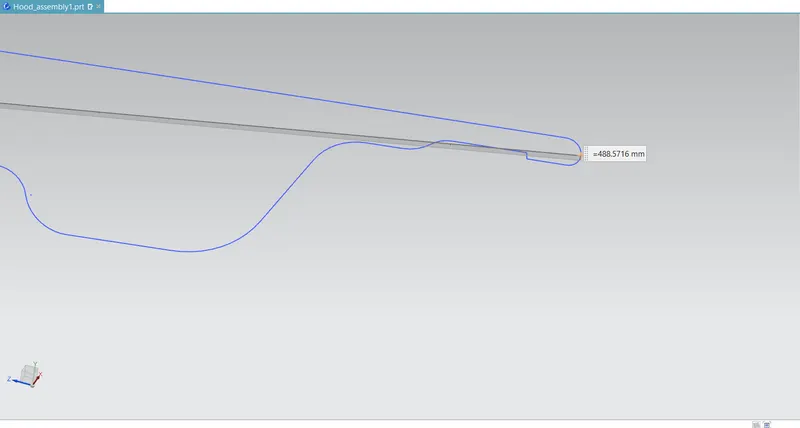
Distance between the neutral axis and the extreme and of
the object. Y = 488.5716 mm
To find section modulus, we have to calculate
S = I[minimum]/Y
S = 6.314735429*10^4/488.5716
S = 12.9248mm^3
Case 2:
Calculating the section modulus by changing the dimensions of
the hood design.
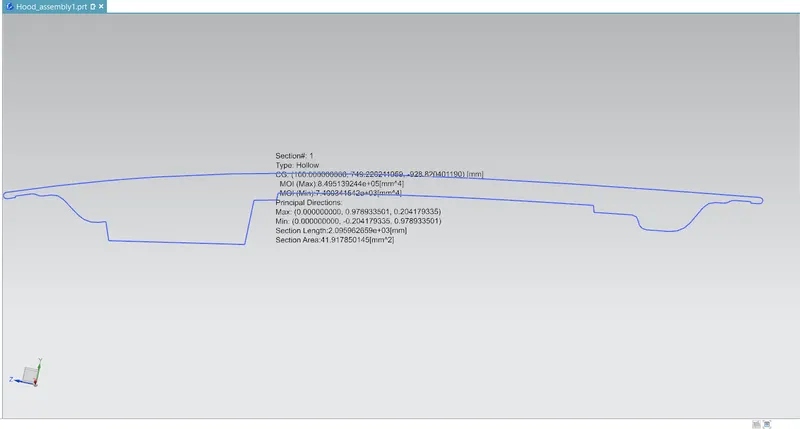
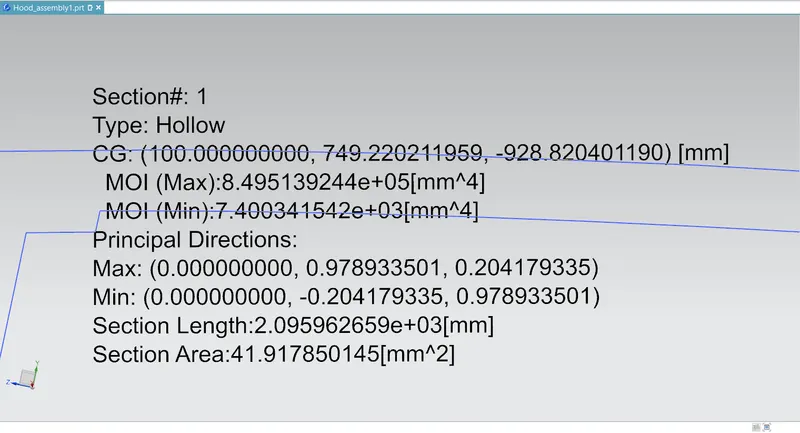
Maximum moment of inertia = 8.495139244e+05[mm^4]
Minimum moment of inertia = 7.400341542e+03[mm^4]
Distance between the neutral axis and the extreme and of
the object. Y = 488.5716 mm
To find section modulus, we have to calculate
S = I[minimum]/Y
S = 7.400341542*10^4/488.5716
S = 15.1468mm^3
Results:
Case 1:
S = 12.9248mm^3
Case 2:
S = 15.1468mm^3
The difference between case 1 and case 2 is the varying
distance between the hood inner panel and outer panel.
So, the moment of inertia has been increased and the strength
of the hood also increased.
Conclusion:
This calculation is necessary to know the design actual
withstand capability of product. As we increase sectional area,
the moment of inertia and section modulus increases it means
capacity of material also increases.