Section Modulus calculation and optimization
Objective:
To study the section modulus of the Hood assembly using NX section interface tools and to optimize the results from the output data of sectional modulus.
Sectional Modulus Definition:
Section Modulus is a geometric property used to calculate the bending stresses in a structural member. Mathematically, It is defined as the ratio of the moment of inertia of a section about its centroidal axis and to the distance of the extreme layer from the neutral axis. It represents the strength of the section.
Greater the value of S, greater will be the strength of the section.
The section modulus depends upon the moment of inertia which again depends not only on the total area of the cross-section but also on the disposition of the area with respect to neutral axis.
It is denoted by S.
S = I/ymax
Where,
I = Moment of Inertia(m⁴)
y = distance from NA to extreme layer(m)
The unit of section modulus is m³.
SECTION MODULUS OF VARIOUS SHAPES:
Square:
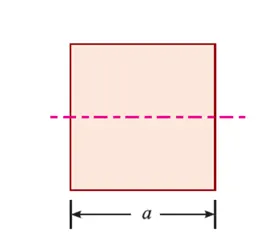
Area, A = a2
Moment of Inertia, IN.A = a4/12
ymax = a/2
Section Modulus, ZN.A = (a4/12)/a/2 = a3/6
Rectangle:
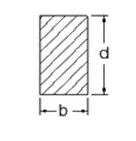
Moment of Inertia at neutral axis, IN.A = bd312
ymax = d2
Section Modulus, ZN.A = IN.Aymax = bd3/12d/2 = bd26
Section modulus study of Hood:
For determining the sectional modulus of the hood, a cut section view is created in (0 , Y) plane and the hood is intersected with that plane which results a intersected curve. The curve we got will be a open section. We have to close the sketch by manual sketch operations. Once the section is created , click on Section inertia settings in the command box and select the curve.
Case 1:
The moment of inertia is found out to be:
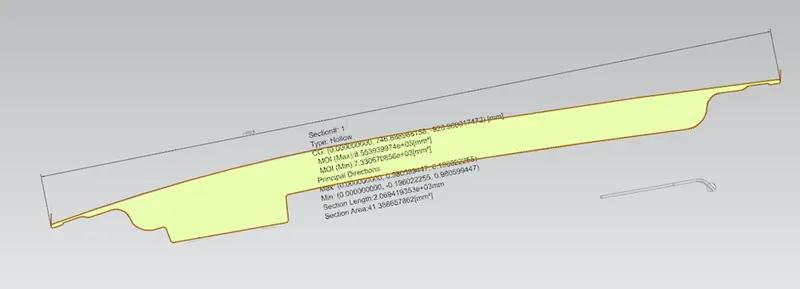
MOI (min) I= 7.33 e+3 mm4
For measuring Y , i.e the distance between the neutral axis to the outermost fibre , two lines are created at either ends and the distance between the lines is found out.
Y= 492.8/2
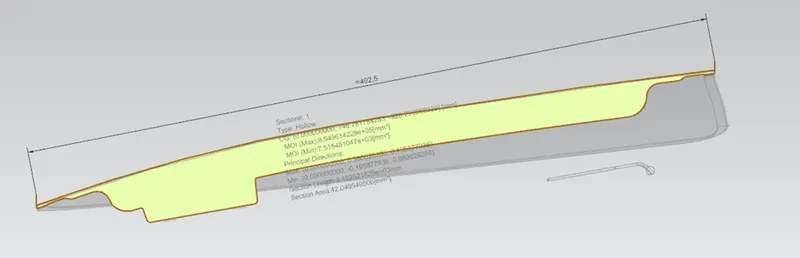
Sectional modulus ( Case 1):
S= I/ y max
S= 0.59mm^3
Case 2 :
To optimize the sectional modulus, the gap between the hood outer and inner panel is increased i.e the inner panel outer edge is offset by 0.3mm and again the sectional modulus is found out.
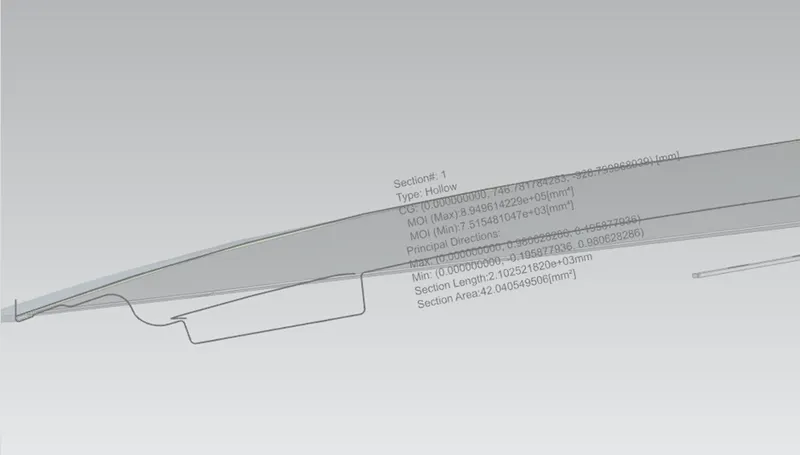
I= 7.51 e^3 mm4
Y= 246.64mm
So, S= 7.51e^3/246.64
S= 0.61mm^3
Conclusion:
It is obvious from the calculations that in the second case the sectional modulus value is higher than the case 1. This is obtained by increasing the area moment of inertia of the hood . in other words, distance between the neutral axis to the outermost fibre is increased which proportionaly increases the strength of the hood.