Section Modulus calculation and optimization
Section Modulus calculation and Optimization
Objective: To calculate the section modulus of the hood design and compare with new section of hood design with necessary changes to increase the strength and to conclude which one has a more strength.
SECTION MODULUS:
Section Modulus is termed as the ratio of the second moment of area and distance from N.A (Neutral axis) to the extreme fiber. Also, it is the measure of the strength of the given member. The stress in the outermost section of the beam is computed with the help of section modulus. It is indicated by S. It is also referred to as the Polar Modulus or the Torsional Sectional Modulus. It is denoted by Zp. It is the geometric property of the given cross-section of any shaft or beam structures.
It is directly related to the area of material in the cross-section and the displacement of that area from the centroid. Once the centroid is located, the more important structural properties of the shape can be calculated. The axis that determines the centroid is also known as the neutral axis (N/A).
The second moment of area is a measure of the 'efficiency' of a shape to resist bending caused by loading. A beam tends to change its shape when loaded. The second moment of area is a measure of a shape's resistance to change.
Importance:
• It is significant for beam and flexural member design.
• More the section modulus, the more the member is resistant to the bending of the beam.
• It is easier to calculate stresses in the beam and an exact measure of the strength of steel.
• If two beams are made of the same material and comparing the “section modulus” of two beams, the beam with bigger section modulus will be tougher and more capable to withstand larger loads
Use the formula: where b = breadth (width) and d = depth (height) to calculate the moment of inertia about the x-x axis for beams A and B using information from the diagram.


 ,
,





Steps to calculate section modulus:-
- Step 1:- Find location of centroid of given cross section.
- Step 2:- Find moment of inertia about neutral axis (I)
- Step 3:- Find Ymax from neutral axis.
- Step 4:- Find elastic section modulus using the formula
S = I/y
where,
S - Section modulus
I - Moment of Inertia
y - Distance from the neutral axis to the most extreme end of the object
Section Modulus Analysis:
CASE 1 :
Taking an intersection of the designed car hood outer panel and the inner panel
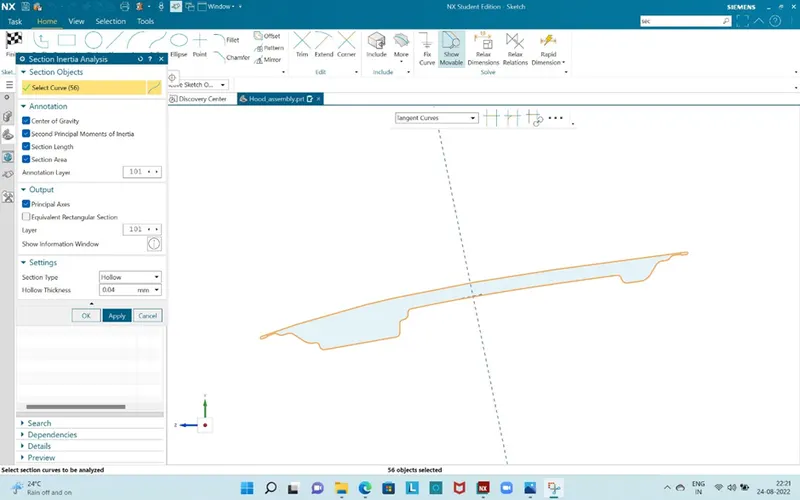
Distance from extreme ends of section
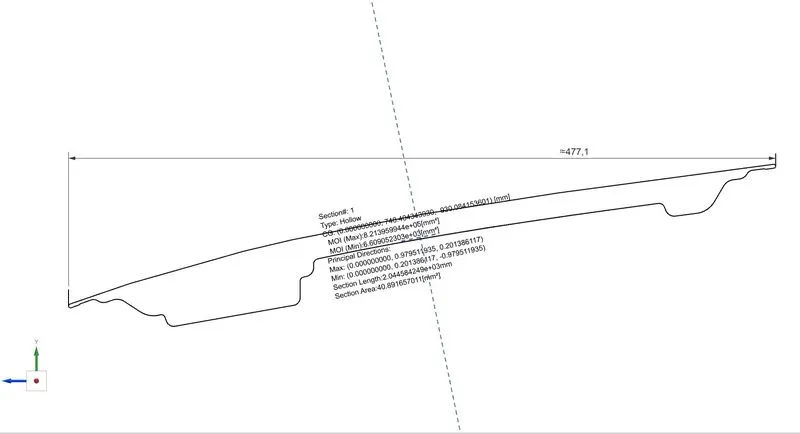
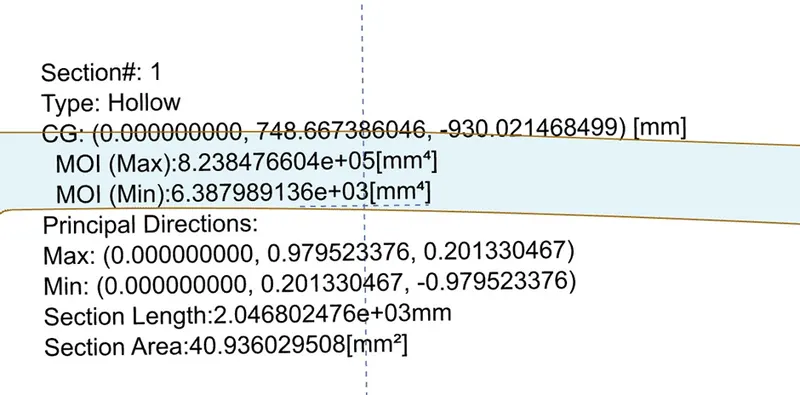
Initial section iteration
MOI (Min) = 6.387989136e+03 [mm4]
MOI (Max) = 8.238476604e+05 [mm4]
ymax= 477.1 / 2 = 238.55
S = I/y
MOI (min) considered;
S = 6.387989136e+03 mm4 / 238.55 mm
S = 26.77 mm3
Case 2:
changes for initial case
Offset distance: 0.5 mm
Offset part: hood inner panel to outside direction.
action: Increased the gap between Hood Outer panel and Hood inner panel by offsetting Hood inner panel 0.5mm outside to increase the cross sectional area.
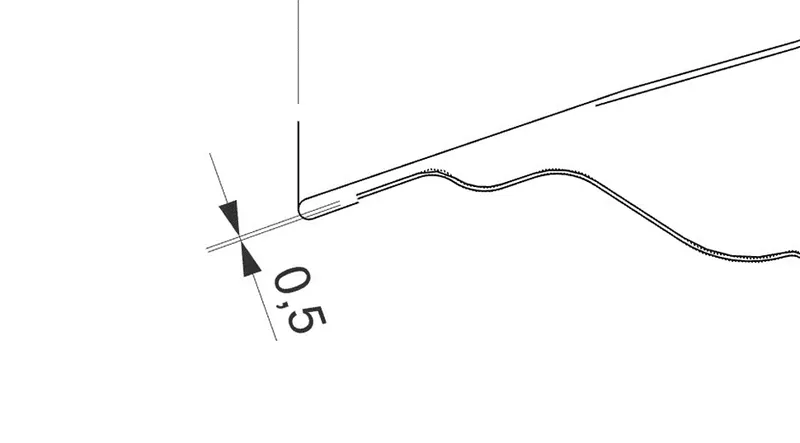
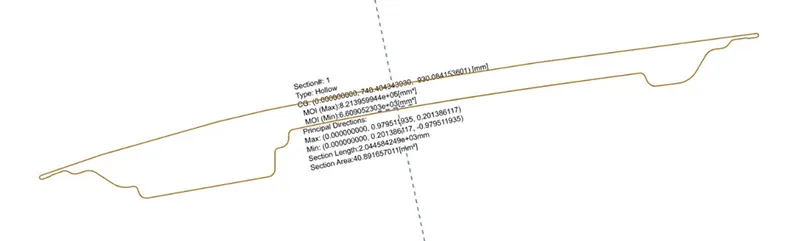
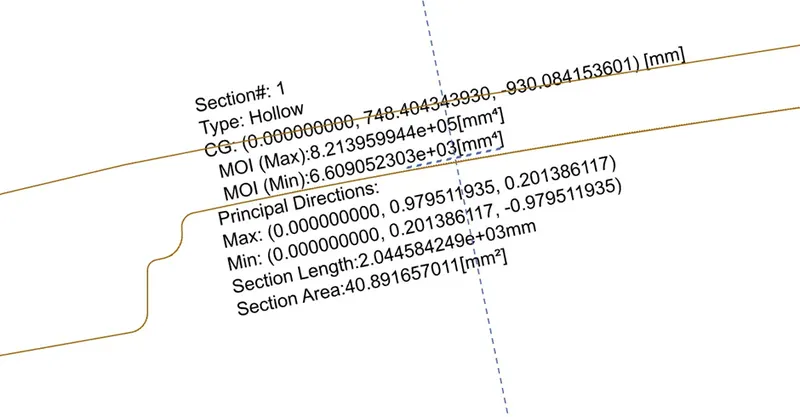
case 2:
MOI (Max) = 8.213959944e+05 [mm4]
MOI (Min) = 6.609052303+03 [mm4]
ymax= 477.1 / 2 = 238.55
S = I/y
MOI (min) considered;
S = 6.609052303e+03 mm4 / 238.55 mm
S = 27.70 mm3
Optimization Result:
By increasing the gap between Hood outer panel & inner panel 0.5 mm, we increased the area of section, thus we improved the Section Modulus to increase the strength.
Conclusion:
Resulting by comparing case 1 & case 2,
- The section modulus value of case 2 is higher than the case 1
- As we increased the section area, the moment of inertia & section modulus increases which means strength and load material also increase. Which the moment of inertia directly proportional to the strength of the material.