Section Modulus calculation and optimization
SECTION MODULUS:
- It is a geometric property for a given cross section used in the design of beams or flexural members.
- The unit of section modulus is mm^3.
- There are two types of section moduli. They are
a) elastic section modulus (S):
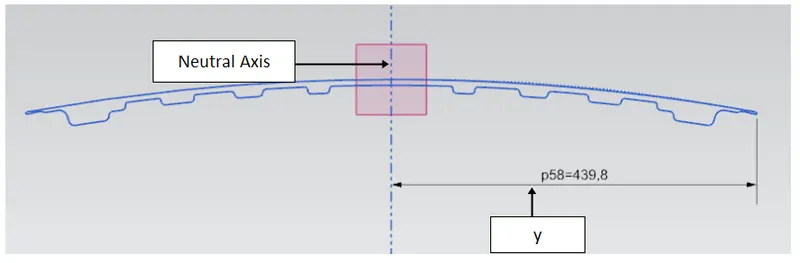
- It is defined as S=I/y, wherein I is the second moment of area (or moment of inertia) and y is the distance from the neutral axis to any given fiber. The y is often consider as y = c, where c is the distance from the neutral axis to the most extreme fiber.
- It is also often used to determine the yield moment (My = S x `sigma`y) where 'sigma' y is the yield strength of the material.
b) plastic section modulus (Z).
- It is used for materials where (irreversible) plastic behavior is dominant. The majority of designs do not intentionally encounter this behavior.
- The plastic section modulus depends on the location of the plastic neutral axis (PNA).
- The plastic section modulus is then the sum of the areas of the cross section on each side of the PNA (which may or may not be equal) multiplied by the distance from the local centroids of the two areas to the PNA.
CASE STUDY :
CASE 1:
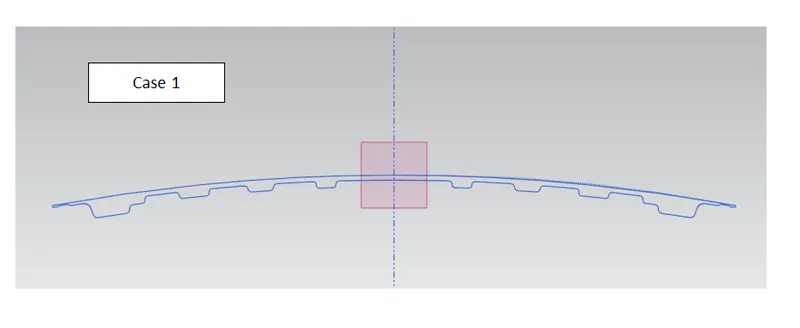
Moment of Inertia (MOI 1) :
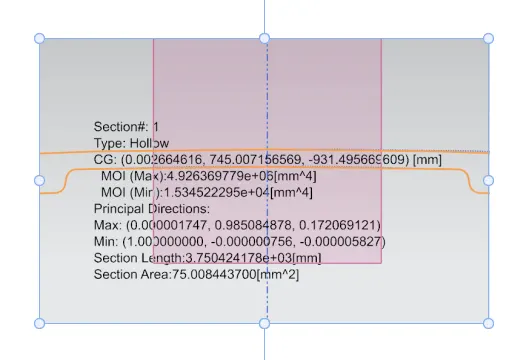
The moment of inertia (Minimum) is considered for determining section modulus. The minimum moment of inertia is considered with respect to factor of safety. The Moment of inertia (MOI 1)is 1.534 x 10^4 mm^4.
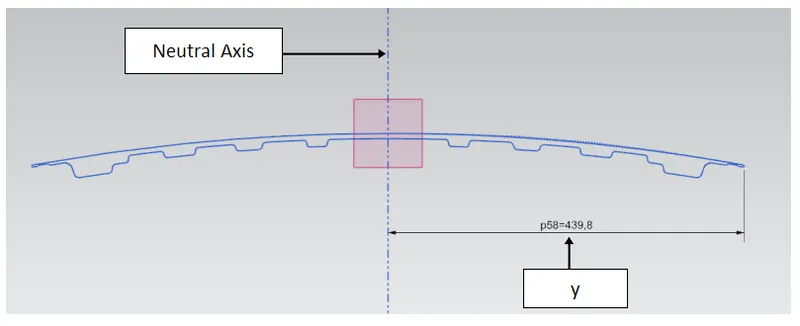
Distance From Neutral axis to the most extreme fiber (y):
CASE 2:
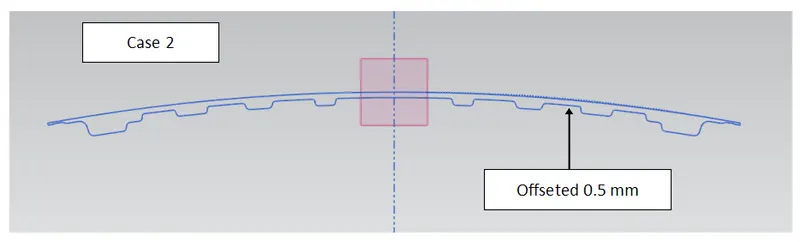
Moment of Inertia (MOI 2) :
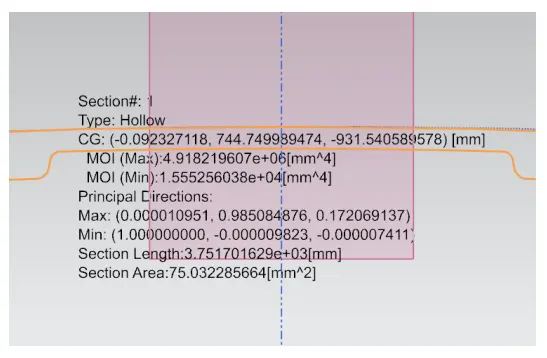
The moment of inertia (Minimum) is considered for determining section modulus. The minimum moment of inertia is considered with respect to factor of safety. The Moment of inertia (MOI 2) is 1.555 x 10^4 mm^4.
Distance From Neutral axis to the most extreme fiber (y):
Tabulation :
| S.No | CASE | MOI (I minimum) (mm^4) | Y (mm) | Section modulus (S)(mm^3) |
| 1 | CASE 1 | 1.534 x 10^4 | 439.8 | 34.879 |
| 2 | CASE 2 (offested 0.5 mm) | 1.555 x 10^4 | 439.8 |
35.356 |
S = I/ y
S = Section modulus
I = Minimum Moment of Inertia
y = distance between the neutral axis and the extreme end of the object
Conclusion :
- The section modulus for following Case 1 & Case 2 is calculated.
- In case 2 the lower panel curve was offested to a distance of 0.5 mm. There is increase in value of section modulus (S) in Case 2 by a value of 0.477.
- Thereforethe increase in value of section modulus shows that Case 2 has better capability to withstand the load than Case 1.
- Thus a new section that has an improved Section Modulus was achieved.