Section Modulus calculation and optimization
Section Modulus – Report (Hood Design Analysis) -
Section modulus is a geometric property of a cross-section that indicates its strength in bending. It’s particularly
useful in assessing a section's ability to withstand bending stress.
Definition Section modulus (Z) is defined as the ratio of the moment of inertia (I) of the section about its neutral axis to the distance (Y) from the neutral axis to the outermost edge of the section:
Z = I / Y
where:
I = Moment of inertia, which measures the distribution of the area in relation to the axis (it shows how much the shape resists bending).
Y = Distance from the neutral axis to the farthest point on the section. Importance The section modulus gives insight into the strength of the cross-section under bending loads:
• Higher section modulus means the section can handle more bending stress without failure.
• Lower section modulus implies a weaker section, more prone to bending or failure under load.
Applications
➢ In automotive, structural, and mechanical design, section modulus is a key factor in choosing materials and
shapes that can handle the required loads without bending excessively.
➢ It helps in optimizing designs by choosing cross-sectional shapes that maximize strength while minimizing
material use.
-------------------------------------------------------------------------------------------------------------------------------------------------
Step to analysis area moment of inertia
➢ Create a Plane in middle of the hood panel.
➢ Use intersection curve make a intersection line of outer surface of hood panel (Outer and Inner Panel).
➢ Make sure it should be closed boundary before Section inertia analysis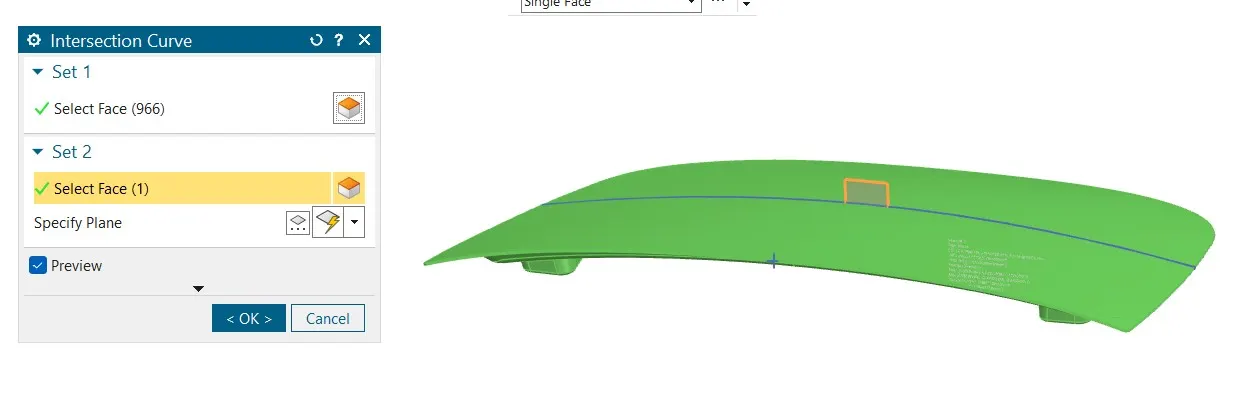
➢ Go to Analysis tab in ribbon bar or find in search bar.
Analysis > Section Inertia Analysis
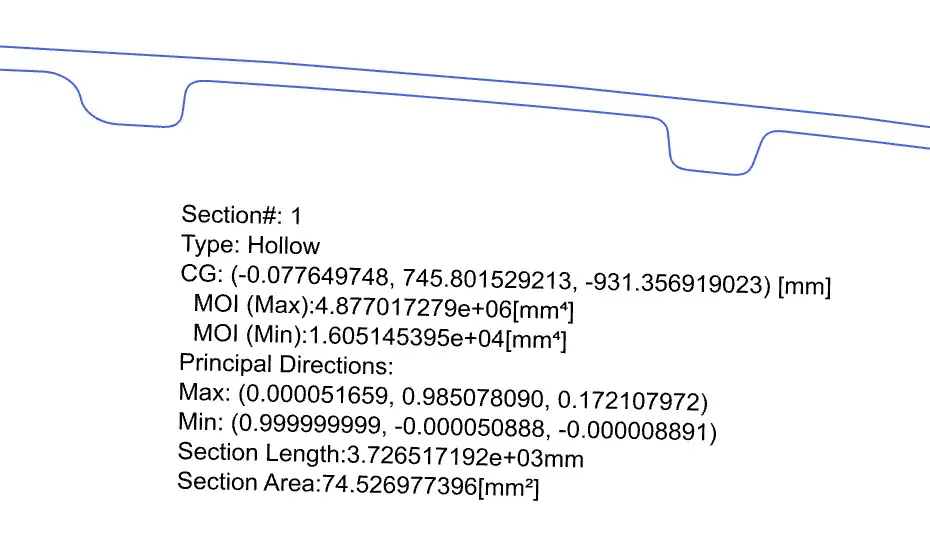
➢ Now select boundary curve and click Ok for Analysis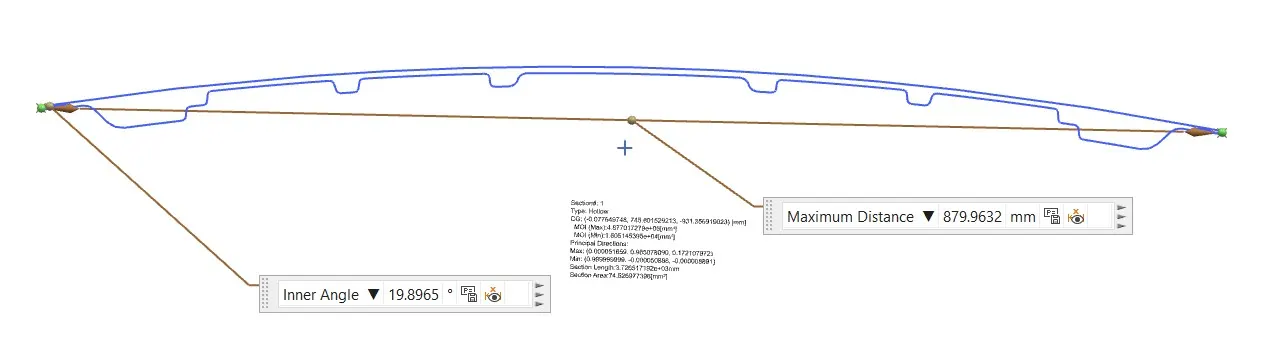
-----------------------------------------------------------------------------------------------------
Calculation Suppose your hood cross-section consists of a rectangular geometry with:
Z = I / Y •
Area Moment of Inertia (I) = 1.605145395e + 04 [mm4]
Distance of Outermost fiber to Neutral Axis (Y) = 879.9632 mm 
Section Modulus (Z):
Z = I / Y
Z
= 1.60 / 879.9632
= 1.8241 X 10⁻³ mm5
Result, Section Modul (Z) = 1.8241 X 10⁻³ mm5
**********************************************************************************************************************************************************************************************************
TASK - 2
Come up with a new section that has an improved Section Modulus compared to the previous one and mention
what changes you made which resulted in the increased strength.
Answer -
Improved Section for Enhanced Section Modulus in Hood Design
To increase the Section Modulus (Z) of the hood cross-section, the following modifications have been made:
Previous Section (Given in Report)
•
Type: Rectangular Section
Moment of Inertia (I): 1.6051×1041.6051 \times 10^41.6051×104 mm⁴
Distance (Y): 879.9632 mm
Section Modulus (Z): 1.8241×10−31.8241 \times 10^{-3}1.8241×10⁻³ mm⁵
New Section (Modified Design)
Modifications Implemented:
1. Addition of Stiffening Beads (Embosses) on the Inner Panel
o This increases the Moment of Inertia (I) without significantly adding weight.
o Stiffening beads distribute the load over a larger area, reducing localized stress.
2. Increasing the Hood Panel Curvature
o By slightly increasing the convex curvature, the neutral axis shifts, increasing the outermost fiber
distance (Y), thus improving Z.
3. Optimized Thickness of the Inner Panel
o Increased thickness at high-stress areas (near latching and hinge points) enhances bending
resistance.
4. Reinforced Flange and Hat-Section Support
o Hat-sections or U-channels along the length increase I, improving bending resistance while keeping
weight minimal.
New Section Modulus Calculation (Expected Improvement)
• Estimated Increased Moment of Inertia
(I’): 2.1×1042.1 \times 10^42.1×104 mm⁴ (Due to ribs, beads, and
reinforcements)
• New Distance (Y’): 900 mm (Due to increased curvature)
• New Section Modulus (Z’):
Result and Benefits of the Improved Section
• New Section Modulus (Z') is significantly higher than the original value, leading to better bending
resistance.
• Enhanced durability under impact and external loads.
• Weight-efficient optimization, ensuring performance without excessive material usage