Section Modulus calculation and optimization
AIM:
Section modulus calculation and optimization
OBJECTIVE:
Use section of the Hood and calculate the section modulus. Vary the section in such a way that new section is an improved version of the previous section.
THEORY:
Section modulus is to find the geometric property for a given cross - section used in the design. Calculate the section modulus using
the formula
S = I / S = Section modulus
I = Moment of Inertia
Y = Distance between neutral axis and the extreme end of the object
SECTION MODULUS OF AN HOOD:
- Section modulus is a direct measure of strength of any sectional area of an object about an reference axis ( neutral axis ) . Strength is nothing but , capable of supporting greater loads , so higher the strength it has a high capable of supporting greater loads .
- This strength can measured directly from Section modulus formula , and defined by below formula .
- Section modulus represented with a symbol of ' S. S = I / Y where ' I'moment of inertia ' Y ' is the distance from the reference line ( neutral axis ) to one of the extreme end of an object .
- Moment of inertia is nothing but offering resistance against of moment , bending or twisting , i.e if we applied any external load on the body , how much resistance its offering to tend to deform .
- So , higher the value of moment of inertia , have higher resistance to deform under certain load , hence we can say that moment of inertia directly proportional to the strength of the material , and strength of the material can be calculated with the help of section modulus . If we vary the neutral axis towards positive or negative side the overall strength of the body will decrease . because when nuetral axis line lies on the middle of the section only have higher strength at particular point , so , here'Y ' value was inversely proportional to section modulus .
- Thats why formula represented as above . By using the same principle i going to calculate the strength of an hood panel.
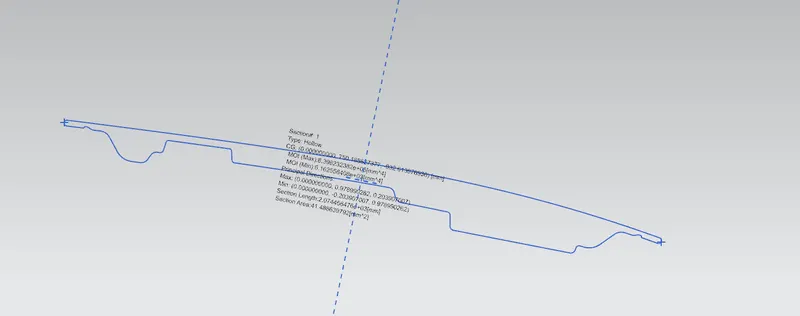
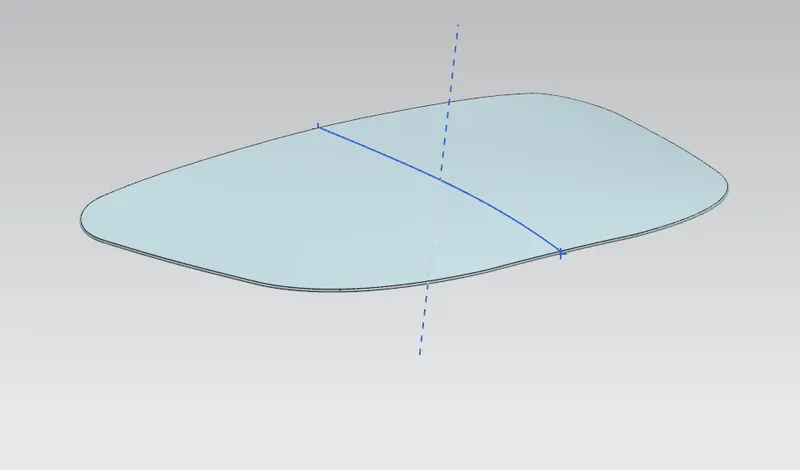
- For studying the section modulus we need the cross section of hood. For that I created a cross section using intersection curve.
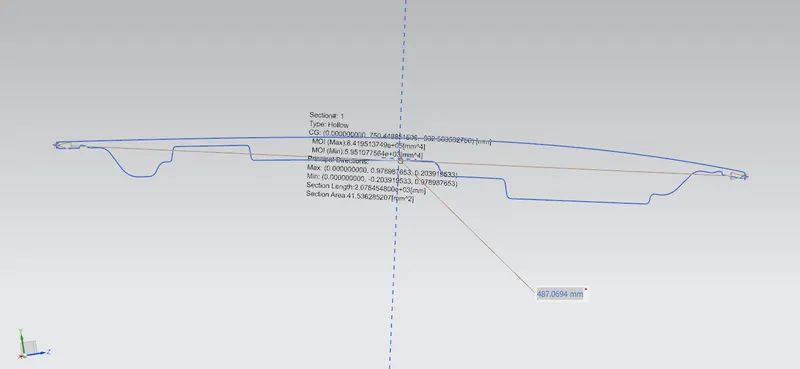
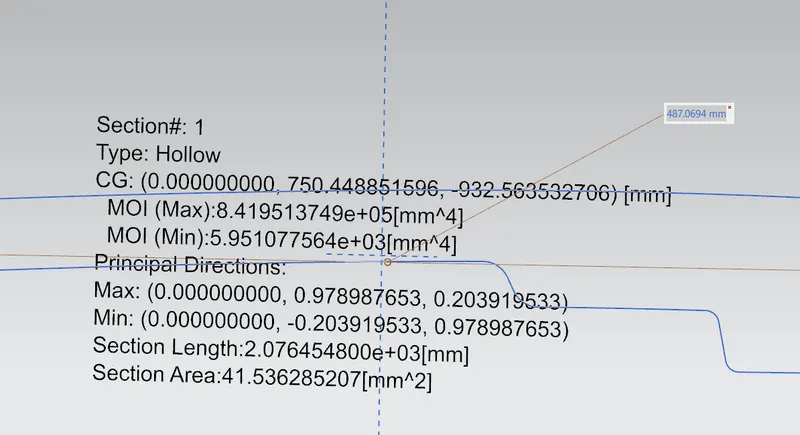
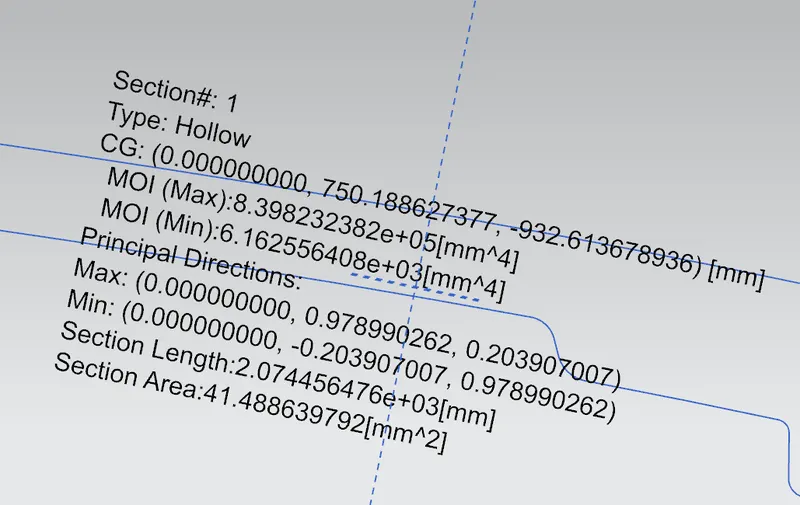
Here the moment of inertia was calculated by using the NX - software obtained values are
Imax: 8.4195xe^5mm^4
Imin: 5.9510xe^3mm^4
Total length of 'Y' value was 487.0694mm
So, at neutral axis we need 'Y' value: -Y / 2 = 487.0694 / 2 = 243.5347mm
1) Section modulus (S): - 1 / Y = 8.4195xe^5mm^4 / 243.5347mm = 3.457xe^3mm^3 (Maximum strength).
2) Section modulus (S): - 1 / Y = 5.9510xe^3mm^4 / 243.5347mm =1.303xe^1mm^3 (minimum strength).
So the strength of an hood varies from 1.303xe^1mm^3 to 3.457xe^3mm^3
Now, one more trail is that, here the inner panel curve offsetting outside by 0.5 mm i.e increasing in cross sectional area, the results shown below.