Section Modulus calculation and optimization
AIM
To calculate and compare a section modulus value of hood of car
SECTION MODULUS
Section modulus (S) is a geometric property for a given cross-section used in the design of beams or flexural members.
The section modulus of the cross-sectional shape is of significant importance in designing beams. It is a direct measure of the strength of the beam. A beam that has a larger section modulus than another will be stronger and capable of supporting greater loads.
It is known that the stress in a fibre is proportional to its distance from the neutral axis. If y is the distance of the extreme fibre from neutral axis then. Here, S represents Section modulus or Modulus of section, i.e., S = I / y.
Theory:
The ratio of Area Moment of Inertia to the Distance from the Neutral Axis to the Point where the Bending Normal Stress is determined.
Section modulus (S) = I/Y
S=section moduls
I=moment of inertia
Y=distance from neutral axis to the extreme fiber
A beam that has a larger section modulus than another will be stronger and capable of supporting greater loads, it is denoted by S.
Instance 1
The distance between the inner panel and outer panel is 2.5mm
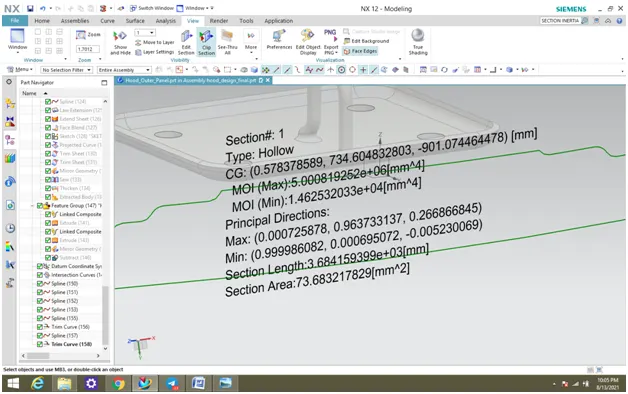
INPUT VALUES:
I=5.000819252x10^6mm^4
Y=440.6mm
S=I/Y
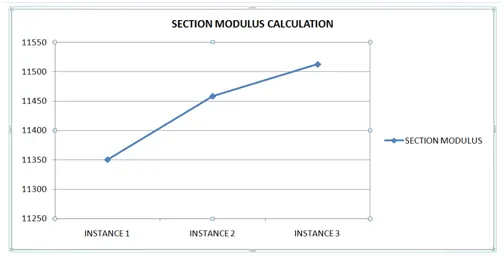
S=11350.021mm^3
Instance 2
The distance between the inner panel and outer panel is 3.5mm
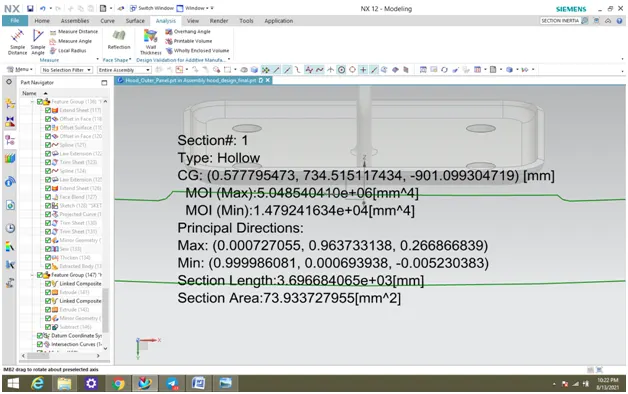
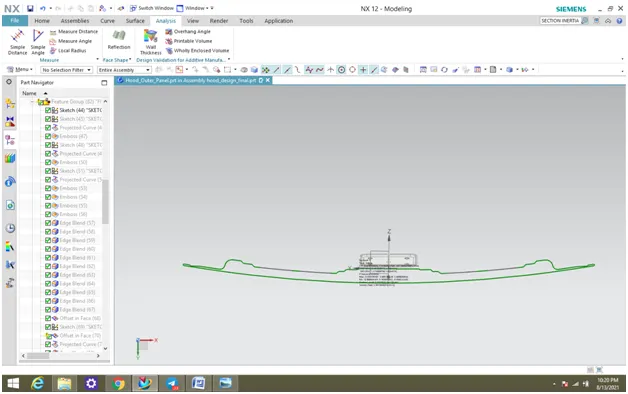
INPUT VALUES:
I=5.048540410x10^6mm^4
Y=440.6mm
S=I/Y
S=11458.3305mm^3
Instance 3
The distance between the inner panel and outer panel is 4.5mm
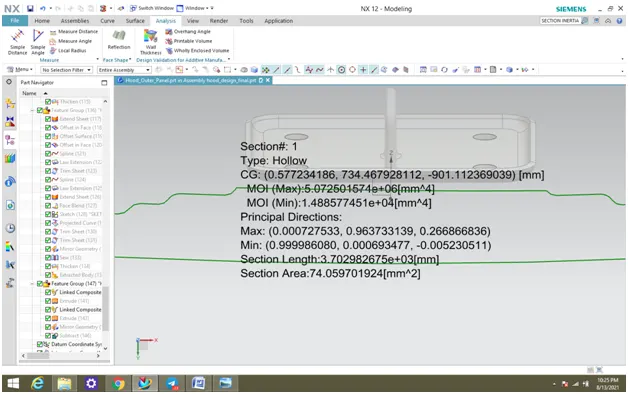
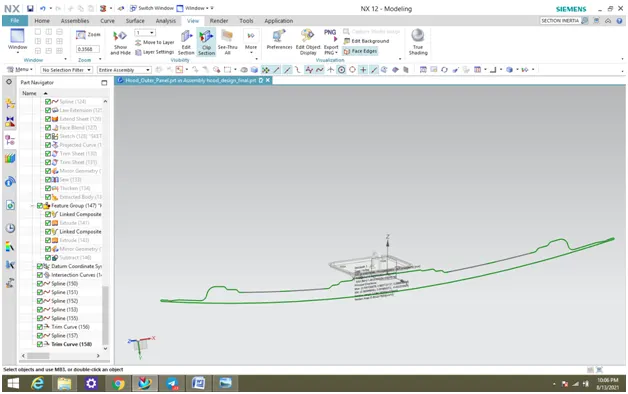
INPUT VALUES:
I=5.07250157x10^6mm^4
Y=440.6mm
S=I/Y
S=11512.7135mm^3
CHART
CONCLUSION
If the distance between the inner panel and outer panel is increases then the section modulus is also increases. A hood that has a larger section modulus than another will be stronger and capable of supporting greater loads.