Section Modulus calculation and optimization
SECTION MODULUS OF THE HOOD
Objective:
To find the section modulus of the hood and optimization to improve the overall section modulus.
Section Modulus:
The section modulus (S) is geometric property of the cross section used for designing beams and flexural members. It does not represent anything physically.
The section modulus of a hood is a geometric property that represents its resistance to bending. It is calculated by dividing the moment of inertia of the hood's cross-section by the distance from the neutral axis to the extreme fiber of the hood.
The moment of inertia is a measure of how the mass of the hood is distributed around the neutral axis. The neutral axis is the line that passes through the centroid of the hood's cross-section and is perpendicular to the axis of bending. The extreme fiber is the fiber of the hood that is farthest from the neutral axis.
The section modulus is an important parameter in the design of car hoods. It is used to ensure that the hood is strong enough to withstand the loads that it will be subjected to during normal operation, such as the weight of the engine and the impact of wind and road debris. It is also used to ensure that the hood is stiff enough to maintain its shape and protect the occupants of the vehicle in the event of a collision.
There are a number of factors that can affect the section modulus of a hood, including the material of the hood, the thickness of the hood, and the shape of the hood's cross-section. In general, hoods made of stronger materials, such as carbon fiber or aluminum, will have a higher section modulus than hoods made of weaker materials, such as steel or plastic. Additionally, hoods with a thicker cross-section will have a higher section modulus than hoods with a thinner cross-section. Finally, hoods with a more streamlined cross-section will have a higher section modulus than hoods with a more boxy cross-section.
Here are some examples of how the section modulus of a hood can be improved:
- Using a stronger material, such as carbon fiber or aluminum.
- Increasing the thickness of the hood.
- Changing the shape of the hood's cross-section to a more streamlined shape.
- Adding stiffeners to the hood.
Improving the section modulus of a hood can make it stronger, stiffer, and more resistant to bending. This can make the hood more resistant to damage in the event of a collision and can also improve the handling and performance of the vehicle.
Formula of Section Modulus: It may be defined as the ration of total moment resisted by the section to the stress in the extreme fibre which is equal to yield stress.
There fore
S = I/Y, Where
S = Section modulus (mm^3)
I = Moment of Inertia of the section about the bending axis. (mm^4)
Y = Distance between the neutral axis and extreme end of the object (mm)
Area moment of Inertia:
The area moment of inertia of a beams cross sectional area measures the beam ability to resist bending. The larger the moment of inertia less will be the bend.
Where
M = Bending moment
I = Area moment of Inertia
E = Youngs modulus
R = Radius of gyration
Neutral axis:
When beam is subjected to pure bending the top most fibres of the beam are subjected to maximum compression, while the bottom most fibres of the beams are subjected to maximum tension.
Material Data: Stainless steel AISI 302 – cold rolled
Where yield strength of stainless steel is 520MPa = 520 N/mm^2
Calculation:
CASE 1: Before Optimization
The Hood which was already created is imported and the section inertia analysis is done.
We have to make sure that the curve obtained is a single/closed curve.
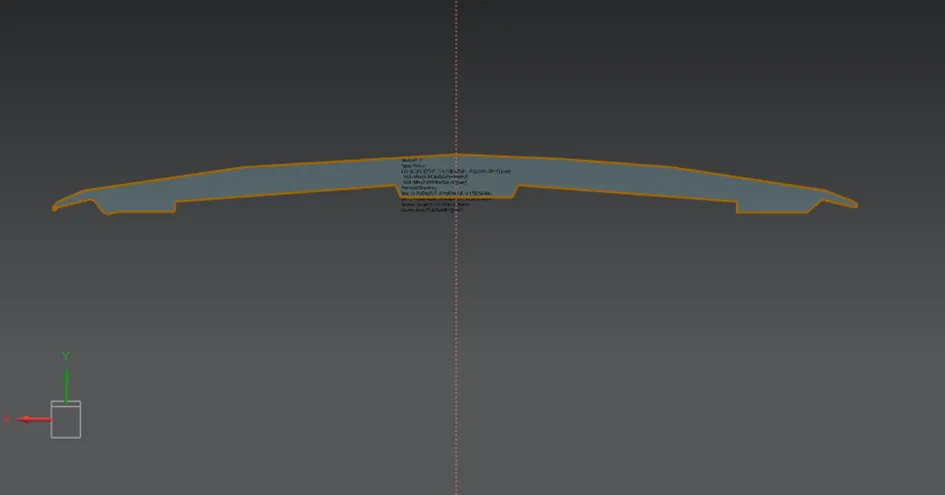
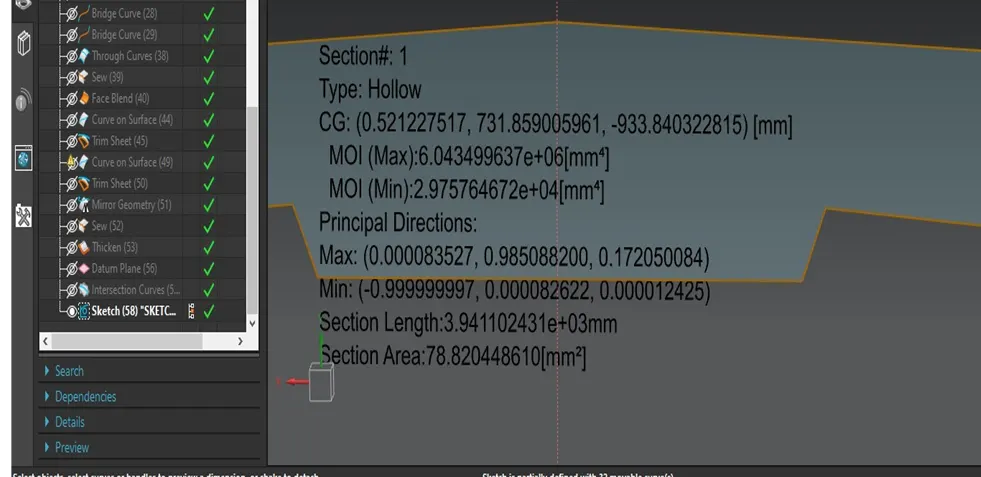
MOI (max) = 6.043499637e+06 (mm^4)
MOI (min) = 2.975764672e+04 (mm^4)
As per the section modulus equation,
S = I/Y
I = MOI (min) value is considered
Y = Total distance /2, Total distance =944mm
Y = 944/ 2
= 472 mm
Therefore, S = 2.975764672e+04 (mm^4) / 472mm
S = 630.459 mm^3
CASE 2: After optimization
The hood inner panel’s curve is offset by 0.5mm outwards and section inertia analysis is done same as case 1 for a closed curve.
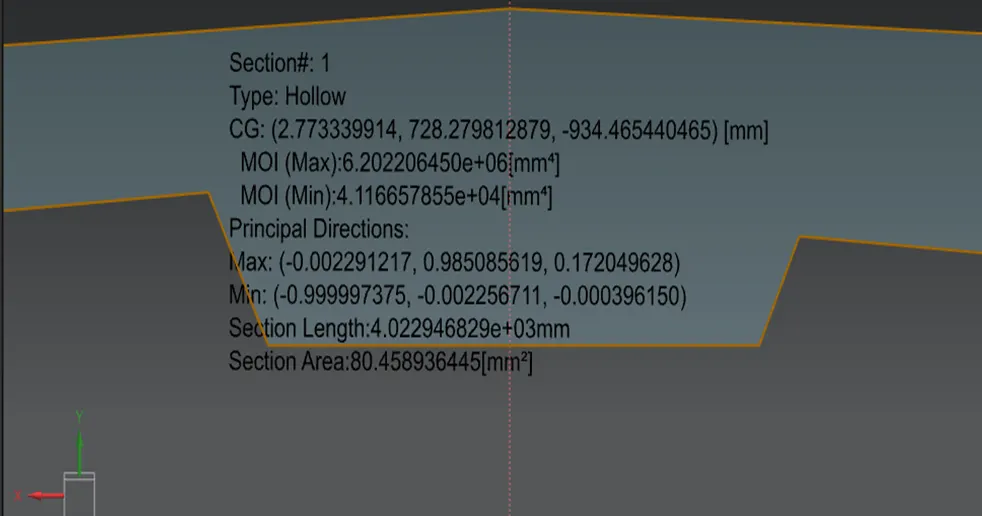
MOI (max) = 6.202206450e^06 mm^4
MOI (min) = 4.116657855e^04 mm^4
As per section modulus equation,
S = I / Y
I = MOI (min) value is considered
Y = Total distance /2, Total distance =944mm
Y = 944/ 2
= 472 mm
Therefore, S = 4.116657855e^04 mm^4 / 472 mm
S = 872.175 mm^3
Conclusion:
Hence when comparing case 1 & case 2,
1. The section modulus value of case 2 is higher than the case 1
2. As we increase the section area, the moment of inertia & section modulus increases which means strength and load material also increase
The section modulus of a hood is a measure of its resistance to bending. It is calculated by dividing the moment of inertia of the hood cross-section by the distance from the neutral axis to the extreme fiber of the hood. A higher section modulus indicates a stronger hood that is better able to withstand bending loads.
The section modulus of a hood is an important factor in its design, as it affects its ability to protect occupants in the event of a collision. A hood with a higher section modulus will be less likely to deform and will provide more protection to the occupants.
Here are some conclusions that can be drawn about the section modulus of a hood:
- A higher section modulus indicates a stronger hood that is better able to withstand bending loads.
- The section modulus of a hood is an important factor in its design, as it affects its ability to protect occupants in the event of a collision.
- A hood with a higher section modulus will be less likely to deform and will provide more protection to the occupants.
To improve the section modulus of a hood, the following can be done:
- Increase the thickness of the hood material.
- Add stiffeners to the hood.
- Use a stronger material for the hood.