Section Modulus calculation and optimization
AIM:
To measure a Section Modulus calculation and optimization.
PROCEDURE:
Neutral Axis:
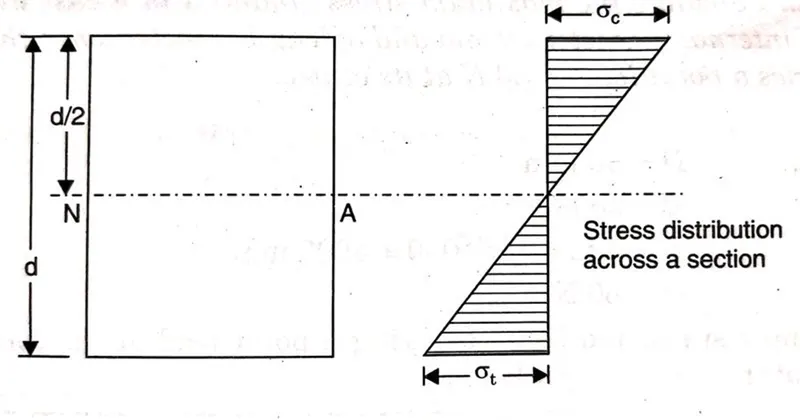
The centremost layer of any section of a component is called the Neutral axis.
Neutral Axis doesn't get affected by any kind of load that is perpendicular to it which means there is no stress or strain on the neutral axis.
The range of stress varies with respect to the distance from the neutral axis.
The below figure shows the Neutral axis (dotted line) and in the Load situation the stress on either side of the neutral axis.
SECTION MODULUS:
Section modulus is defined as the ratio of the moment of inertia of a section about the neutral axis to the distance of the outermost layer from the neutral axis. It is denoted by the symbol S. Hence mathematically section modulus is given by,
S=I/Y-max
I=Moment of Inertia about the neutral axis and
Y-max = Distance of the outermost layer from the neutral axis.
we know Max Bending Moment(M)/ moment of inertia(I) = Stress(σ)/strain(Y)
The stress σ will be maximum when y is maximum. Hence above equation can be written as
M/ I = (σ-max)/(Y-max)
M= σ max*(I/Y-max)
But
I/(Y-max) =Z
M = σ max * Z
In the above equation, M is the maximum bending moment (or moment of resistance offered by the section). Hence moment of resistance offered by the section is maximum when section modulus Z is maximum. Hence section modulus represents the strength of the section.
Area - Area is directly proportional to section modulus.
Thickness of sheet metal- Thickness is also directly proportional to the section modulus.
The distance between the outermost layer to the neutral axis called Y. Y is inversely proportional to section modulus.
Cross-sectional depth of the component - It is directly proportional to the sectional modulus.
Increasing the area by offsetting the outermost layer.
At Zero Offset:
Select the Part body on which we must do analysis and create a cross-section of the part and make sure that the cross-section sketch is a closed profile.
Perform Section Inertia Analysis over the section that we have created.
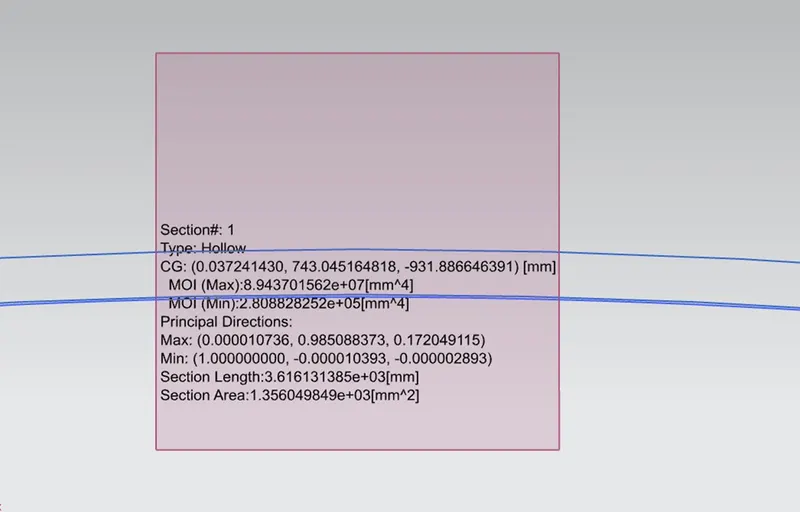
The Distance we got here is 878/2=439mm
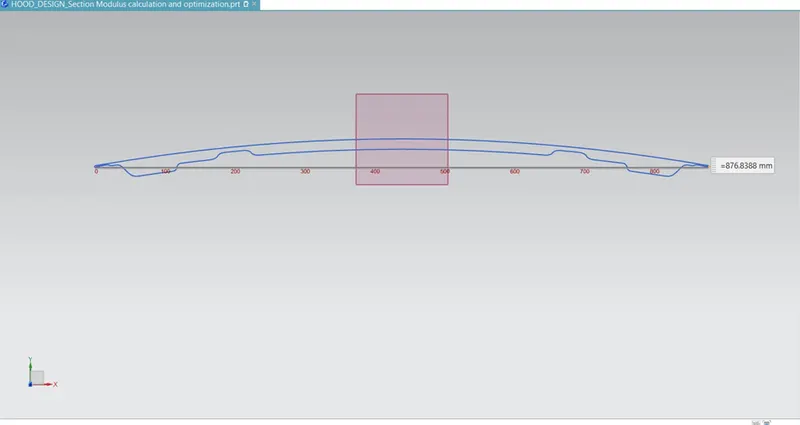
According to the formula for section modulus
S = I/Y
Were,
S = Section Modulus
I = Moment of Inertia
y = distance between the neutral axis and the extreme end of the object
MOI min/Y = (2.808828252x10^5)/439 = 639.824203189mm^3
MOI max/Y = (8.943701562x10^7)/439 = 203728.964966mm^3
Section Modulus at MOI min = 639.824203189mm^3
Section Modulus at MOI max = 203728.964966mm^3
At 0.5 Offset:
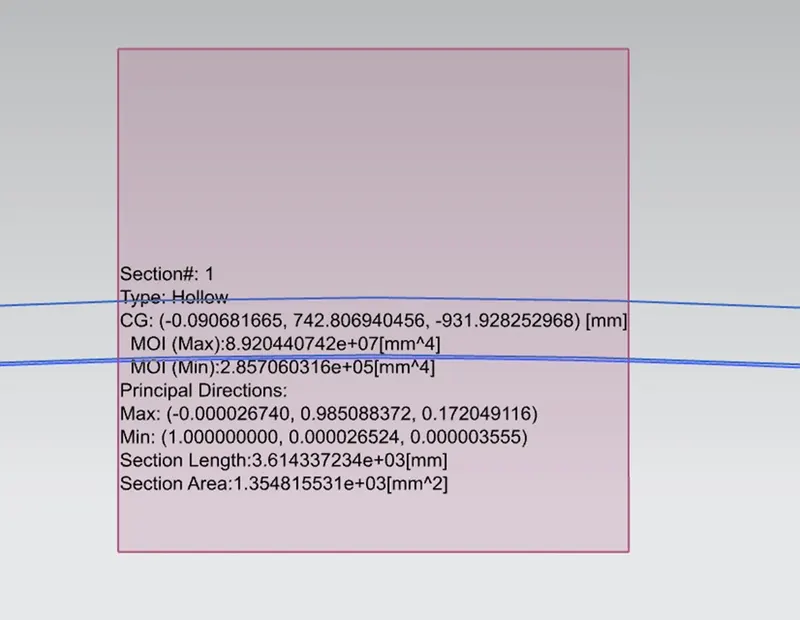
MOI min/Y = (2.857060316x10^5)/439 = 650.811005923 mm^3
MOI max/Y = (8.920440742x10^7)/439 = 203199.10574mm^3
Section Modulus at MOI min = 650.811005923 mm^3
Section Modulus at MOI max = 203199.10574mm^3
At 0.8 Offset:
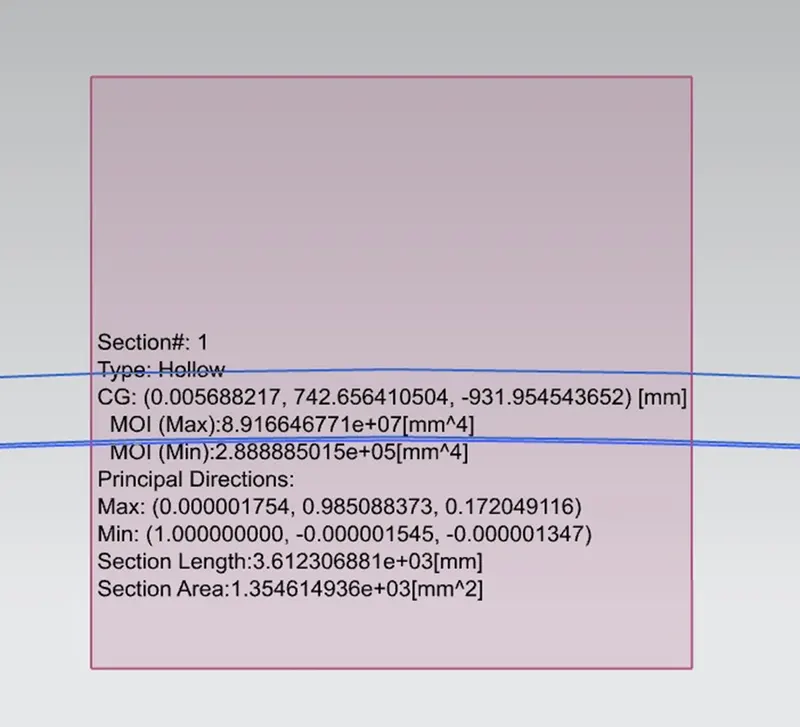
MOI min/Y = (2.888885015x10^5)/439 = 658.060367882mm^3
MOI max/Y = (8.946646771x10^7)/439 = 203796.054009mm^3
Section Modulus at MOI min = 658.060367882mm^3
Section Modulus at MOI max = 203796.054009mm^3
Result
|
S.No |
Case |
Y(mm) |
Section modulus at min MOI (mm^3) |
|
1 |
At Zero Offset |
439 |
639.824203189 |
|
2 |
At 0.5 mm Offset |
439 |
650.811005923 |
|
3 |
At 0.8 mm Offset |
439 |
658.060367882 |
|
S.No |
Case |
Y(mm) |
Section modulus at max MOI (mm^3) |
|
1 |
At Zero Offset |
439 |
203728.964966 |
|
2 |
At 0.5 mm Offset |
439 |
203199.10574 |
|
3 |
At 0.8 mm Offset |
439 |
203796.054009 |
CONCLUSION:
Above the measure a Section Modulus calculation and optimization.