Section Modulus calculation and optimization
section Modulus Calculation and Optimization
aim: To understand and learn the optimization and calculation of section modulus of hood design
Section Modulus-
Section modulus is a geometric property for a material used in the design of beams or structural members.
Different types of section modulus:
1.Elastic section modulus (s)
2.Plastic section modulus (z)
Elastic section modulus:
the elastic section modulus is used applying up to the yield point for most metals and other common materials.
the elastic section modulus is obtained by yielding given material up to the yield point.It is defined by the ratio of moment of inertia to the distance from the neutral axis S = I / y. It is also used to determine the yield moment (My) such that My = S × σy, where σy is the yield stress of the material.
Plastic section modulus-
The plastic section modulus depending on the location plastic neutral axis (PNA). The PNA is defined as the axis that splits the cross-section in such a way that the compressive force when the area is in compression equal to the tension force when the area is in tension. So, forgiven sections with constant yielding stress, the above area and below area of the PNA is equal, for composite sections not equal.The plastic section modulus is the sum of the areas of the cross-section on each side of the PNA multiplied to the distance from the local centroidal areas of the two PNA. The Plastic Section Modulus can also be called the 'First moment of area'
It is calculate by the plastic moment, Mp,. The two terms are related by the yield strength of the material by Fy, by Mp=Fy*Z. Plastic section modulus and elastic section modulus are related by a shape factor which can be denoted by 'k', used to indicates the capacity beyond the elastic limit of the material the formulais K=Z/S.
Section modulus Calculation
CASE:1
Front crash analysis of Hood design (No optimization)
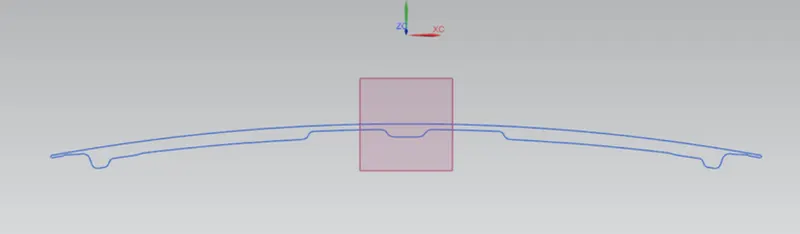
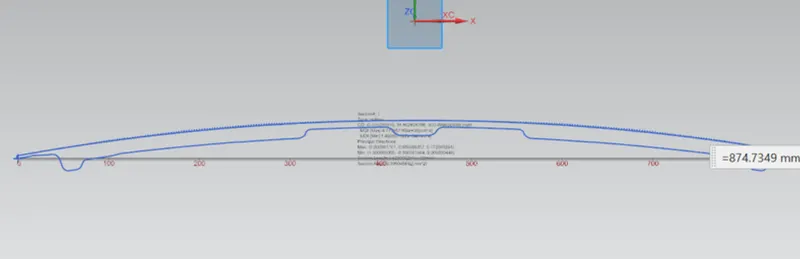
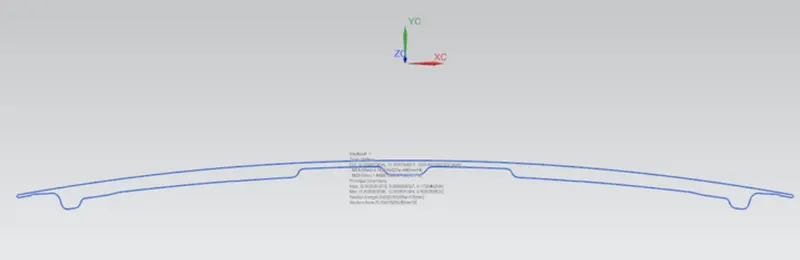
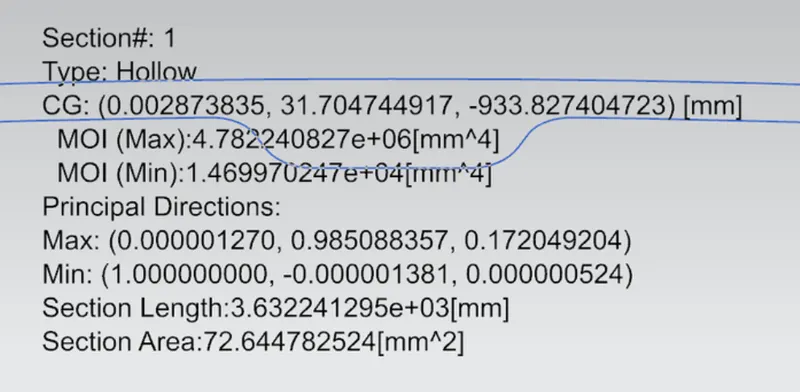
Moment of Inertia (MOI), I max = 4.782240182×10^6 (mm^4)
Moment of Inertia (MOI), I min = 1.469970724×10^4 (mm^4)
Distance between the neutral axis and the extreme end of the object,
Y = 874.73 mm/2 =423.72 mm
Section modulus, S = Moment of inertia I / Distance between the neutral axis and the extreme end of the object (y)
S = I/y
For MOI Max-
S =4.782340824×10^6mm^4 /432.74 mm
S = 11.2816742×10^3 mm^3
For MOI Min-
S = 1.469971247×10^4mm^4/423.74mm
S = 0.36955×10^2 mm^3
CASE:2
Front crash analysis of Hood optimized design
In this case, we have to modify the section curve of 0.5 mm offsetting the inner panel curve outward.
Calculation of section modulus of the optimized hood.
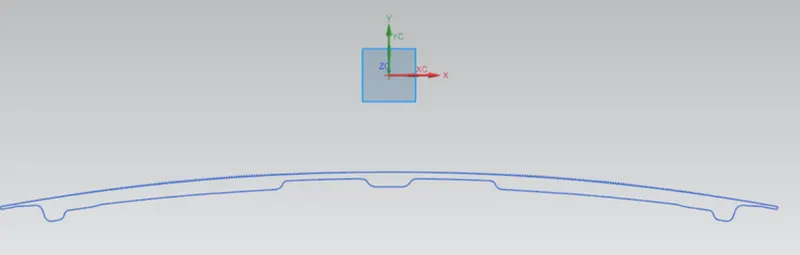
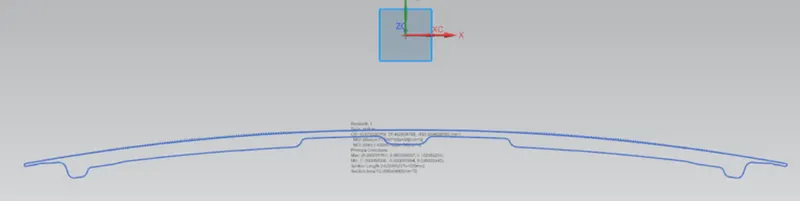
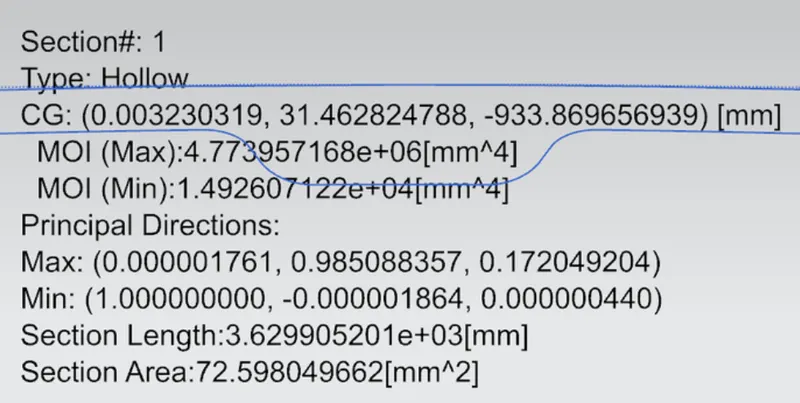
Moment of Inertia (MOI), I max = 4.773957168×10^6 mm^4
Moment of Inertia (MOI), I min = 1.492607122×10^4 mm^4
Distance between the neutral axis and the extreme end of the object,
Y = 874.74mm/2 =423.87 mm
Section modulus, S = Moment of inertia I / Distance between the neutral axis and the extreme end of the object (y)
S = I/y
For MOI Max-
S = 4.773957168×10^6 mm^4/423.87 mm
S = 11.26×10^3 mm^3
For MOI Min-
S = 1.492607122×10^4 mm^4/423.87 mm
S = 0.351379×10^2 mm^3
Conclusion-
From the calculation of section modulus of with and without optimization of the hood design. By doing this calculation observed that the withstanding capability increase to the new optimized hood by increase the distance of the inner panel by 0.5 mm from the outer panel. So we can observe that the increase the gap between the inner and outer panel, the Modulus of inertia increases. That means modulus increases with the increase in section area. so that the section modulus is totally dependents on the area moment of inertia of the section. We concluded that section modulus is directly proportional to the moment of inertia if increase the value of the moment of inertia the section modulus also increases.