Section Modulus calculation and optimization
Bending Equation
M/I=SIGMA b/y=E/R---------------1
where,
M= Moment of Resistance
I= Moment of Inertia
Sigma b= Bending Stress
y= distance from neutal axis to farthest point on the component crosss section.
E = Modulus of Elasiticity
R= Radius of Curvature
from 1,
we can say....M/SIGMA B=I/y-----------2, where M/SIGMA B is
"Section Modulus"
Hence, S=I/y---------3
Section Modulus
We can simply say, the value of Section Modulus refers to resistance value of the part against bending force.
From previous Hood Challenge Section Modulus value of the part was calculated after finding out the minimum moment of Inertia value(I) and dividing it with the value of y.
Initially a datum plane was created to pass through the part's cross section thereby showing us the cutsection of the part while using the "Intersection curve" command.then this was projected on to a sketch plane(outer curve of hood outer panel,outer curve of hood inner panel) and joined to create a closed section.
Then "section Inertia analysis" was performed on the existing section to find out minimum moment of Inertia value.
From 3 we can say S is directly proportional to I.So when I increases S also increases which means bending resistance of the part increases.We know I = length*(depth^3)/12. So whwn we increase depth value ,the value of S increases.
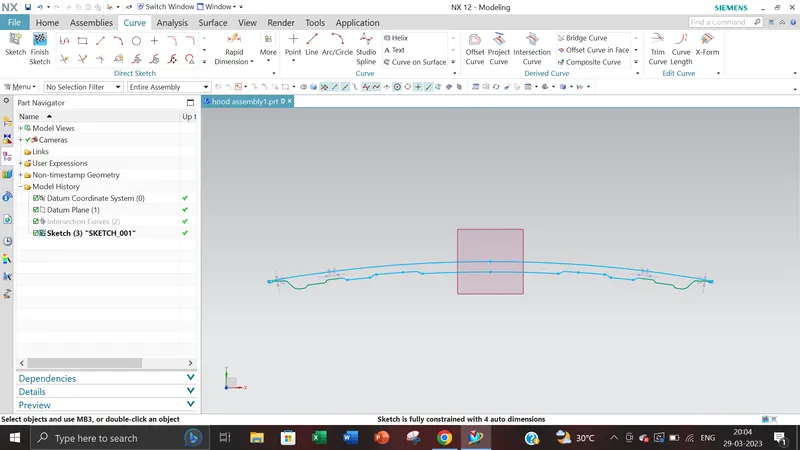
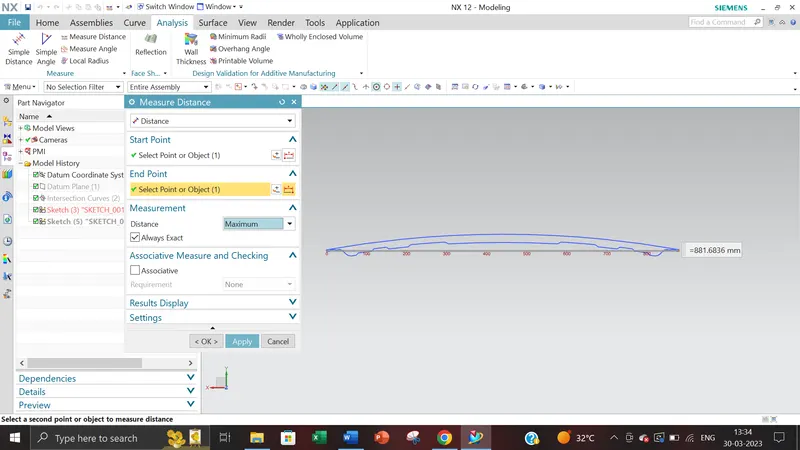
Cross section Distance
The following picture shows minimum MOI value for existing cross section of hood.
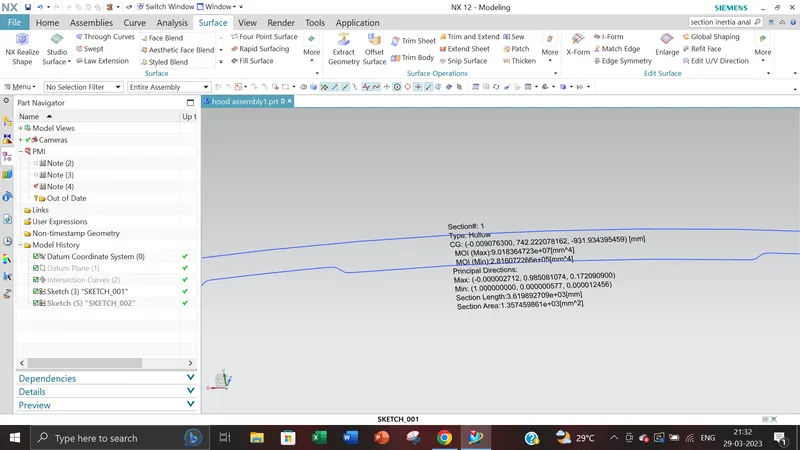
Therefore S=I/y
= 2.81*10^5/440.84---------------------y=881.68/2.
=637.41 mm^3
The following picture shows minimum MOI for hood when innerpanel (outer layer) is offset by 3mm on downward direction to increase overall cross section.
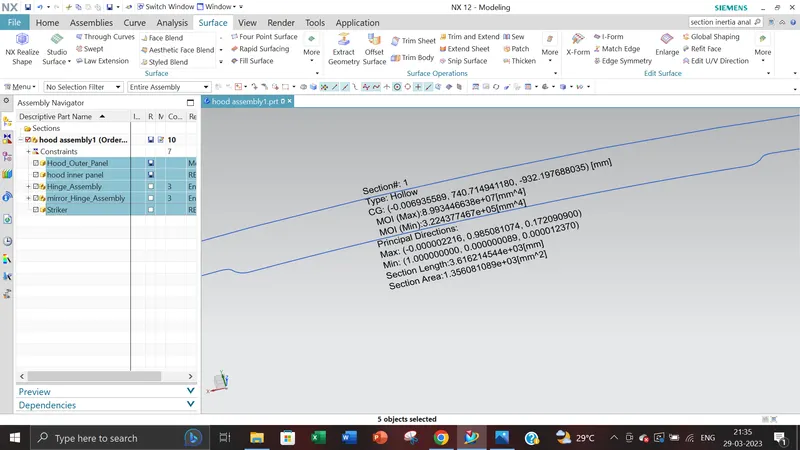
Therefore S=I/y
=3.224*10^5/440.84
=731.33 mm^3.-------------In this case optimisation was done by increasing cross section area of the part.