Section Modulus calculation and optimization
QUESTION:
Use the Section from your Hood design and calculate the Section Modulus using the formula
S = I/y
Where,
S = Section Modulus
I = Moment of Inertia
y = distance between the neutral axis and the extreme end of the object
Come up with a new section that has an improved Section Modulus compared to the previous one and mention what changes you made which resulted in the increased strength.
SOLUTION:
Use the Section of Hood design and the formula S = I/y S = Section Modulus to figure out the section modulus.
I = Point of Stability
Y is the distance between the object's centre of balance and its end.
Make a new section that is better than the last one in terms of section modulus.
Think about cold-rolled AISI 302 stainless steel, where y = 520 M Pa.
The section modulus is a geometric property of a given cross-section that is used to design beams or flexural members. Other geometric properties used in design are area for tension and shear, radius of gyration for compression, moment of inertia and polar moment of inertia for stiffness, and moment of inertia and polar moment of inertia for stability.
There are two kinds of section moduli: the elastic section modulus and the plastic section modulus.
The Elastic section modulus is used for general design. It works for most metals and other common materials up to their yield points.
The elastic section modulus is given by S = I / y, where I is the second moment of area (or area moment of inertia, not to be confused with moment of inertia) and y is the distance from the neutral axis to any given fibre.
It is also often used to figure out the yield moment (My), which is given by My = S y, where y is the yield strength of the material, which is the most force that can be put on a mechanical part.
Plastic section modulus is used for materials where elastic yielding is acceptable and plastic behaviour is assumed to be an acceptable limit.
The Elastic section modulus is used in the Hood design case. Prepare the model as shown below.
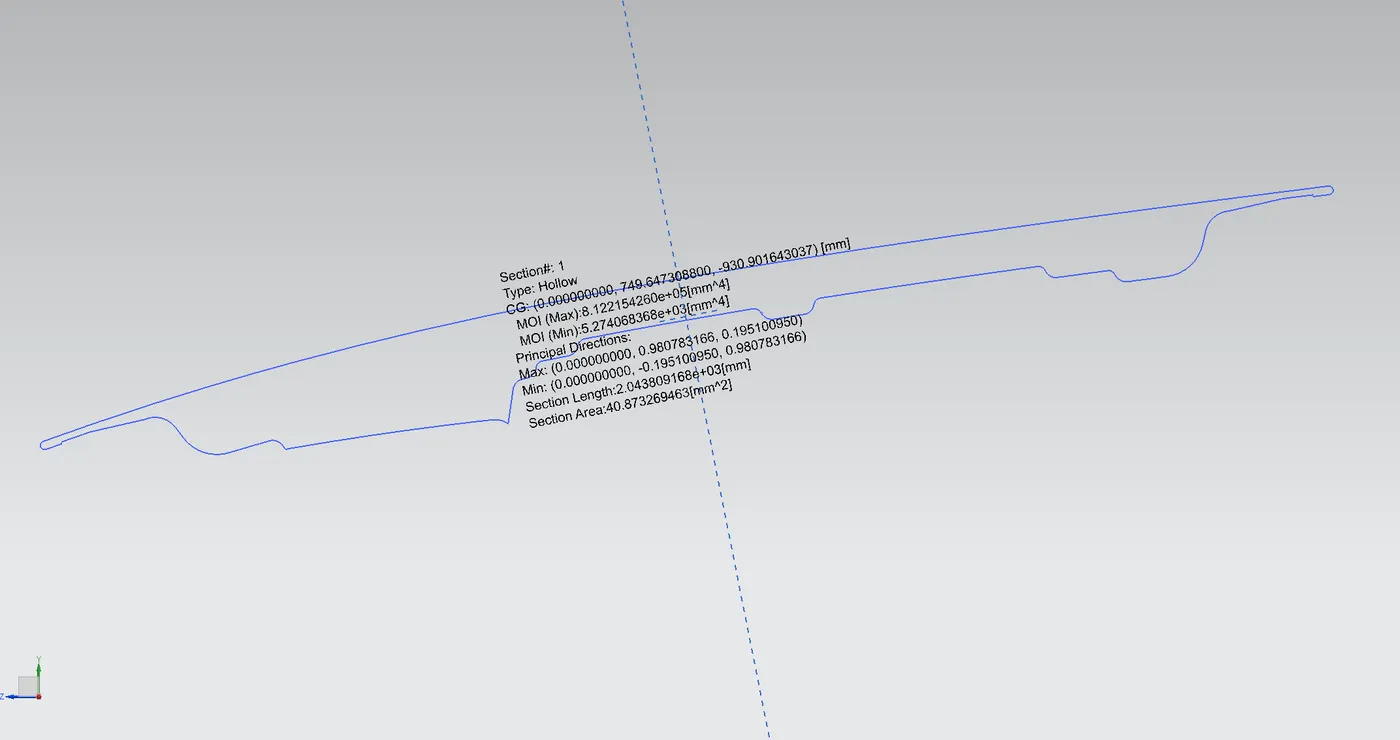
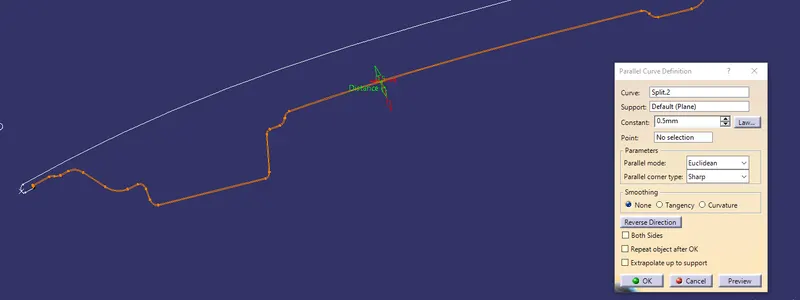
I copied two parts of the hood's outer panel and inner panel into a new part model called "Section modulus." I then created the section geometry of the outer most geometry of the hood's outer panel and the lower most geometry of the hood's inner panel and joined them with lines as we need a closed profile to measure the inertia. I then used the "Measure the Inertia" option in Catia to note the moment of inertia
See the images and calculations from the Catia model of down below as a guide.
Part One:
How to figure out Section 1:
Iox= 2.025e-006m4 =2025000 mm4 (IoxG value from above image)
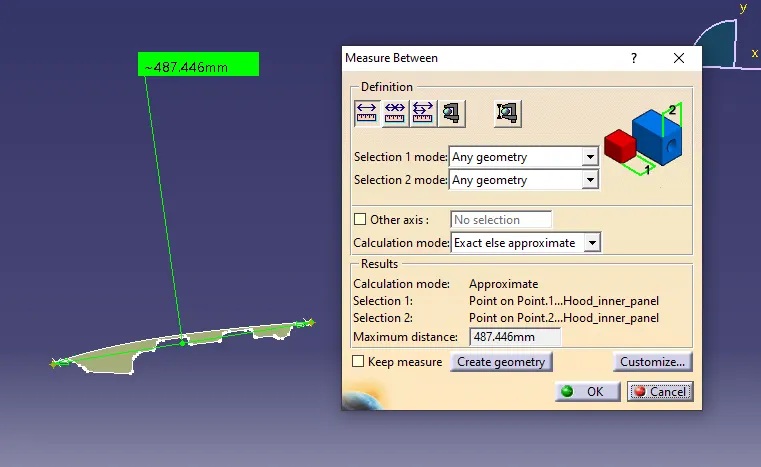
Y= 430.17 mm (Measured value fom image 1) (Measured value fom image 1)
S= I/Y = 2025000 mm4 /430.17 mm = 4707.44 mm3
Yield moment My = S y, where y is the material's yield strength, which is given as 520 MPa or N/mm2 in the question.
M= S × σy = 4707.44 mm x 520 N/mm2 = 2447868.8 N mm = 2.4e6 N mm.
To make the above section stronger, I added 3mm to the distance between the geometry of the outer panel and the geometry of the inner panel. I then repeated the above steps, and we got a much better strength value. See the part and pictures in section 2 below.
Part Two:
How to figure out Section 2:
Iox= 2.556e-006m4=2550000 mm4 (IoxG value from above image)
Y= 430.17 mm (Measured value fom image 1) (Measured value fom image 1)
S= I/Y = 2550000 mm
4 / 430.17 mm = 5927.8 mm3
Yield moment My = S y, where y is the material's yield strength, which is given as 520 MPa or N/mm2 in the question.
M= S × σy = 5927.8 mm3 x 520 N/mm2 = 3082456 N mm = 3.08 e6 N mm.
So, by making the distance between the inner and outer panels of the Hood assembly bigger, the section modulus went up, which meant that the strength also increases.