Section Modulus calculation and optimization
SECTION MODULUS OF THE HOOD
Objective: To find the section modulus of the hood and to optimize the design to improve the overall section modulus.
Section modulus
Section modulus is a geometric property for a given cross-section used in the design of beams or flexural members, it is also referred to as the Polar Modulus or the Torsional Sectional Modulus. Other geometric properties used in design include area for tension and shear, radius of gyration for compression, and moment of inertia and polar moment of inertia for stiffness. Any relationship between these properties is highly dependent on the shape in question. Equations for the section moduli of common shapes are given below. There are two types of section moduli, the elastic section modulus and the plastic section modulus.
S=I/Y
Here,
S = Section modulus
I= Moment of Inertia (Unit mm 4)
Y= Distance from Neutral axis to the extreme end (unit mm)
The Unit of a “section modulus” is (mm3)
Neutral axis: When beam is subjected to pure bending the top most fibres of the beam are subjected to maximum compression, while the bottom most fibres of the beams are subjected to maximum tension.
CALCULATIONS:-
CASE 1:- The hood design created by the given class A surface undergoes section inertia calculation by intersecting half of the hood. The intersecting curve is created by the original design and then closed to run the section inertia calculation.
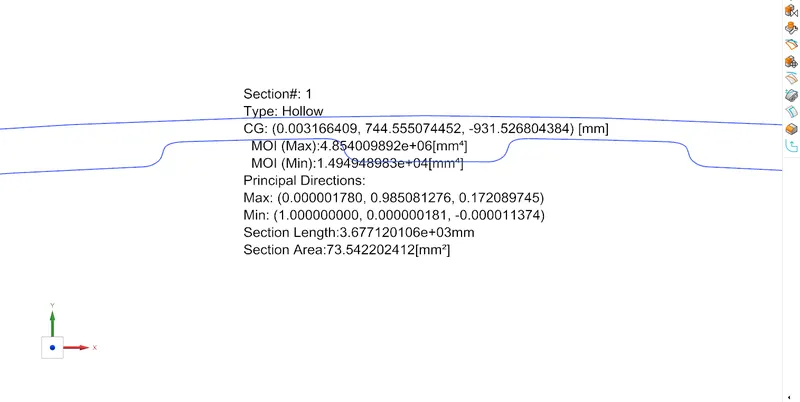
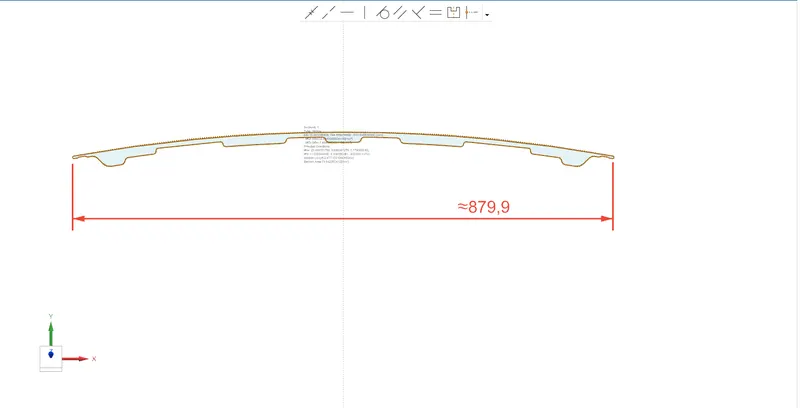
MOI (max) = 4.854009892e+06 (mm^4)
MOI (min) = 1.494948983e+04 (mm^4)
As per the section modulus equation,
S = I/Y
I = MOI (min) value is considered,
Y = Total distance /2, Total distance =879.9mm
Y = 879.9 / 2
= 439.95 mm
Therefore, S = 14949.48983 /439.95
S = 33.97mm^3
CASE 2:- The inner anel line is offset by 0.5 mm and then section inertia analysis is taken.
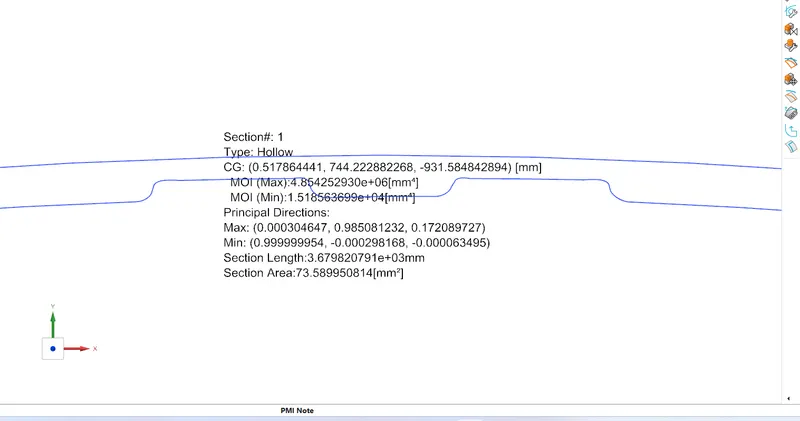
MOI (max) =4.854252930e+04 (mm^4)
MOI (min) = 1.518563699e+04 (mm^4)
As per the section modulus equation,
S = I/Y
I = MOI (min) value is considered,
Y = Total distance /2, Total distance =879.9mm
Y = 879.9 / 2
= 439.95 mm
Therefore, S = 15185.63699 /439.95
S =34.51 mm^3
Conclusion:
While comparing case 1 & case 2, we observed that by changing the depth of the design we got higher value of section modulus in case 2.
As we increase the section area, the moment of inertia & section modulus increases which means strength and load of the material also increases. As we know that the moment of inertia is directly proportional to the strength of the material.