Section Modulus calculation and optimization
Before going into the section modulus we should be familiar with some basic terms SOM and their uses. There are also some phonically similar sounding words but have different meaning and application.
Some of them are:
Centroid: geometric center of any 2 d or 3d object. It is the central point of area (in 2d) or volume (3d) where whole area/volume can be assumed to be concentrated. It is the weighted average of position where area/volume at each position is the corresponding weight of each position.
Center of mass: It is the central point of the mass where whole mass can be assumed to be concentrated for simplification of problem. It is the weighted average of position where mass at each position is the corresponding weight of each position.
The centroid and the center of mass may or may not coincide, it depends upon whether the material is homogeneous or not, if the material would be homogeneous the center of mass and centroid will coincide else not.
1st moment: When summation of moments of area/volume or mass or weight is divided by the total area/volume or mass or weight respectively gives centroid, center of mass and center of gravity respectively.
So in one sentence we can say that 1st moment is used to find weighted average of position.
2nd moment: where as the 2nd moment is used to find the variance, or in other word how much a property area/volume/mass/weight etc. is distributed/scattered about the reference position.
2nd moment is also called as moment of inertia:
If moment of inertia is taken for mass it would be called MASS MOMENT OF INERTIA. The physical significance of mass moment of inertia is that more an object poses the mass moment of inertia more difficult will be to change it state of rest or motion in rotation.
If moment of inertia is taken for area it would be called AREA MOMENT OF INERTIA. The physical significance of area moment of inertia is that more an object poses the area moment of inertia more difficult it will be to bend.
LIKE “E” IS MEASURE OF STIFNESS DUE TO MATERIAL “I” IS STIFNESS DUE TO GEOMETRY.
Now coming to section modulus:
We know for pure bending:
M / I = σ /y = E / R.
Taking first two terms
M / I = σ /y
Rearranging the equation:
M = (σ * I )/y
M= σ * (I/y)
M= σ * z (z = section modulus)------------------(1)
For given material the maximum stress it can resist will be constant it can be σut for brittle material or it can be σy for ductile material.
But for safety reason we take σut or σy to be lesser than the original by some factor this factor is called as “FACTOR OF SAFETY” or FOS
The FOS can ranges from (0 to less than 1) it is always +ve , and dimensionless.
So the safer value of σ is called as “ALLOWABLE STRESS”
So we can replace σ of equation (1) by σallowable where
σallowable =FOS X σ
M= σallowable x z
Since σallowable = constant
M ∝ Z
Since Z = I /Y
Z ∝ I
SO M ∝ I
SO MORE THE VALUE OF “I” WOULD BE MORE WOULD BE THE VALUE OF “M”
MORE M MEANS MORE FORCE REQUIRED TO GENERATE MORE M , SO THE STRENTH OF THE PART IS INCRESED BY OPTIMIZING THE SECTION MODULUS.
THERE ARE VARIOUS KINDS OF LOADING SUCH AS LONGITUDNAL (OR AXIAL LOADING) AND THE TRANVERSE LOADING (TRANVERSE CAN ALSO BE IN TWO DIRECTION AS CAN BE SEEN IN BELOW IMAGES)
LOGITUDNAL LOADING IF APPLIED ALONG THE CENTROIDAL AXIS CAUSES PURE TENSION OR COMPRESSION DEPENDING THE DIRECTION OF FORCES WHEREAS IF NOT APPLIED ALONG CENTROIDAL AXIS IT WILL ADD SOME OTHER EFFECTS AS WELL.
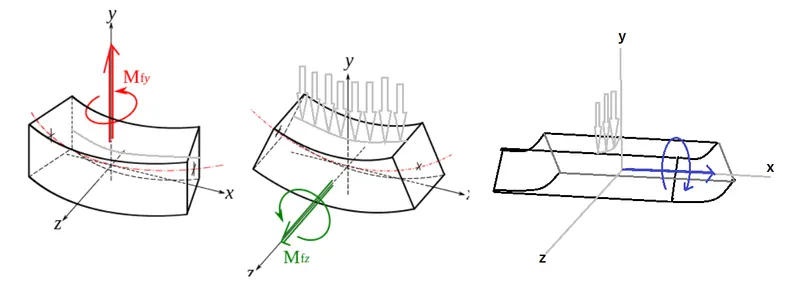
There are many asssumption for pure bending to understand those assumption we should be familier with the term PLANE OF BENDING.
Plane of bending is the plane on which the bending occurs.Diffrent person have diffrent visualisation technique i have my own i visulaise it like this " on which plane i will have to make the circle matching the arc of bend to measure the radius of curvature, that plane is the plane of bending"
in 1st figure that bending plane will be zx- plane
in 2nd figure the bending plane will be x-y plane
in 3rd figure the bending plane will be yz-plane
In all the above figures the force applied are the trasverse force.
We are now going to optimize the hood for better strength.For optimization we will be using the same bending equation although the force of collision is not so simple neither the bending is so simple but for the sake of simplicity we will consider the bending equation and all its assumptions to be valid.
When we use the section inertia analysis command it gives two momwnt of inertia ,these moment of inertia are the inertia with refrence to two perpendicular centroidal axis , we should always consider the minimum "I" So as to remain inside the safe limit , if we take the maximum one than the part will not be safe along other axis.
CASE1:
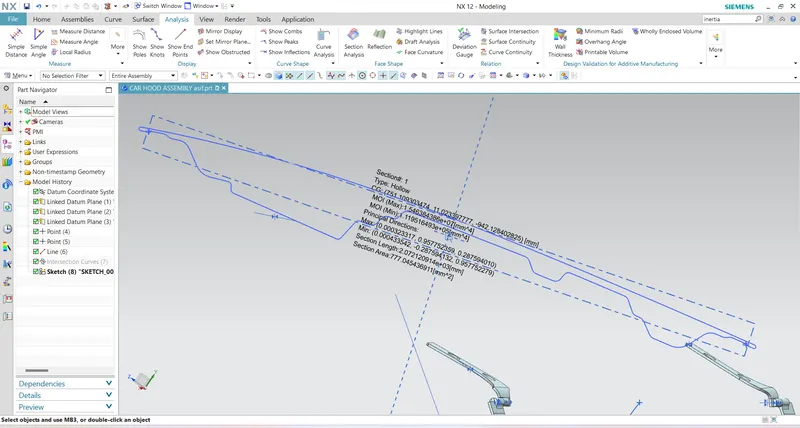
IN CASE 1 : I WAS FOUND TO BE Imin = 1.1195 mm4
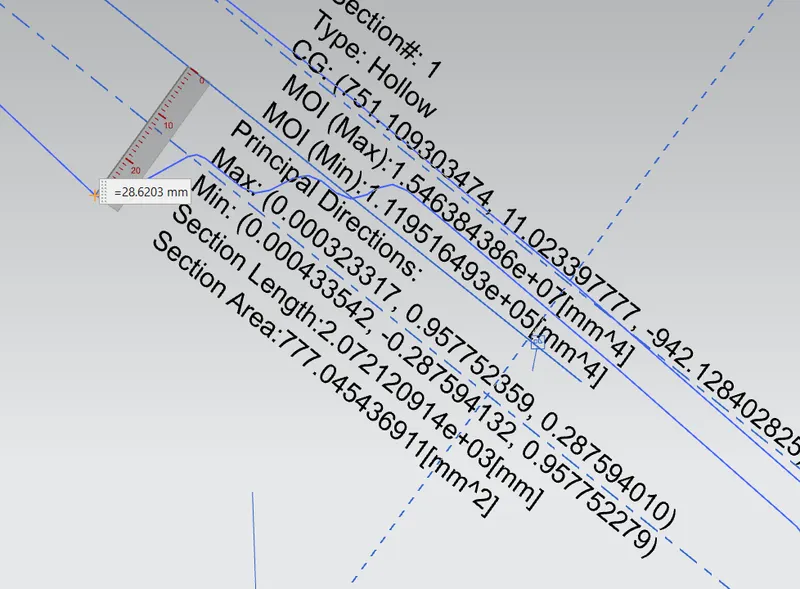
YMAX :28.62 MM
I HAVE TAKEN Y MAX IN THIS DIRECTION BECOUSE , WE KNOW THAT THE "I" CORRSPONDS TO DISTRIBUTION OF AREA ABOUT CENTROIDAL AXIS , WE HAVE TWO CENTOIDAL AXIS ALSO WE HAVE TO "I"s .The "I" with lower value will coresspond to centroidal axis about which there is lesser distribution of area , similary "I" max will be about the other axis about which the distribution of area is more.
Z= I/Y
Z1= 1.1195/28.62 =0.03911
CASE 2:
In order to increase the I i tried to distribute the area far from centroidal axis . This was achieved by decreasing the first stage emboss height keeping the second level same becouse second set of emboss facilitates maestic placement so the distance between inner and outer cant be ultered.
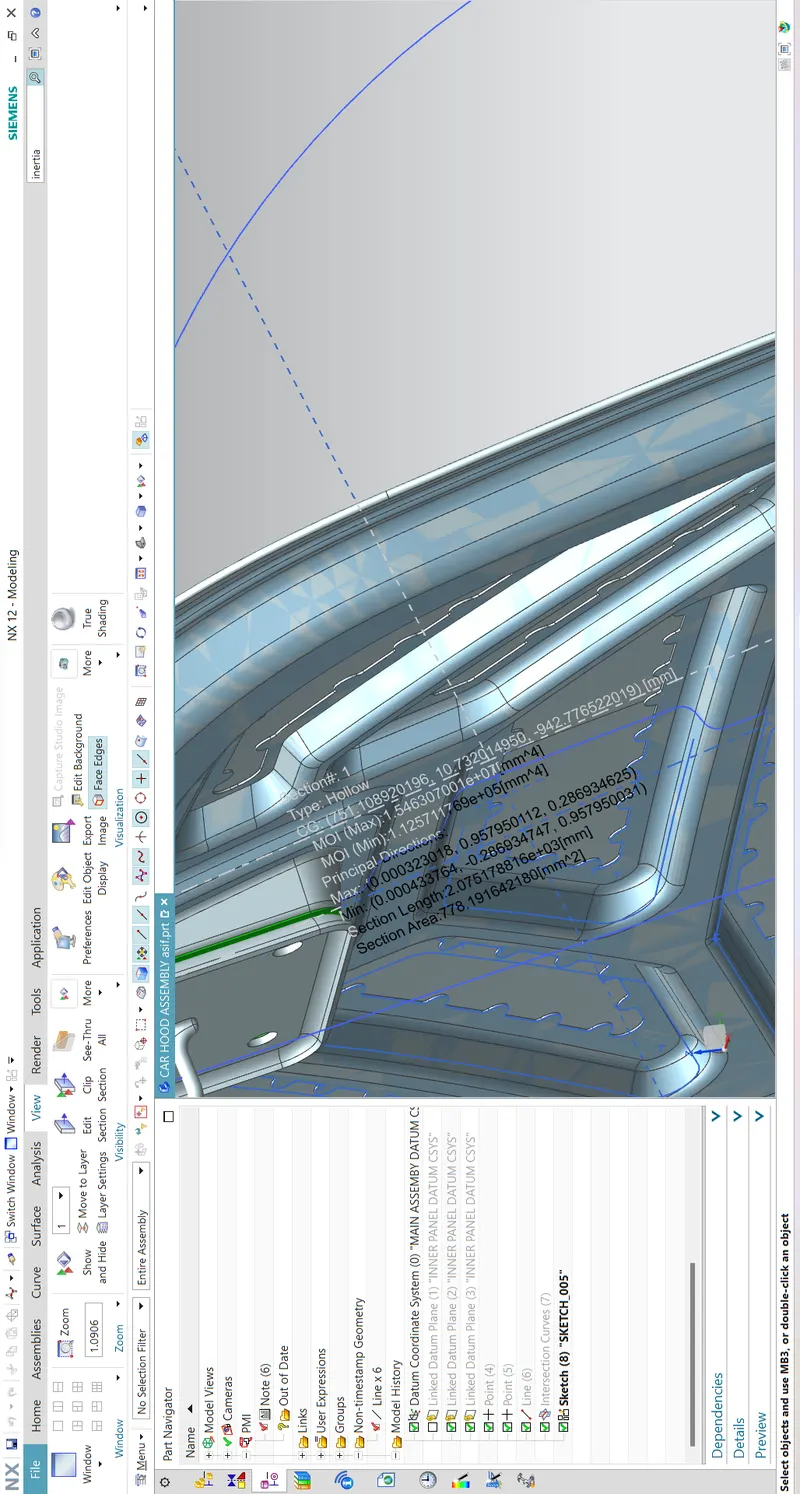
CASE 2 : I(MIN) FOUND TO BE I(min)= 1.126 mm4
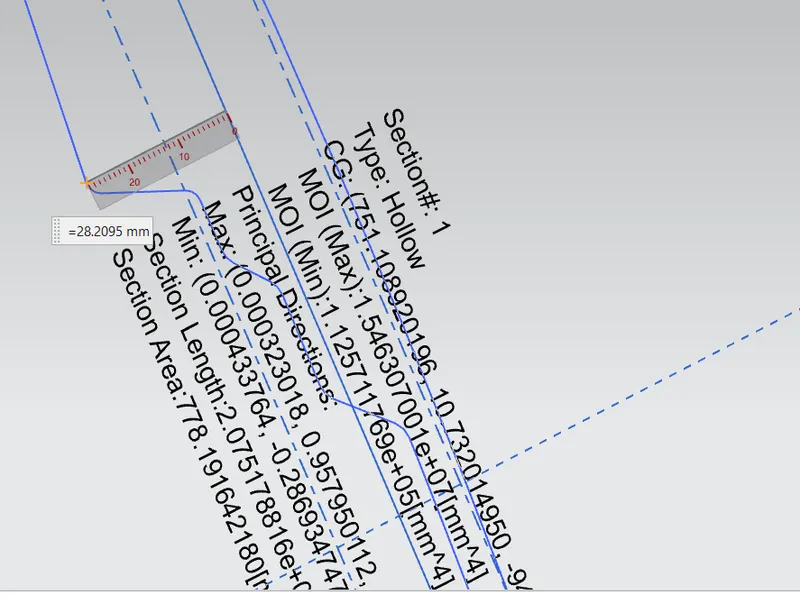
Y MAX = 28.20 MM
I HAVE TAKEN Y MAX IN THIS DIRECTION BECOUSE , WE KNOW THAT THE "I" CORRSPONDS TO DISTRIBUTION OF AREA ABOUT CENTROIDAL AXIS , WE HAVE TWO CENTOIDAL AXIS ALSO WE HAVE TO "I"s .The "I" with lower value will coresspond to centroidal axis about which there is lesser distribution of area , similary "I" max will be about the other axis about which the distribution of area is more.
Z= I/Y
Z 2= 1.126/28 = .0402
(Z2 -Z1)/Z1 =.0402-0.03911= 2.7%
CONCLUSION:There is 2.7 % increase in the section modulus .It can be further increased by ultering diffrent features , but it totally depends upon the requirement and need.