Section Modulus calculation and optimization
  Given Data
   Use the Section from your Hood design and calculate the Section Modulus using the formula.

S = I/y

 Where,

S = Section Modulus

I = Moment of Inertia

y = distance between the neutral axis and the extreme end of the object


- So We are going to use two sections to find out differance between the section modulus.
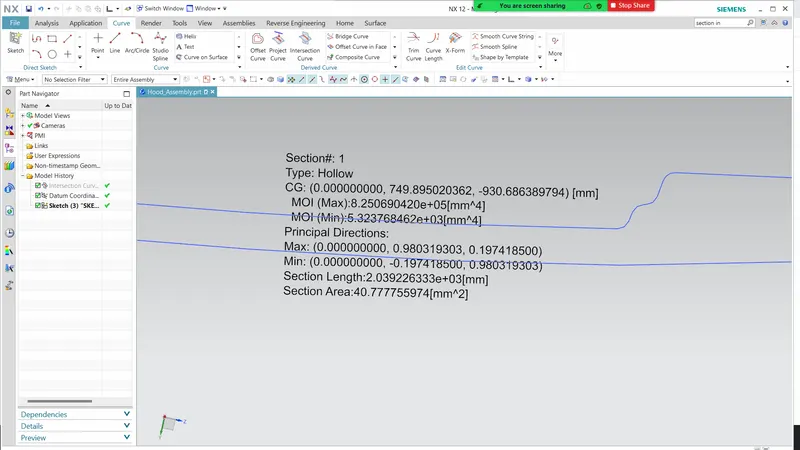
- by using Section Inertia Analysis command in NX we Are getting two different minimum
  moment of inertia.
- Section modulus is a geometric property for a given cross-section used in the design of beams or flexural members.
There are two type of section modulus

1.elastic section modulus

plastic section modulus
For general design, the elastic section modulus is used, applying up to the yield point for most metals and other common materials.
The elastic section modulus is defined as S = I / y,
I = is the second moment of area (or area moment of inertia, not to be confused with moment of inertia)

Y = is the distance from the neutral axis to any given fibre. It is often reported using y = c,

C = is the distance from the neutral axis to the most extreme fibre, as seen in the table below.

It is also often used to determine the yield moment (My) such that My = S × σy, where σy is the yield strength of the material.
Higher the Section Modulus higher will be the Resistance to Bending.

- Procedure:

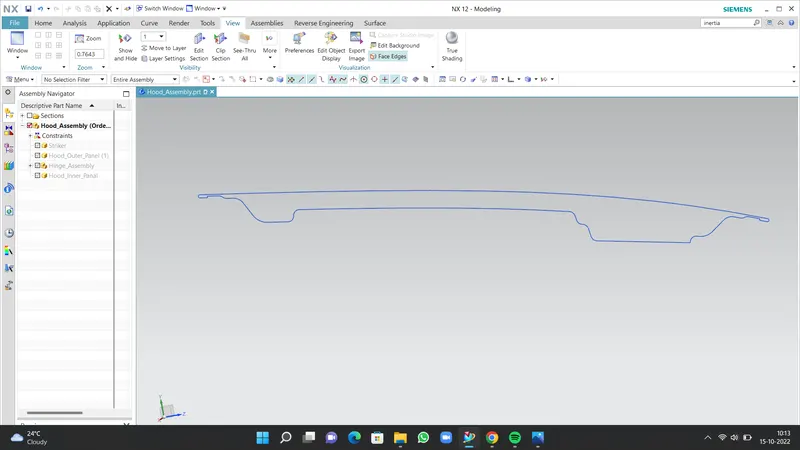
By using intersection command, we have found out the shape of inner and outer panel of hood.
After getting intersection curve we have to extract the outer most curve of both panel.
Connect them by using line
Convert the closed sketch to surface using fill command and measure the 2D inertia of section.
** 2D CURVE OF HOOD PANEL-**
**DATA FOR FIRST INERTIA PANEL**
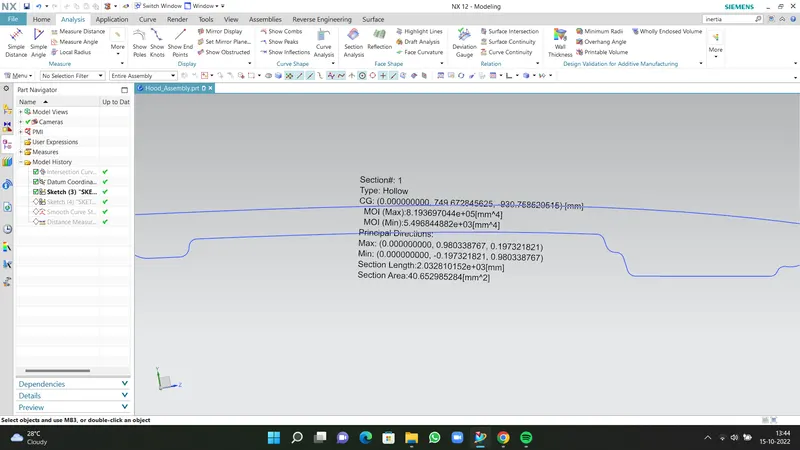
**DATA FROM INCRESED CROSS SECTION BY 0.5MM**
**DISTANCE BETWEEN THE BOTH EXTREME END OF THE PROJECT**
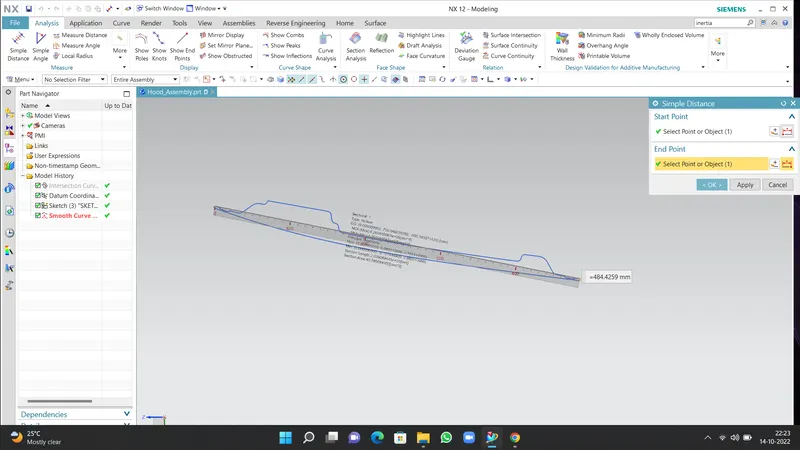
To Calculate y Divide The whole distance by 2 ie. 484.4259/2 = Y.
** Calculations-
1- For First Section Which is otignal Section Of hood.
S = I/y
I = 5.323*10^3 mm^4
Y = 242.21 mm
S = 5.323*10^3/242.21
S = 21.9767 mm^3
2- For Secont Condtion We Reduced The cross section by 0.5 mm.
S = I/y
I = 5.4968*10^3 mm^4
Y = 242.21 mm
S = 5.4968*10^3/242.21
S = 22.6943 mm^3
* Conclusion-
- As We Can See The Results more the cross Section more the Section modulus.
- And If we reduce the cross section it reduces the section modulus.
- soo we have to try to kept more cross section between outer and inner panel to increase
  the strength of the part or any component.