Roof Design
AIM: To design a roof with all the components like front roof rail, rear roof rail, and bow roofs by following the given master sections and the high-quality surface, considering all the design requirements as per the OEM standards.
ROOF
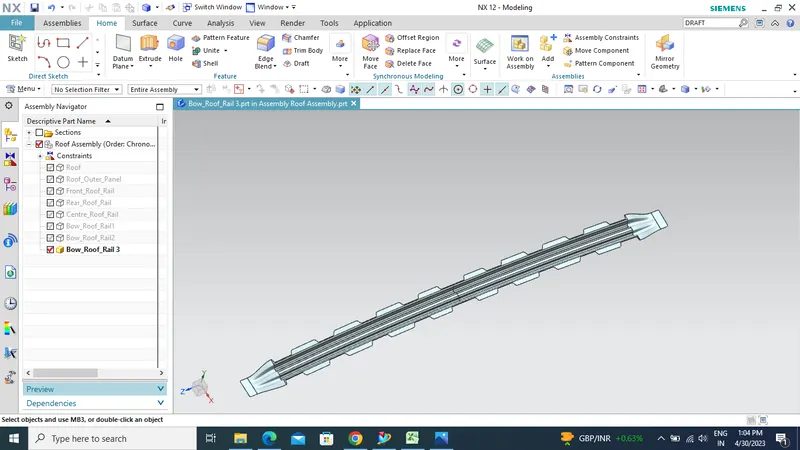
An automobile roof or car top is the portion of an automobile that sits above the passenger compartment, protecting the vehicle occupants from sun, wind, rain, and other external elements. The roof is not a single panel as seen from the exterior it consists of front roof rail, bow roofs, center roof rail, and rear roof rail with different thicknesses which act as a reinforcement for the top.
OBJECTIVE
- To design a roof of the car with all the reinforcement from the given styling surface.
- To perform the curvature study on the roof by considering Heat Distortion and Snow load criteria.
- To calculate the moment of inertia for the reinforcements.
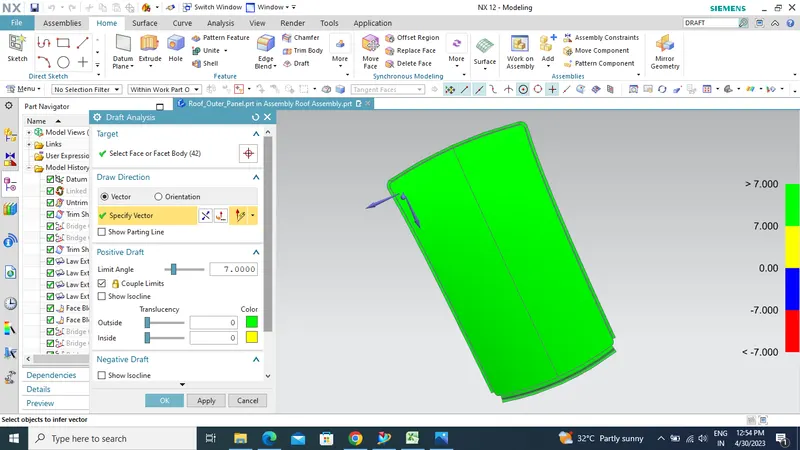
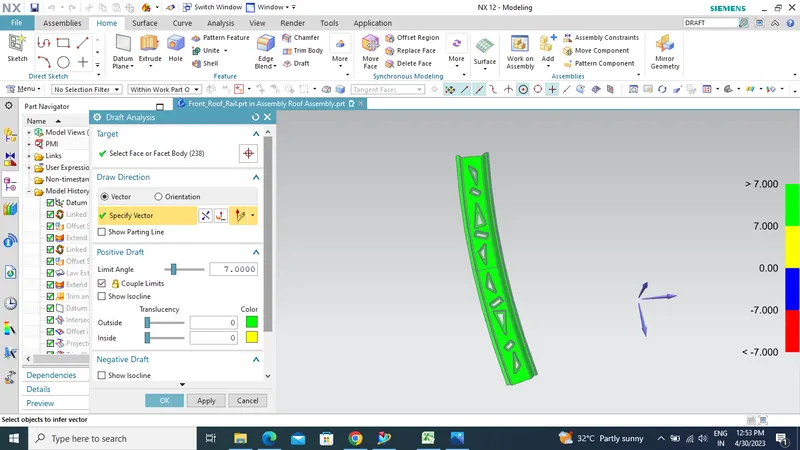
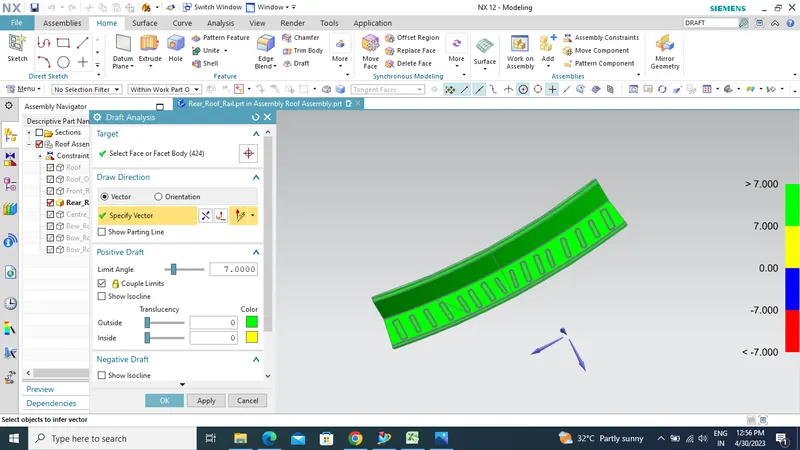
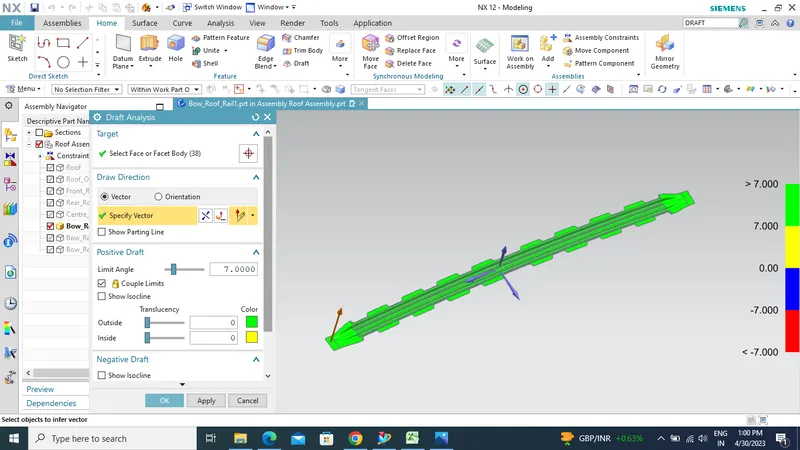
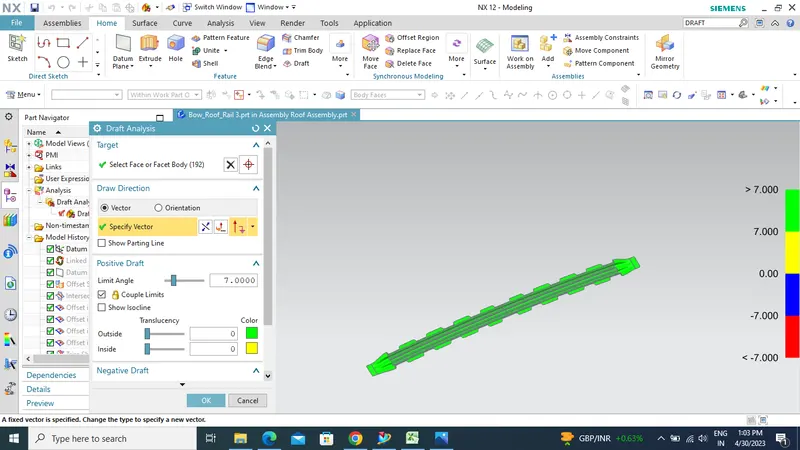
- To Perform the draft analysis for analyzing the components' manufacturing feasibility.
Type of roofs:
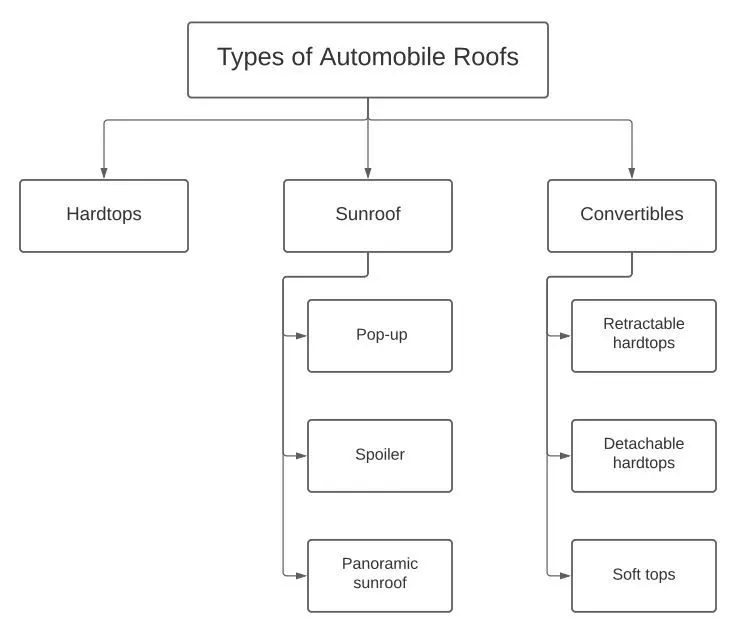
Manufacturing Process:
The process of manufacturing a car roof typically involves several steps, which may vary depending on the specific materials and manufacturing techniques used. However, a general outline of the process might include the following:
-
Design: The car roof design is typically created using computer-aided design (CAD) software, which allows engineers to create detailed 3D models of the roof.
-
Material selection: The materials used to make the car roof may vary depending on the manufacturer and the type of car. Common materials include steel, aluminum, fiberglass, and carbon fiber.
-
Cutting and shaping: Once the materials have been selected, they are cut and shaped into the appropriate size and shape for the car roof. This may involve the use of CNC machines, which are able to cut and shape the materials with a high degree of precision.
-
Bonding: In some cases, the various components of the car roof may need to be bonded together using adhesives or other bonding agents. This process may be done manually or using automated equipment.
-
Finishing: Once the car roof has been assembled, it may need to undergo additional finishing processes, such as painting or coating, to protect it from the elements and give it a polished appearance.
-
Quality control: Finally, the car roof will undergo rigorous quality control testing to ensure that it meets all of the necessary safety and performance standards before being installed in a car.
Design Consideration and criteria:
1.Roof:
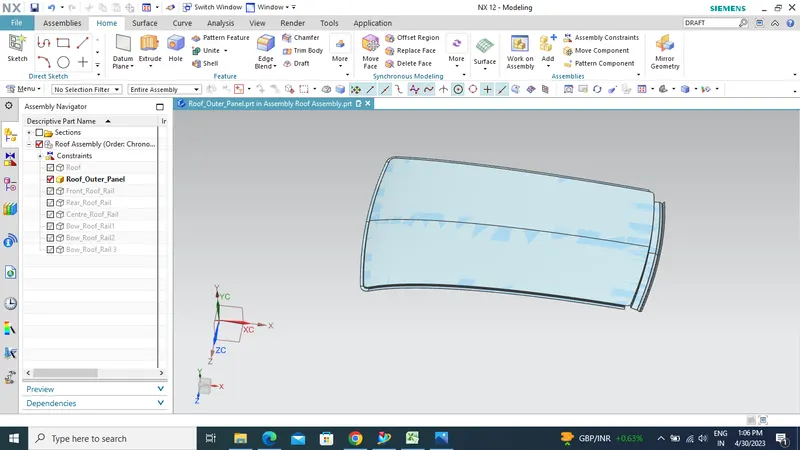
a.We are making the hardtop type of roof from the given master section so we are not adding any reinforcement for the central roof rail.
b.We are adding the flanges to all sides of the roof for spot welding of the front roof rail, central roof rail, rear roof rail, and bows.
c.The length and angle of the flange are decided based on the visibility criteria and according to the draw angle required for manufacturing the sheet metal.
d.The thickness of the roof is decided 0.75mm
2.Front roof rail:
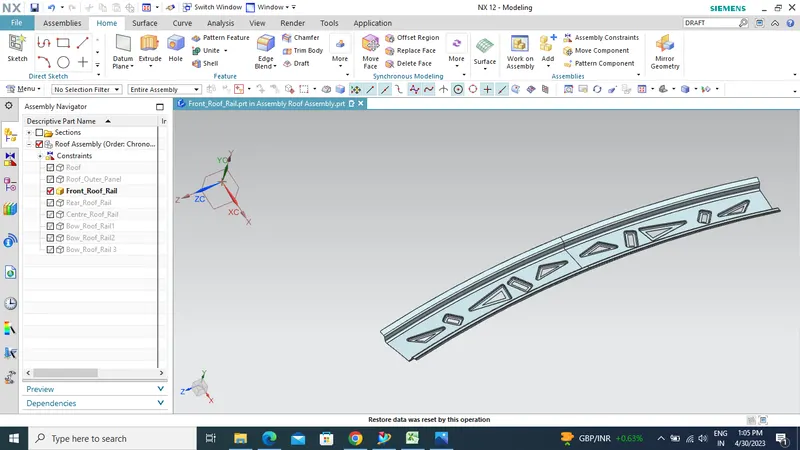
a.The front roof rail is used as the reinforcement to the roof surface to increase the strength and also used to mount the brackets for some features such as room lamp or map lamp and rear mirror.
b.The depth of the front roof rail is decided based on the visibility criteria line decided for the driver visibility.
c.The width of the front roof rail is decided in such a way that there should be enough headroom clearance between the head of the driver and the end surface of the roof rail to avoid injuries to the person.
d.At the front side we are doing spot welding and on the rear side of the front roof rail, we are using mastic points to join it with the roof surface.
e. The minimum radius for the fillet at edges is 3mm
3.Rear roof rail:
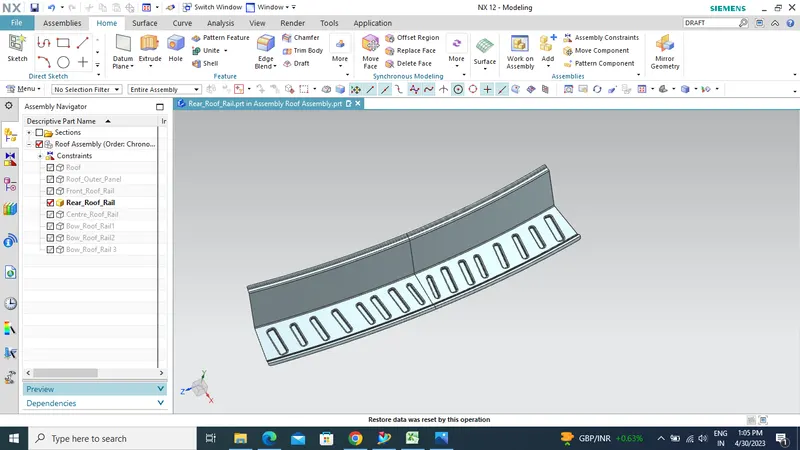
a.The rear roof rail is used as the reinforcement to the roof surface at the rear side.
b.The joining method used for this rail is the same as that of the front roof rail.
c.The minimum radius for the fillet is 3mm.
4.Bows:
a.We are making two bows one is in between the front roof rail and central roof rail and another is in between the central roof rail and rear roof rail.
b.Both ends of the bow are joined to the roof outer flanges by the spot welding and the inner sides of the bow are joined to the inner surface of the roof with the help of mastic points.
c.The minimum radius of the fillet is 3mm.
d.The cross-section of the bow is made in such a way that we should get the maximum value of the minimum moment of inertia at which the bow fails.
Heat distortion criteria:
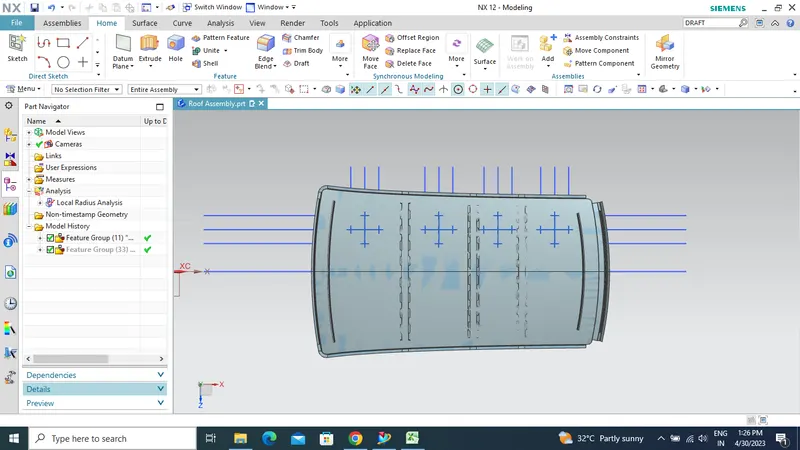
In this criteria, we check the heat distortion capacity of the roof at higher temperatures with the fixed load on it. So when the surrounding temperature is high and the roof is loaded with some weight on it then if the roof is deformed it fails, so to calculate whether the roof deform or not, according to the position of the bow we do these calculations as follows
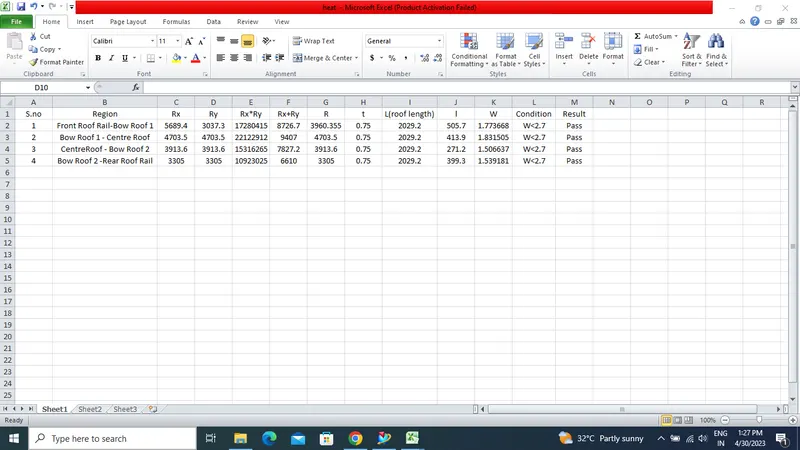
W = [1.73 x 10^(-3) x L] + [1.85 x 10^(-8) x (R^2)/t] + [ 1.10x10^(-3) x l] - 2.68
Where,
L = Roof Length in X-Direction[mm](Roof dimension in 0-Y)
R = Roof curvature
R = 2(Rx*Ry)/(Rx+Ry)
Rx = X curvature
Ry = Y curvature
t = Roof plate thickness [mm]
l = Bow Roof Span [mm]
Judgment Condition
OK< 2.7
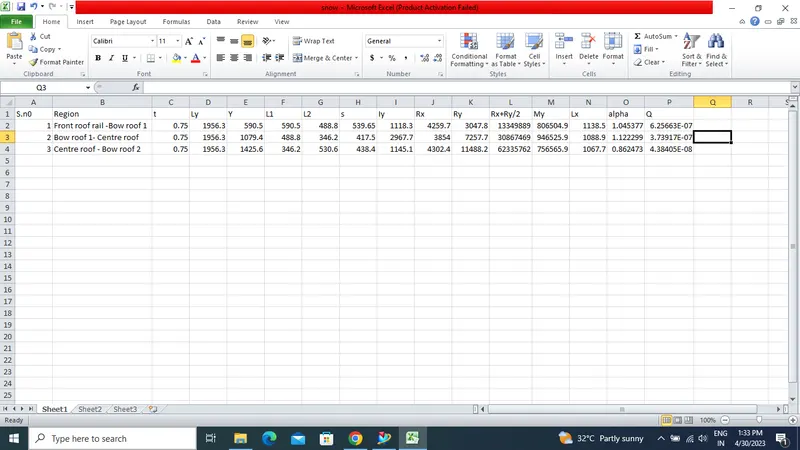
CALCULATION USING EXCEL BASED ON ABOVE GIVEN FORMULA:
Snow Load Prediction Formula
Qr = [Iy x t2] / [α x s x [(Rx + Ry)/2]2 x 10-8]
Note: The Qr value given over here is correct. There was a typo error in the formula given in the video.
Where,
α = My x Lx2 x 10-12 , My = Y(Ly-Y)
t = Roof plate thickness [mm]
Ly = Distance between the front and rear roof Rails on the Vehicle along with 0Y[mm]
Length of Roof panel with the center point between Roof rail Front /Rear as the front and rear reference point.
Lx = Distance between the Left and Right end of the roof on the Roof BOW [mm]
The width of the roof panel is exposed on the surface.
Y = Distance front Front Roof Rail to Roof BOW[mm]
s = Distance for which Roof BOW bears divided load [mm]
s = L1/2 + L2/2
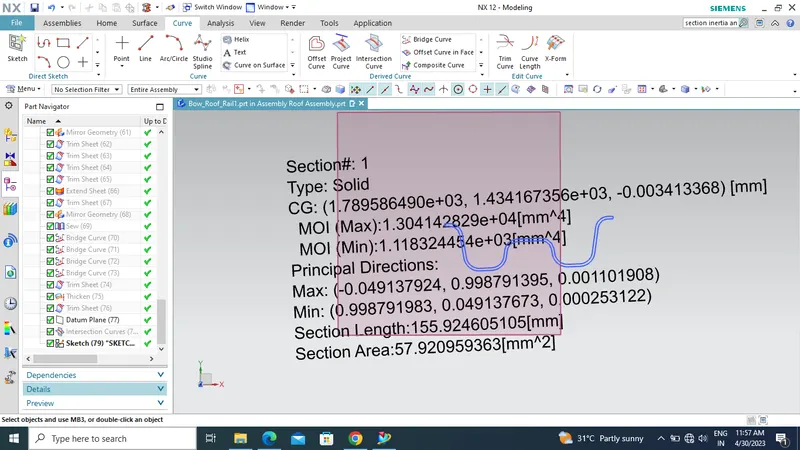
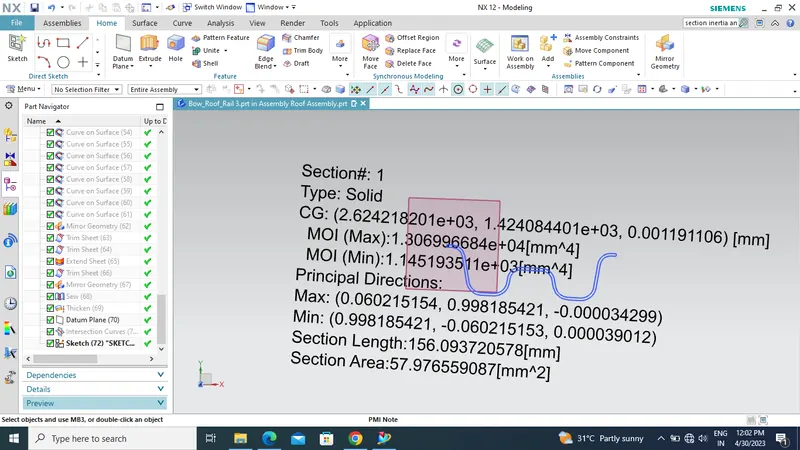
Iy = Geometrical moment of inertia of Roof BOW (Y cross-section )[mm4]
Rx = Lateral direction curvature radius of roof panel Y cross-section on Roof BOW [mm]
Roof panel curvature Radius of the Length Lx in Front view
Ry = Longitudinal Direction curvature radius of the Roof panel X cross-section on Roof BOW [mm]
Roof panel X curvature radius of length s in Side view
Judgment condition
Qr ≥ 3.1
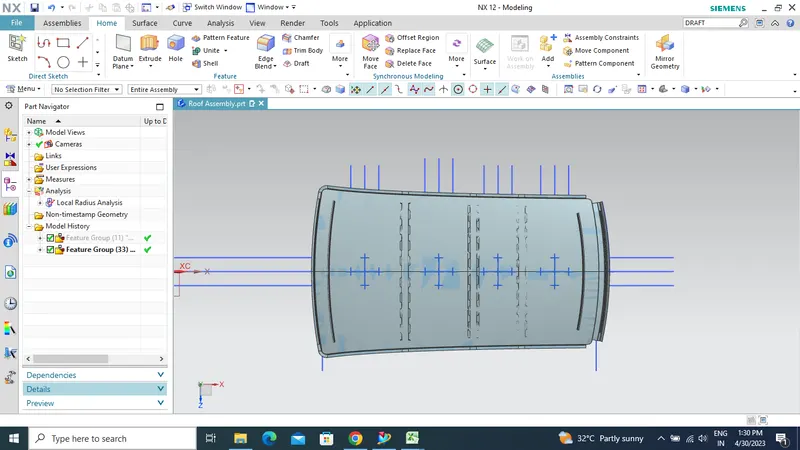
FIND THE VALUE OF Iy:
1.CENTRE ROOF RAIL
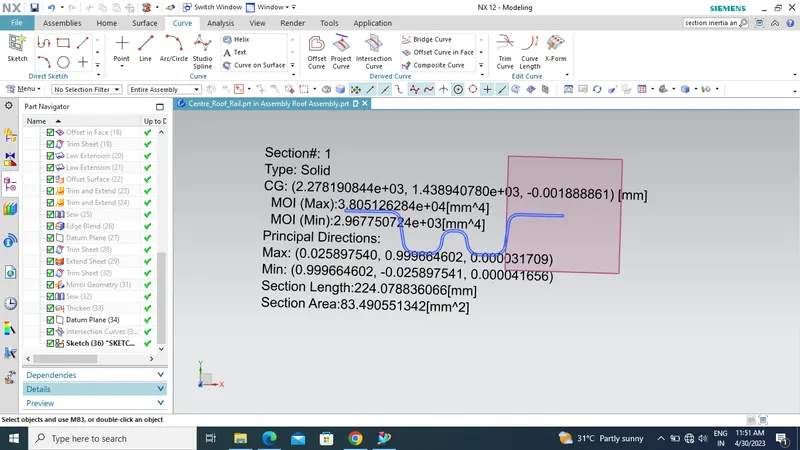
2. BOW ROOF 1
BOW ROOF 2
CALCULATION USING EXCEL BASED ON ABOVE GIVEN FORMULA:
DRAFT ANALYSIS
1. ROOF
2. FRONT ROOF RAIL
3. REAR ROOF
4. BOW ROOF 1
5. BOW ROOF 2
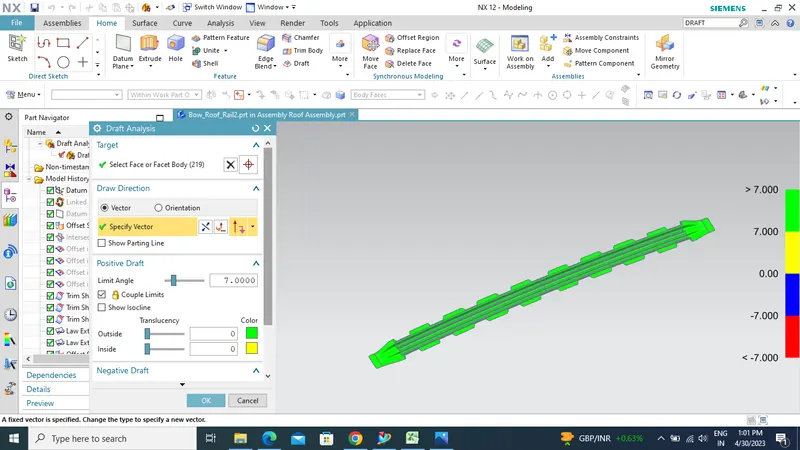
6. BOW ROOF 3
Actual test conducted by National Highway Traffic Safety Administration(NHTSA) for rollover of the vehicle to check the roof strength :
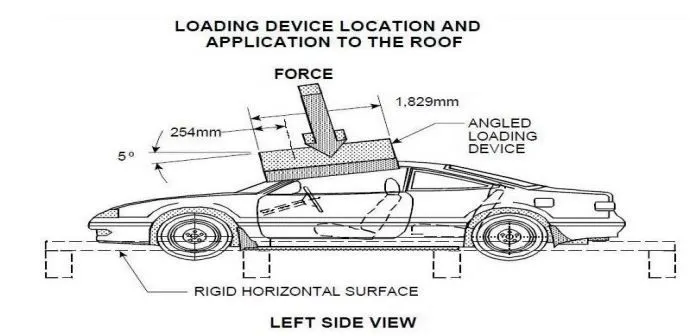
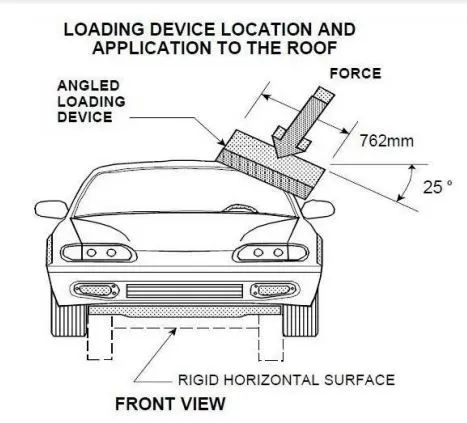
In this test, e apply the force at one side at the top surface with the block of dimensions 1829X762mm at 25°. and the strength of the ditch area of the roof and side area of the vehicle.
Conclusion:
So from this project, we learned types of roofs and reinforcement used to increases the strength of roof and design the roof according to the heat distortion criteria and snow load conditions and how to join the front roof rail, central roof rail, rear roof rail and Bows to the roof.Learned to position the bows so that we can pass the judgemental conditions of the snow load condition and hear distortion criteria.