Roof Design
ROOF DESIGN
Definition:
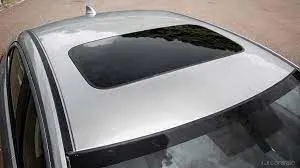
An automobile roof or car top is the portion of an automobile that sits above the passenger compartment, protecting the vehicle occupants from sun, wind, rain, and other external elements. Because the earliest automobiles were designed in an era of horse drawn carriages, early automobile roofs used similar materials and designs.
There are six types of roofs as shown below.
1. Convertible roofs
A convertible or cabriolet is a passenger car that can be driven with or without a roof in place. The methods of retracting and storing the roof vary among eras and manufacturers. A convertible car's design allows an open-air driving experience, with the ability to provide a roof when required. A potential drawback of convertibles is their reduced structural rigidity (requiring significant engineering and modification to counteract the effects of removing a car's roof). The majority of convertible roofs are of a folding construction framework with the actual top made from cloth or other fabric. Other types of convertible roofs include retachable hardtops (often constructed from metal or plastic) and detachable hardtops (where a metal or plastic roof is manually removed and often stored in the trunk).
2. Hardtop roof
A hardtop is a rigid form of automobile roof, typically metal, and integral to the design, strength, and style of the vehicle.In limited cases a hardtop roof can be detachable (often designed to store in the trunk), or retractable within the vehicle itself.The pillarless hardtop (often referred to as simply "hardtop") is a body style of cars without a B-pillar.
3. Sunroof
A sunroof is a movable panel that opens to uncover a window in an automobile roof, allowing light and fresh air to enter the passenger compartment. Sunroofs can be manually operated or motor driven, and are available in many shapes, sizes and styles. While the term "sunroof" is now used generically to describe any glass panel in the roof, the term "moonroof" was historically used to describe stationary glass panes rigidly mounted in the roof panel over the passenger compartment. A moonroof has a glass panel that is transparent and usually tinted. Previous terms include Sunshine Roof, Sliding Head and Sliding Roof.
4. T-top roof
A T-top (UK: T-bar) is an automobile roof with a removable panel on each side of a rigid bar running from the center of one structural bar between pillars to the center of the next structural bar. The panels of a traditional T-top are usually made of auto grade safety glass.The removable panel roof was patented by Gordon Buehrig on June 5, 1951. It was first used in a 1948 prototype by The American Sportscar Company or “Tasco.”The 1968 Chervolet Corvette coupe was the first U.S.-built production automobile to feature a T-top roof. This increased the popularity of the coupe, such that it outsold the convertible and later led to the discontinuation of the Corvette convertible after 1975 until it was revived in 1986. Post-C3 models were built with a targatop instead of a T-top.
5. Targa roof
Targa top, or targa for short, is a semi-convertible car body style with a removable roof section and a full width roll bar behind the seats. The term was first used on the 1966 Porsche 911 Targa, and it remains a registered trademark of Porsche AG. The rear window is normally fixed, but on some targa models, it is a removable plastic foldable window, making it a convertible-type vehicle. Any piece of normally fixed metal or trim which rises up from one side, over the roof and down the other side is sometimes called a targa band, targa bar, or a wrapover band.Targa tops are different from T-tops, which have a solid, non-removable bar running between the top of the windscreen and the rear roll-bar, and generally have two separate roof panels above the seats that fit between the window and central t-bar.
6. Vinyl roof
Vinyl roof refers to a vinyl covering for an automobile's top.This covering was originally designed to give the appearance of a convertible to models with a fixed roof and eventually evolved into a styling statement in its own right. Vinyl roofs were most popular in the American market, and they are considered one of the period hallmarks of the 1970s domestic cars. Vinyl roofs were also popular on European- (especially UK-) and Japanese-built cars during the 1970s, and tended to be applied to sporting or luxury trim versions of standard saloon (sedan) models.
Manufacturing process of car roof:
When we talk about hardtops, we are referring to the common rigid forms of automobile roofs which we see around. In modern-day cars, this type of roof is made from metal or plastic. he invention discloses a manufacturing process of an automobile roof component. The manufacturing process of the automobile roof component comprises the following steps respectively consists of an outer plate processing process, a strip-shaped assembly and annular assembly processing process and an automobile roof side beam processing process, and finally, an automobile roof combining process comprises the following steps that 1, a plurality of M6 screw nuts are arranged on one side of an annular assembly through spot welding, and two M6 screw nuts are arranged at two ends of a strip-shaped assembly through spot welding; 2, the strip-shaped assembly is arranged at the other side of the screw nut corresponding to the annular assembly through spot welding, and in addition, the annular assembly and the strip-shaped assembly are punched for alignment; 3, the annular assembly is welded at the inner side of an outer plate; 4, an automobile roof side beam is arranged at the inner side of the outer plate through spot welding, and finally, an automobile roof is integrally subjected to burr grinding and ending. The manufacturing process of the automobile roof component disclosed by the invention has the advantages that the process is simple, and the production efficiency is high. When it comes to materials you have two options, steel or aluminum. You might see the occasional wood roof rack, but they are not a great long-term solution as they will weaken over time and are not as durable. Think of your roof rack as an extension of your vehicle; it should be as rigid and strong as possible.
Calculations of roof design:
Bow–Roof Prediction Formula :
W = [1.73 x 10^(-3) x L] + [1.85 x 10^(-8) x (R^2)/t] + [ 1.10x10^(-3) x l] - 2.68
R = 2(Rx*Ry)/(Rx+Ry)
L = 2026.86mm
CASE 1
I = 413.11mm
Rx = 3657.85mm
Ry = 1549.92mm
R = 2.47mm
W = 1.28mm
CASE 2
I = 371.54mm
Rx = 5535.17mm
Ry = 4548.40mm
R = 4995.50mm
W = 1.86mm
CASE 3
I = 436.86mm
Rx = 2945.92mm
Ry = 3590.06mm
R = 3236.24mm
W = 1.56mm
CASE 4
I = 377.02mm
Rx = 2649.36mm
Ry = 2199.97mm
R = 2403.84mm
W = 1.38mm

Conclusion
Hence the conditions are correct.
Snow Load Prediction Formula :
Qr = [Iy x t2] / [α x s x [(Rx + Ry)/2]2 x 10-8]
α = My x Lx2 x 10-12 , My = Y(Ly-Y)
s = L1/2 + L2/2
FRONT ROOF-BOW ROOF 1
α = 0.93
s = 1108.3
Qr = 0.83
BOW ROOF 1-CENTRE ROOF
α = 1.13
s = 478.85
Qr = 0.92
CENTRE ROOF-BOW ROOF 2
α = 0.84
s = 514.8
Qr = 0.46

Conclusion
Hence the conditions are not satisfied and should be analyzed.
1. FRONT ROOF DRAFT ANALYSIS
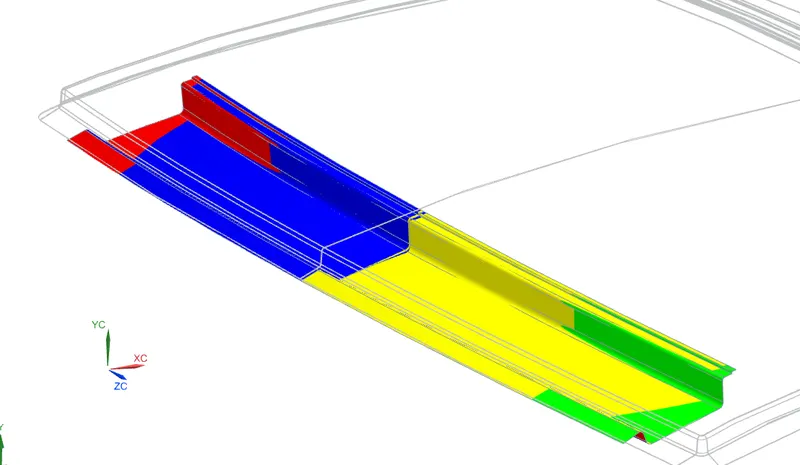
2. BOW ROOF 1 DRAFT ANALYSIS
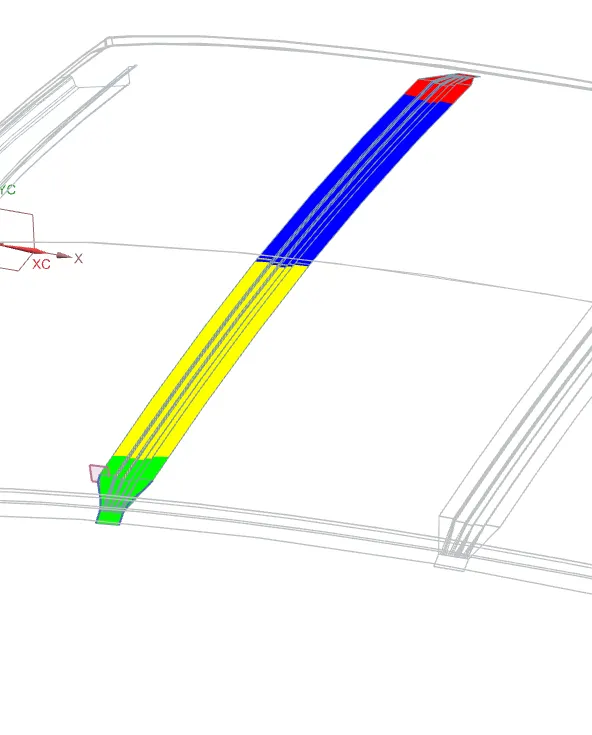
3. CENTRE ROOF DRAFT ANALYSIS
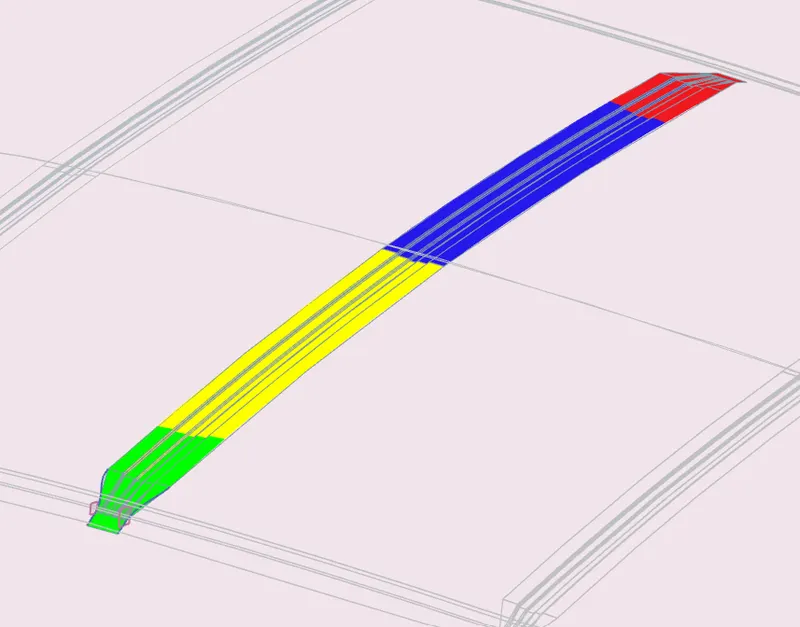
4. BOW ROOF 2 DRAFT ANALYSIS
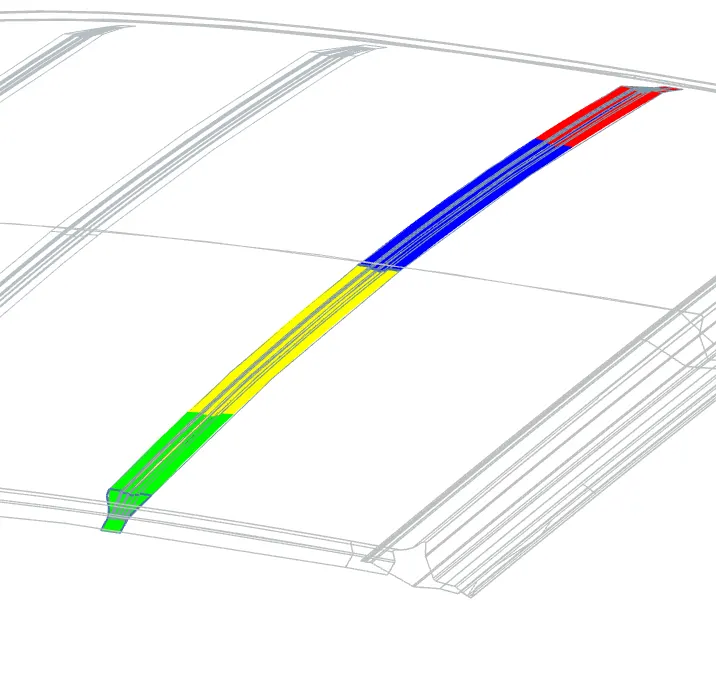
5. REAR ROOF DRAFT ANAYSIS
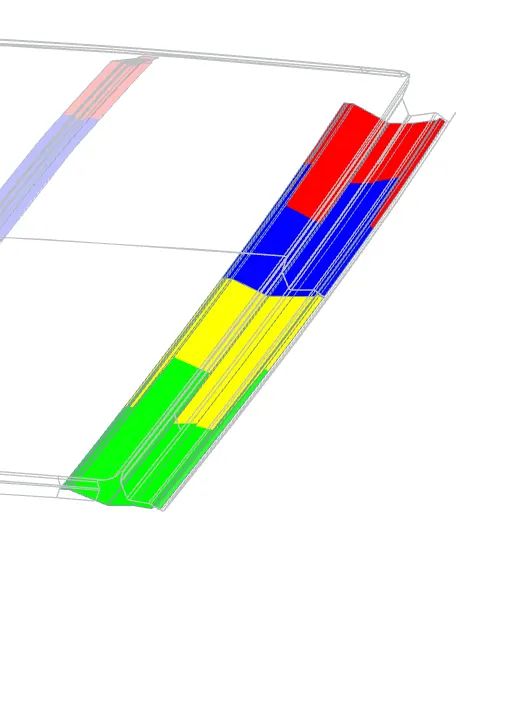
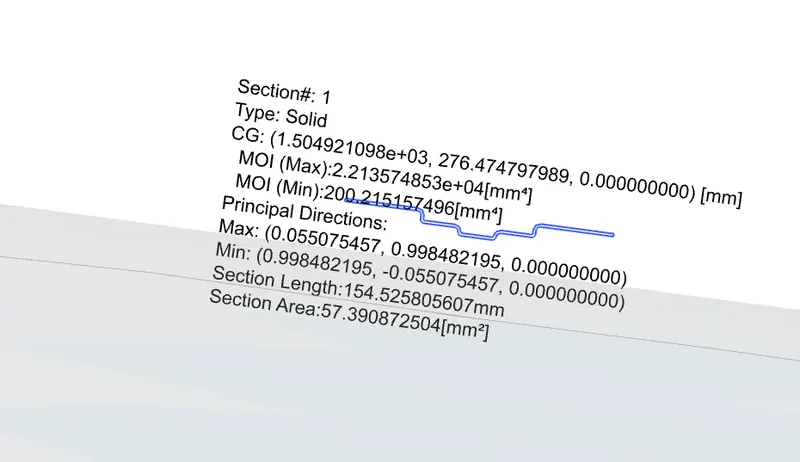
INERTIA:
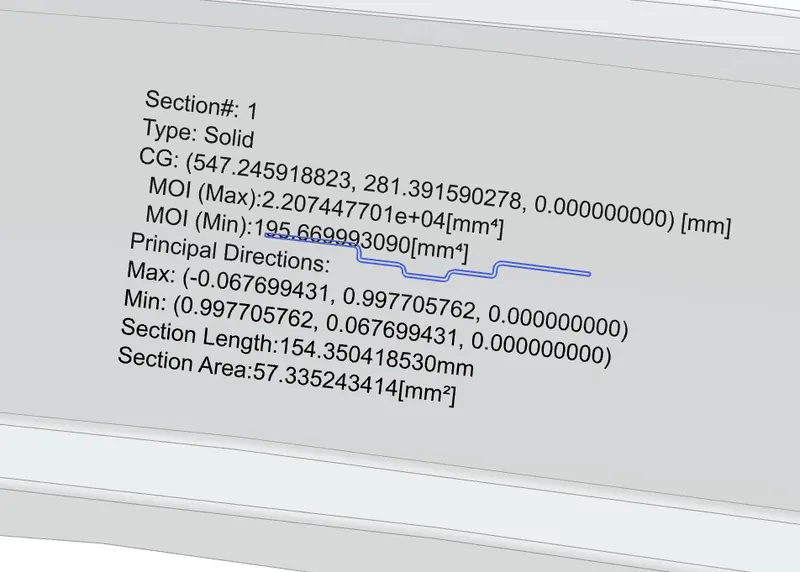
1.BOW ROOF 1
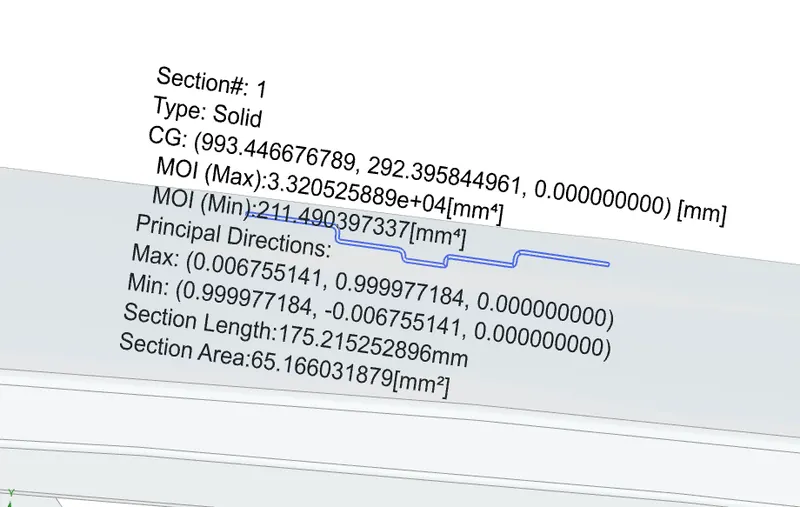
2.CENTRE ROOF
3.BOW ROOF 2