Roof Design
AIM : To Design Roof, Bow Roof Rail, Central Reinforcement and Calculations.
Objective:
- For a given roof styling Come up with a design of the roof and its various components such as front roof rail, Bow roofs, and rear roof rail provide it with essential reinforcements and flanges required.
- To perform a curvature study on the given styling to decide the positions of bow roofs, test the roof for heat distortion and snow load condition.
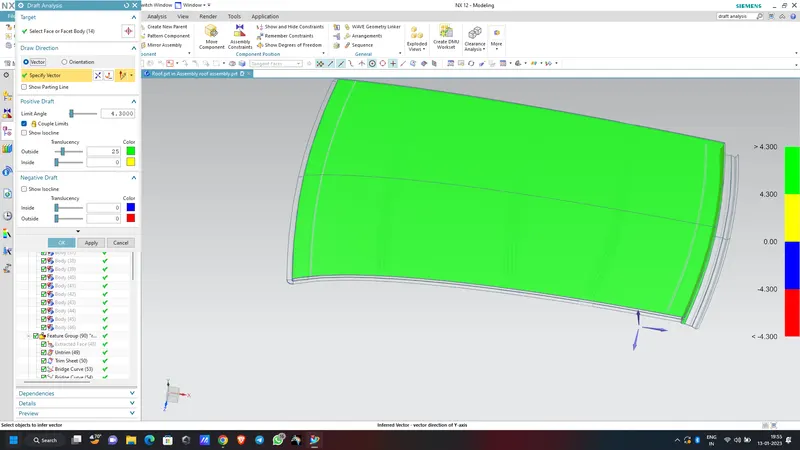
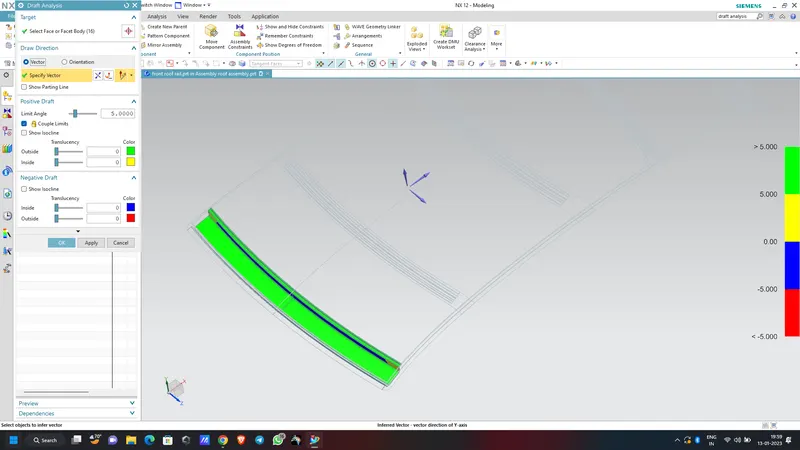
- To perform draft analysis on the various components of the roof, to ensure that they are ready for production.
- To perform section inertia study for the various components of the roof.
1.0 Introduction:
ROOF:
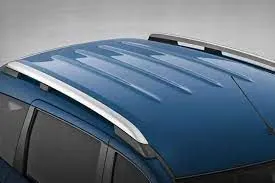
An automobile roof or car top is the portion of an automobile that sits above the passenger compartment, protecting the vehicle occupants from sun, wind, rain, and other external elements. As, it looks simple to see the roof but it plays a crucial role in providing the necessary strength to the car and also protection to the passengers in case of a roll-over crash.
So, the design of the roof is very important with its essential flanges, reinforcement, and various elements of the roof.
Now, many variations in the design of roofs have emerged.
- Convertible Roofs
- Softtop roofs made up of cloth
- Detachable hardtop roofs
THEORY :
An automobile roof or car top is the portion of an automobile that sits above the passenger compartment, protecting the vehicle occupants from sun, wind, rain, and other external elements.
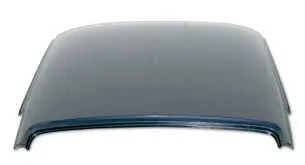
The roof is a styling surface part which is fixed with the BIW body through the rails and panels inside the upper roof to provide it strength and stiffness.
Ditch area plays an important role here to fix the reinforcement on the component.
The rails and reinforcements are joined to the ditch area with a spot weld where it's not the styling part.
The required tool opening angle is minimum 3 Degrees.
Factors which is considered before creating Ditch area,
- Headroom clearance
- Visibility criteria
- Back door assembly
- Windshield assembly
APPROACH TO WORK ON THE PROJECT :
(1). Designing the roof surface usings styling part.
(2). Creating Front Roof Rail.
(3). Creating Rear Roof Rail.
(4). Creating Front Bwo Roof Rail 1.
(5). Creating Rear Bwo Roof Rail 2.
(6). Creating Reinforcement Roof Rail with Bwo Roof Rail 3.
(7). Creating and Measuring all required arcs/curves/length for calculations.
(8). Heat Distortion Calculation.
(9). Snow Load Calculation.
(10). Draft Analysis.
BASIC ELEMENTS OF ROOF
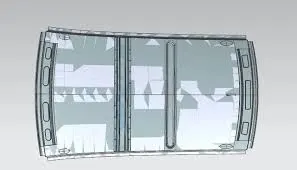
A roof is not a single component but it is an assembly of various components joined together to form a complete roof. The first component of the roof is the outer panel.
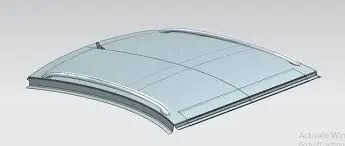
Outer Panel- Forms the outer covering of the roof with other elements enclosed beneath it, It provides sufficient strength to the structure of car body by forming top covering for the compartment of the car it also increases the aesthetic look of the car.
STRUCTURAL COMPONENTS OF ROOF
- Front roof rail reinforcement (FR)
- Bow roof reinforcement 1 (BR 1)
- Center Bow roof reinforcement (primary)
- Center Bow roof reinforcement (Secondary)
- Bow roof reinforcement 2 (BR 2)
- Rear roof rail reinforcement (RR)
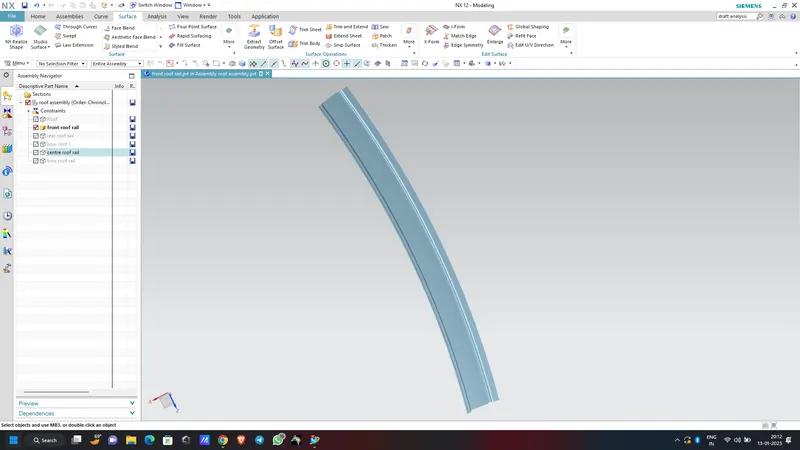
Front roof rail reinforcement (FR): This forms the first element of the roof assembly located at the front side of the car it comes in contact with the car's windshield glass, side body of the car. It is usually provided with the intent to strengthen the front side of the roof rail, while designing this headroom clearance, visibility criteria should be taken as a design consideration. Generally, it is made up of a thin sheet of metal having a thickness in the range of 0.6-0.75mm having an opening angle of 3 degrees, certain embossed are also provided with drat angle more than or equal to 5 degrees for the deep-drawing operation.
First & Second bow roof rail reinforcement (BR 1 & BR 2):
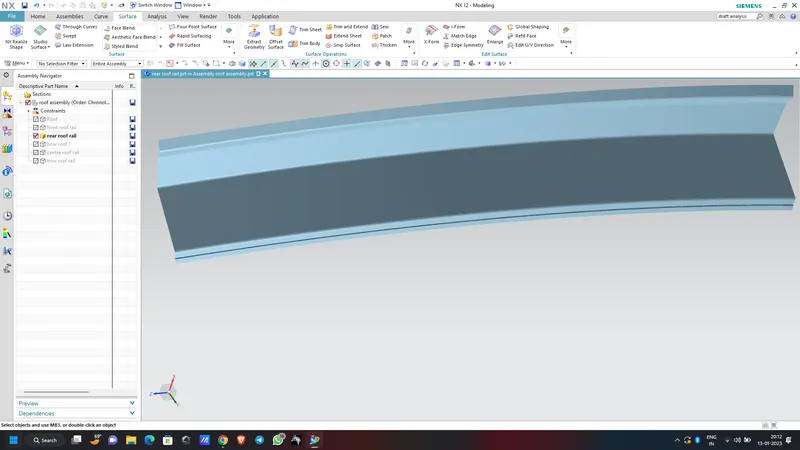
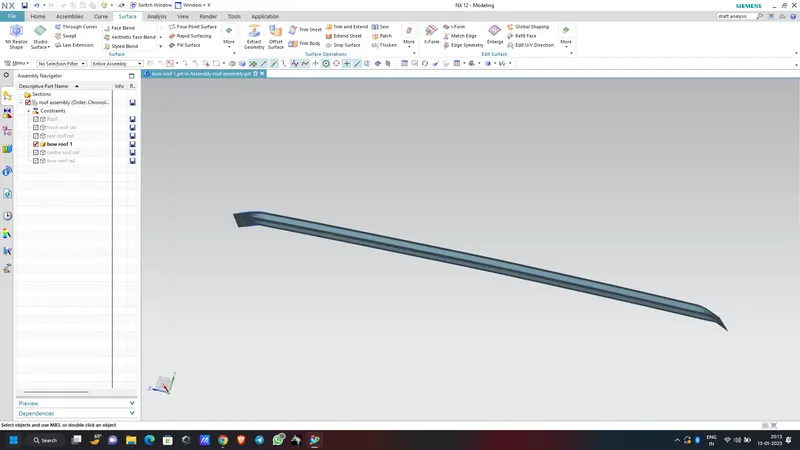
These bow roofs are added to provide extra strength to the roof assembly the number of these intermediate bow roofs completely depends on the size of the roof. Its number may be a single bow roof or more than two bow roofs. This provides sufficient strength to the complete roof assembly the position of these bow roofs is decided by performing the curvature study of the roof surface. Mostly where there is a flat surface or less curvature these are introduced. These are again provided with mastic sealants and necessary embosses to increase the strength of the roof.
Center bow roof rail reinforcement (Primary & secondary):
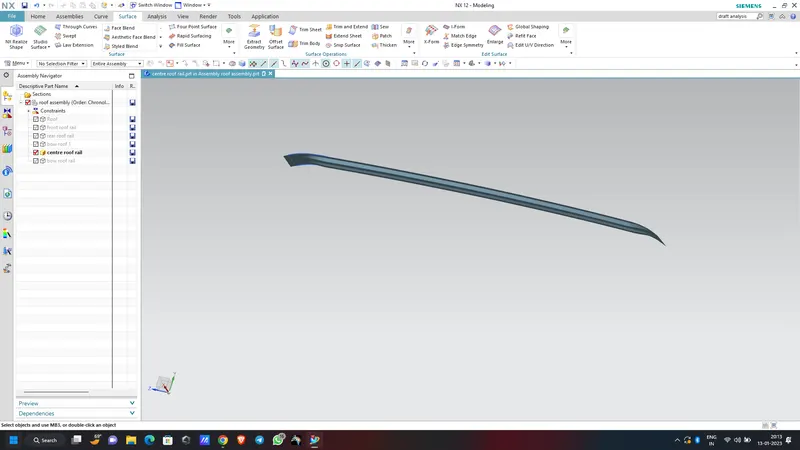
This is the center bow roof as the name suggest this is located at the center portion of the roof assembly it is a bow roof which comprises of a secondary bow roof embedded into the primary bow roof this done to provide strength and support to the roof assembly in case of a rollover crash. The secondary bow roof is provided with the same curvature as that of the primary and this two are joined with mastic sealants rather than spot welding as these are placed under styling surface.
Rear roof rail reinforcement (RR):
This is the support which comes in contact with the backdoor, sidebody and other inner panels of the car. While designing this rear visibility criteria and head room clearance should be taken into account the design inputs of rear rail depends on how the back door arrangement is to be provided as backdoor is directly spot welded to the tail end of the rear rail and other portion of rear rail is attached with mastic sealants with the roof outer panel.
3.0 CURVATURE STUDY OF ROOF & BOWS
Curvature study is to be performed on the roof styling surface and Bow roofs to determine there position to decide where to placed which bow roof and to get knowledge of whether our design fulfills the requirement or not. Their are various tests which are to be carry out in this curvature study we will focus on two tests.
- Heat distortion Criteria
- Snow-load condition
Heat Distortion Criteria
Heat distortion is the temperature at which the metal softens and deforms under the action of specific load. This test is perform upon the roof to check the ability of the roof to withstand the high temperature with the positioned reinforcements which increased the strength of overall roof.
Heat distortion criteria: Heat distortion test is to check the strength of the roof. Heat distortion temperature is when the metal softens and deforms under specific loads.
- To calculate the heat distortion criteria by the bow roof position formula.
- We need to create a sketch , draw a line on the center of the roof on OY axis
- Draw a line from the center line by a 300mm distance.
- Draw a line from 100mm distance on both sides of the 300mm line
- Draw a line between the center of roof rails and draw the lines from the center line by the distance of 100mm on both sides.
- Atlast make an intersection on these lines from a coincident line to get points.
- From that point draw a three point arc and measure the Radius of the arc that will be our Rx and Ry values
Heat distortion Prediction formula
W = [1.73 x 10^(-3) x L] + [1.85 x 10^(-8) x (R^2)/t] + [ 1.10x10^(-3) x l] - 2.68
Judgement Condition : OK< 2.7> 3.1
Where
L = Roof Length in X-Direction[mm](Roof dimension in 0-Y)
R = Roof curvature
R = 2(Rx*Ry)/(Rx+Ry)
Rx = X curvature
Ry = Y curvature
t = Roof plate thickness [mm]
l = Bow Roof Span [mm]
Snow load condition
Snow load condition is performed on the roof to check the stiffness of the roof i.e the roof should withstand the load of the snow during the snow fall with its structural components if not then it should deformed upon the action of load applied by the snow but after the removal of load it should again bounce back tonits original shape without any permanent deformation of any of the structural components of roof.
Snow load test used to verify that roof assembly exhibited no permanent deflection due to distributed load representing snow load.
- To calculate the snow load condition, we have a snow load formula.
- To measure the required values.
- I created a sketch and drew a line on the OY axis from the center of the roof.
- From that line draw a parallel line distance of 100mm on both sides.
- Then make intersection points of these lines and draw a three point arc.
Snow load Prediction formula
Qr = [Iy x t2] / [α x s x [(Rx + Ry)/2]2 x 10-8]
Note: The Qr value given over here is correct. There was a typo error in the formula given in the video.
Where
α = My x Lx2 x 10-12 , My = Y(Ly-Y)
Judgement condition = Qr ≥ 3.1
250 ≤ s ≤ 380
t = Roof plate thickness [mm]
Ly = Distance between the front and rear roof Rails on the Vehicle along with 0Y[mm]
Length of Roof panel with the center point between Roof rail Front /Rear as the front and rear reference point.
Lx = Distance between the Left and Right end of the roof on the Roof BOW [mm]
Width of the roof panel exposed on the surface.
Y = Distance front Front Roof Rail to Roof BOW[mm]
s = Distance for which Roof BOW bears divided load [mm]
s = L1/2 + L2/2
Iy = Geometrical moment of inertia of Roof BOW (Y cross-section )[mm4]
Rx = Lateral direction curvature radius of roof panel Y cross-section on Roof BOW [mm]
Roof panel curvature Radius of the Length Lx in Front view
Ry = Longitudinal Direction curvature radius of the Roof panel X cross-section on Roof BOW [mm]
Roof panel X curvature radius of lengths in Side view
Draft analayasis:
CONCLUSION :
- The Design of Roof, Front roof rail, Rear Roof Rail, Bow Roofs, and reinforcement roof center by following the Master section with the design parameter for the given class A surface is done.
- Thus from calculations made the heat distortion criteria and snow load condition criteria was satisfied and the positioning of the BOW Roofs were determined.