Roof Design
Objective: To design a roof and its reinforcement structures from an existing styling surface. To perform heat distortion and snow load calculations and to perform draft analysis.
Introduction: The car roof refers to the topmost part of a vehicle that covers the interior, providing protection from the elements. It's essentially the overhead structure that encloses the passenger compartment. Car roofs come in various styles such as hardtop, soft-top, convertible, sunroof, or panoramic roof, offering different functionalities and designs. They contribute to the car's overall structure, and aerodynamics, and can also feature additional elements like sunroofs or moonroofs for ventilation and natural light inside the vehicle.

Source: https://estudioespositoymiguel.com.ar/
Necessity for reinforcements: The flat regions of a roof are relatively weaker in withstanding loads when compared to curved regions. In order to protect the structure from deformation from any kind of load, reinforcements are required.
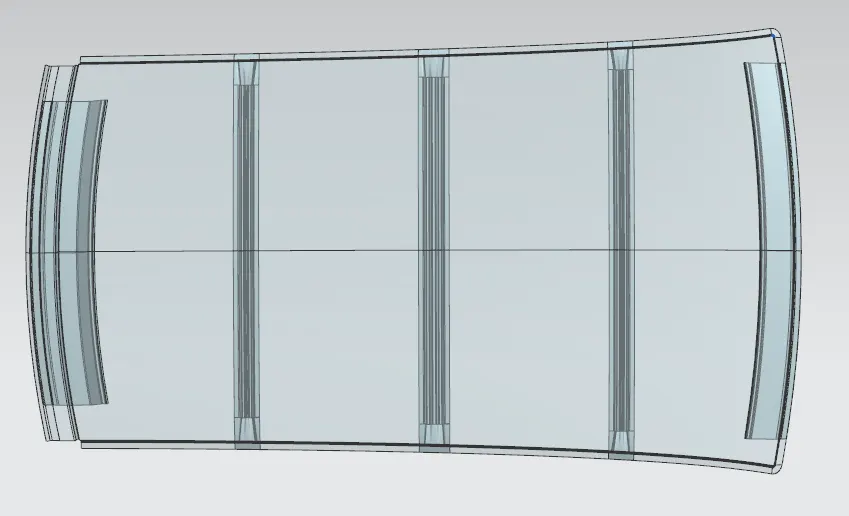
The types of reinforcements are front roof rail, bow roofs, central roof rail, and rear roof rail.
Front roof rail: It is a structural component of the car's roof that runs along the front edge of the roof, typically connecting the A-pillars and providing structural support to the front of the roof. It plays a crucial role in enhancing the vehicle's safety by helping to maintain the integrity of the passenger compartment in the event of a collision
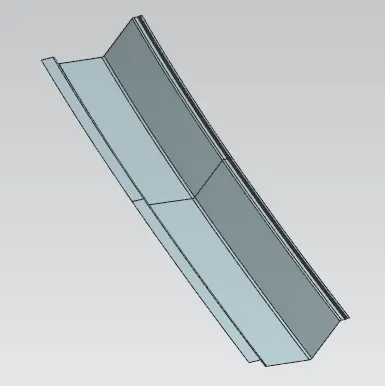
Bow Roof and Central Roof rail: These reinforcements are provided in the almost flat surfaces in a roof where they contribute to rigidity.
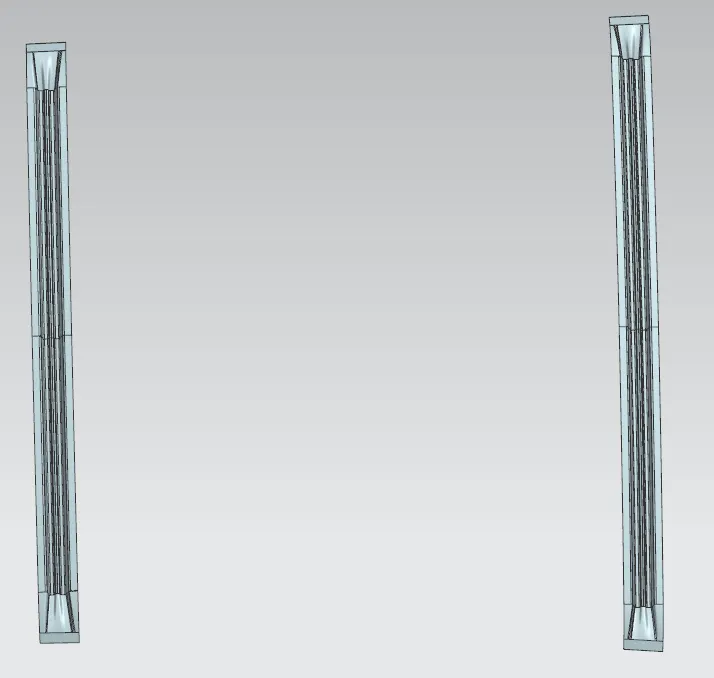
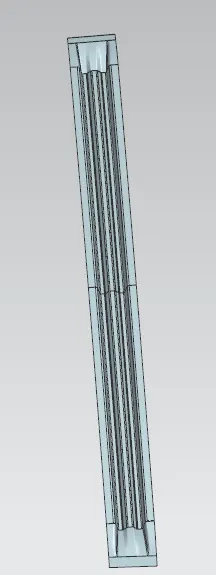
Rear Roof Rail: It is located at the back of the roof, connecting the B-pillars. Similar to the front roof rail, it plays a critical role in maintaining the structural integrity of the vehicle, especially in rear-end collisions or rollover scenarios.
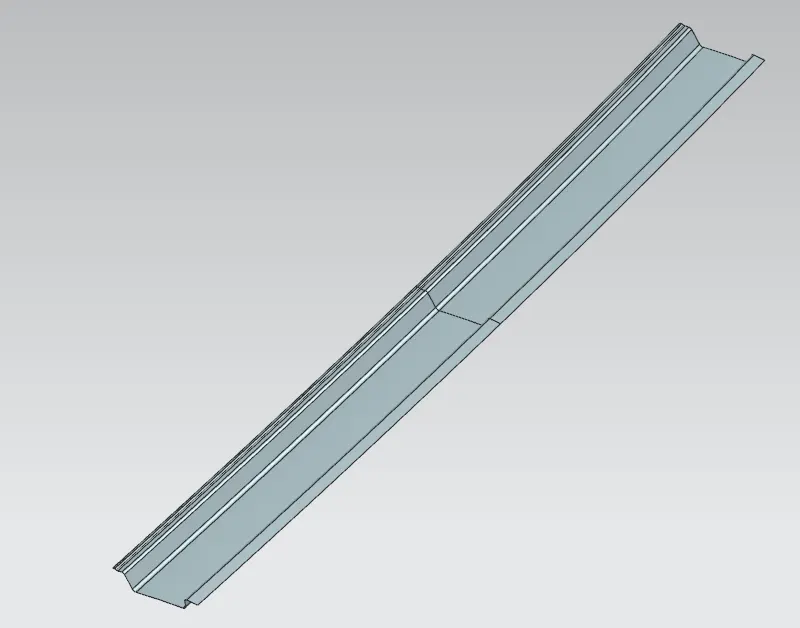
Heat Distortion Study: A heat distortion study on a car roof typically involves assessing how different temperatures affect the structural integrity and material properties of the roof. This includes examining potential issues like warping, bending, or any other form of deformation that might compromise the roof's function or safety.
Bow–Roof Prediction Formula
W = [1.73 x 10^(-3) x L] + [1.85 x 10^(-8) x (R^2)/t] + [ 1.10x10^(-3) x l] - 2.68
Where,
L = Roof Length in X-Direction[mm](Roof dimension in 0-Y)
R = Roof curvature
R = 2(Rx*Ry)/(Rx+Ry)
Rx = X curvature
Ry = Y curvature
t = Roof plate thickness [mm]
l = Bow Roof Span [mm]
Judgment Condition
OK< 2.7

We can see that all the W values satisfy the condition of less than 2.7
Snow Load Calculation: This test is to predict how the roof will behave when snow accumulates. Dents may get formed due to the load acting by snow. But the structure has to get back to its original position at the removal of snow.
Snow Load Prediction Formula
Qr = [Iy x t2] / [α x s x [(Rx + Ry)/2]2 x 10-8]
α = My x Lx2 x 10-12 , My = Y(Ly-Y)
t = Roof plate thickness [mm]
Ly = Distance between the front and rear roof Rails on the Vehicle along with 0Y[mm]
Length of Roof panel with the center point between Roof rail Front /Rear as the front and rear reference point.
Lx = Distance between the Left and Right end of the roof on the Roof BOW [mm]
The width of the roof panel is exposed on the surface.
Y = Distance front Front Roof Rail to Roof BOW[mm]
s = Distance for which Roof BOW bears divided load [mm]
s = L1/2 + L2/2
Iy = Geometrical moment of inertia of Roof BOW (Y cross-section )[mm4]
Rx = Lateral direction curvature radius of roof panel Y cross-section on Roof BOW [mm]
Roof panel curvature Radius of the Length Lx in Front view
Ry = Longitudinal Direction curvature radius of the Roof panel X cross-section on Roof BOW [mm]
Roof panel X curvature radius of length s in Side view
Judgment condition
Qr ≥ 3.1

It is seen that the Qr value is not satisfied in all the cases. So embosses have to be added to strengthen the bow roofs.
Draft Analysis:
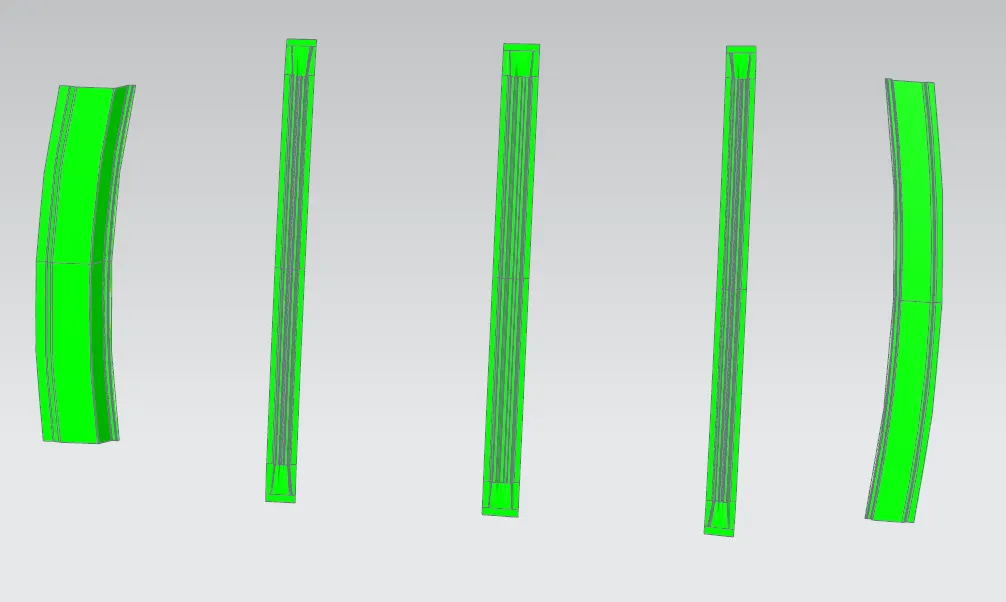
All the reinforcement components are clearing the minimum draft angle of 7 degrees.
Manufacturing:
1. Stamping: Steel roofs are often formed through a process called stamping. This involves pressing a steel sheet into a die to give it the desired shape. The process requires precision machinery and dies specific to the roof's design.
2. Welding and Assembly: Various sections of the roof might be welded together to form the complete structure. This could involve spot welding or other techniques to join the different components securely.