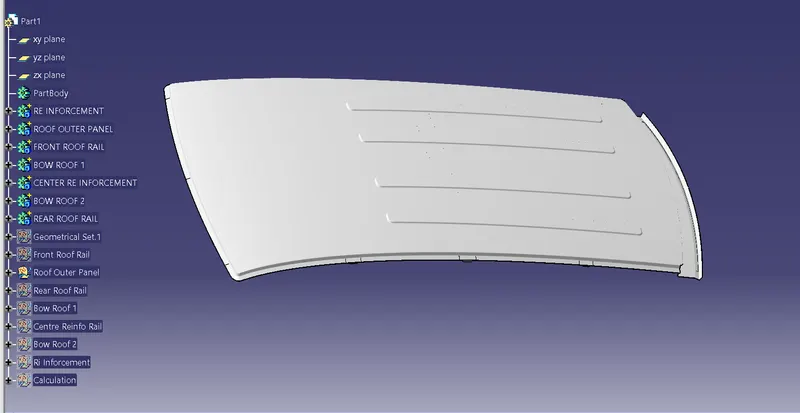
Roof challenge
AIM: For the given car roof styling,design and develop the essential flanges and reinforcement,namely the Ditch area,Frontal Roof Rail,Rear Roof Rail, Centre Roof Rail and Bow Roofs.
Do the curvature study on the roof and perform the calculation for Heat Distortion and Snow load criterion to determine and justisify the positiom of the bow roofs.
INTRODUCTION: An automobile roof is the portion of an automobile that sits above the component, protecting the vehicle occupants from sun heat,rain wind and other external factors.
ROOF DESIGN:
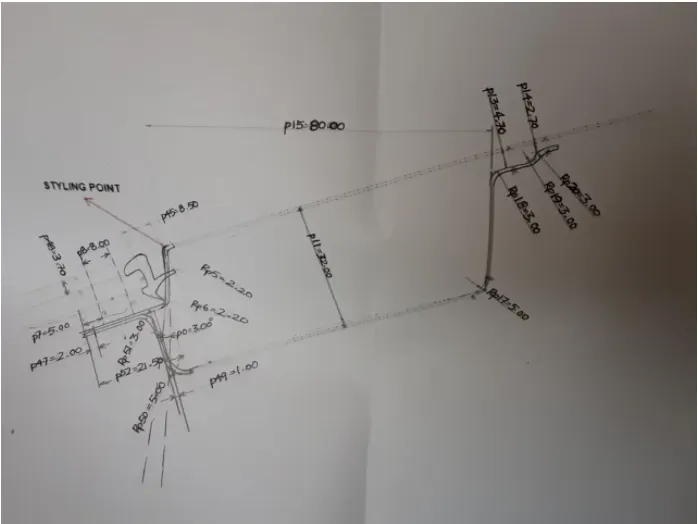
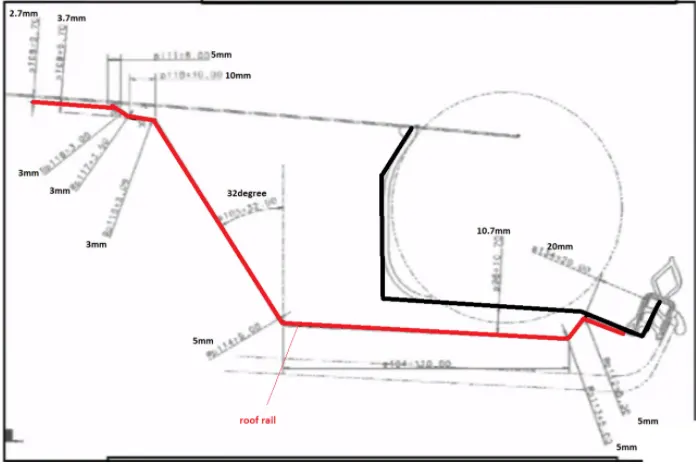
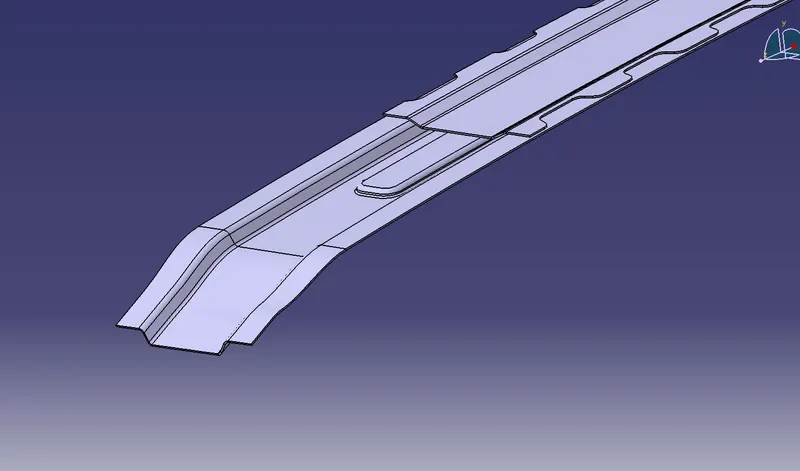
Given surface is A-class and we have to design roof surface with the help of given class-A surface and Master section which is shown below:
There is two master section for the front end roof rail and the next one is for the rear rail roof section.
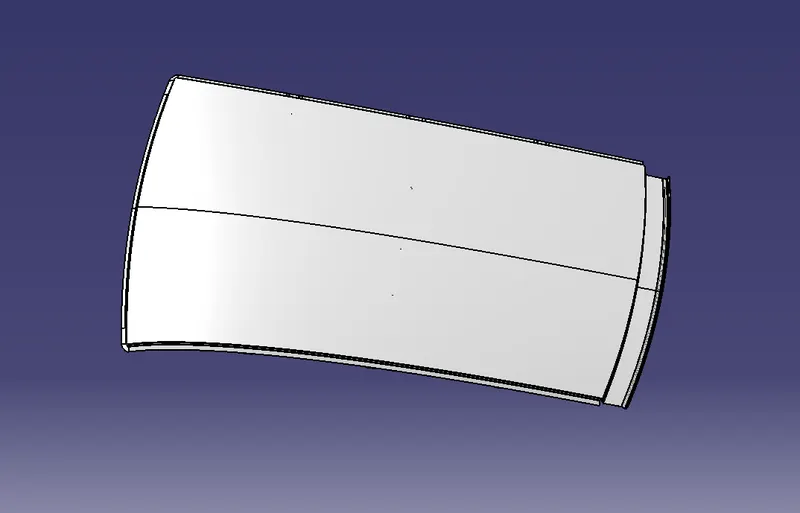
Outer Roof:
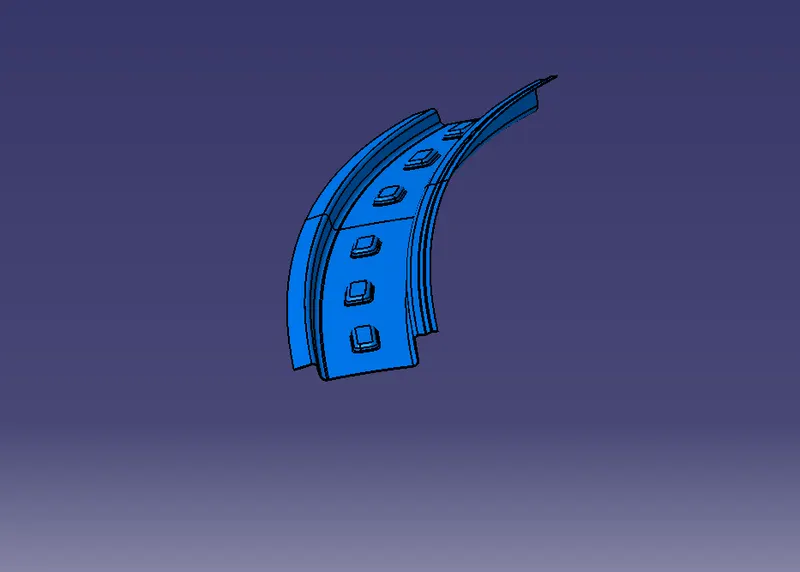
Front Roof Rail:
It is the support that is joined thw windsheild glass.Its thickness is usually 0.75mm. The windshield end flanges are the extract offset os the roof surface. The bottom flanges are decided after taking into consideration the visibility criteria. Spot weld is applied at the wind sheild end of the other end is joined with theroof using Mastic sealents.
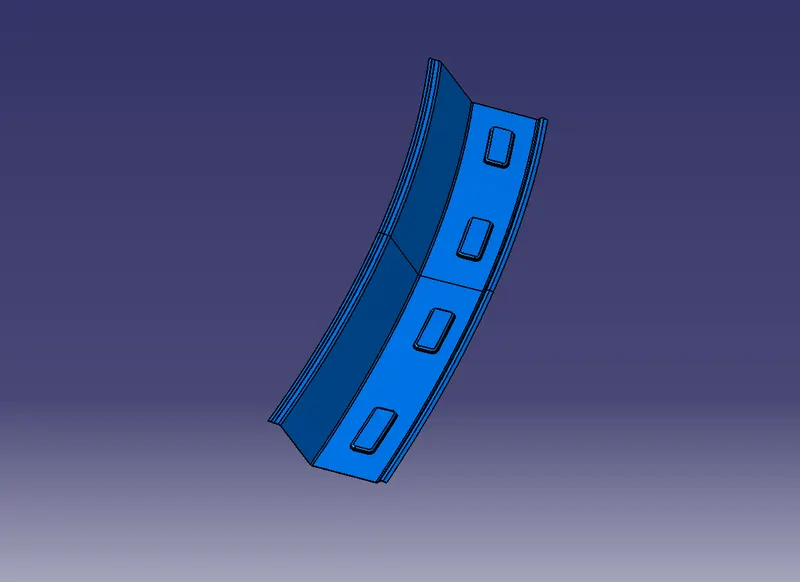
Rear Roof Rail:
It is support that is joined to the back door and the body side outer and the inner panels.It is usually made from body side outer scarp ande therefore the thickness of the rail is 0.75mm. It is similar to the front roof rail design. We have to take consideration the rear head room clearence and the rear visibility criteria.Spot welds are applied at the back door end of the rail and the other end is joined with the roof using Mastic sealants.
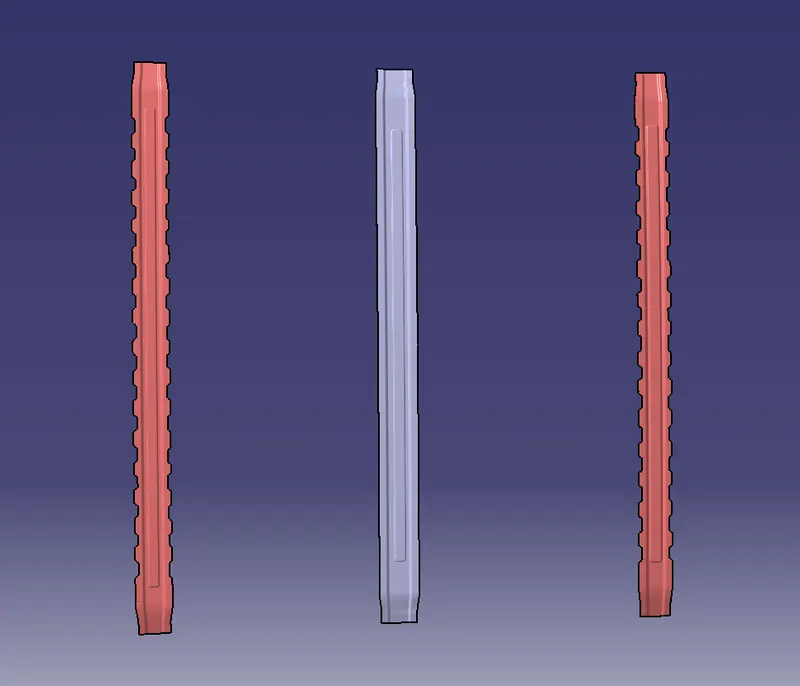
Bow Roof Rails :
Similar to the other design,we have to take into consideration of head room clearence and visibility criteria while designing the bow roof rails and centre roof rail. Here spot weld is not applied for joining these rails of the roofs.for increasing the strength of the rails, Embossing is done.and thickness of the rails is 0.75mm.
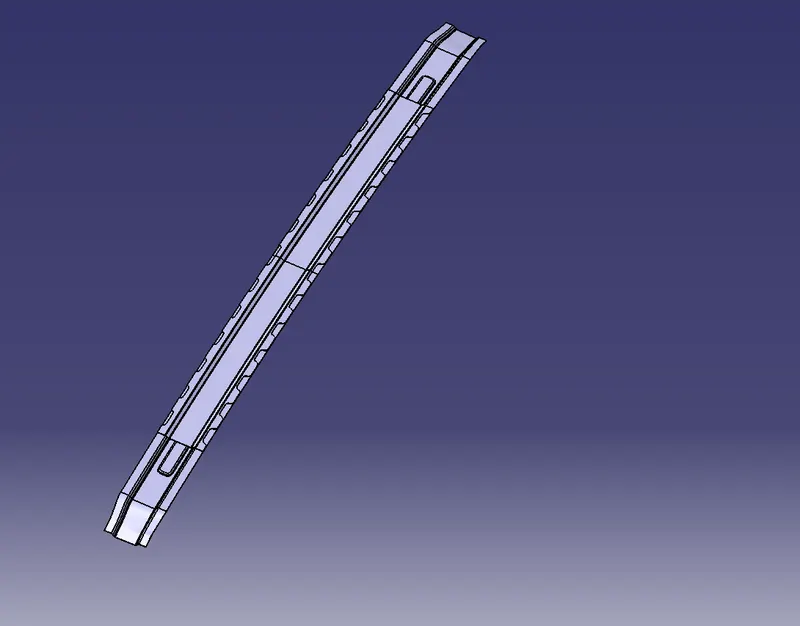
Reinforcement Centre Rail :
It is the main supporting rod for the roof. Their purpose is to provide an attachment point for crossbars and other devices designed to secure loads carried on the roof of the vehicle, it absorbs energy at the time of the crash.Its thickness is 0.75mm.
Analysis:
1) CURVATURE STUDY :
It is done to justify the positioning of the bow roofs. There are mainly two criteria to fullfill.
* Heat Distortion Criteria.
* Snow Load Criteria.
Head Distortion Formula :
W= [1.73x10^(-3)xL]+[1.85x10^(-8)x(R^2)/t]+[1.10x10^(-3)xl]-2.68
where
Judgement Condition:OK<2.7>3.1
L= Roof length in X direction(mm).
R= Roof Curvature
R=2(Rx * Ry)/(Rx+Ry)
Rx= X curvature.
Ry= Y curvature.
t= Roof plate thickness(mm)
l= Bow Roof Span (mm)
From the model we have the values shown in below fig.
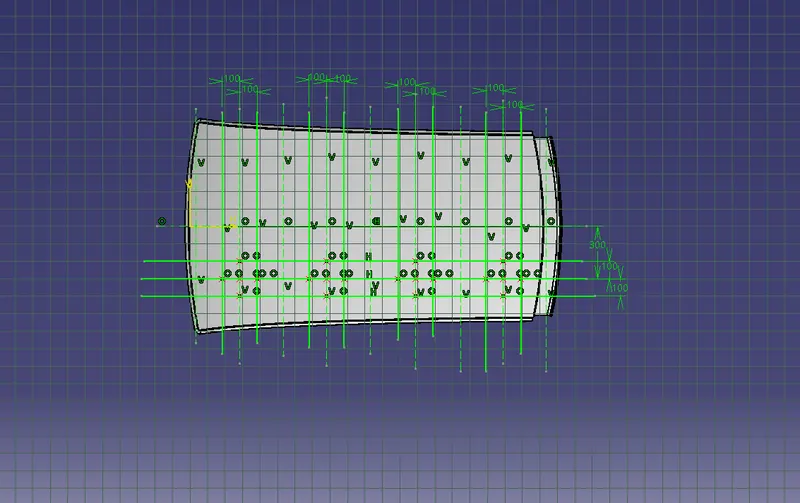
The Horizontal line is Rx and the vertical line is Ry.
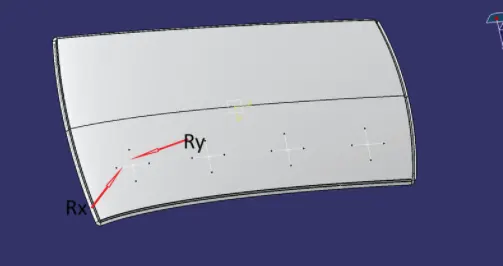
The radius of curvature for the hood component along the x-axis is given below:
Rx values:
The radius of curvature for roof component along the x-axis is given below.
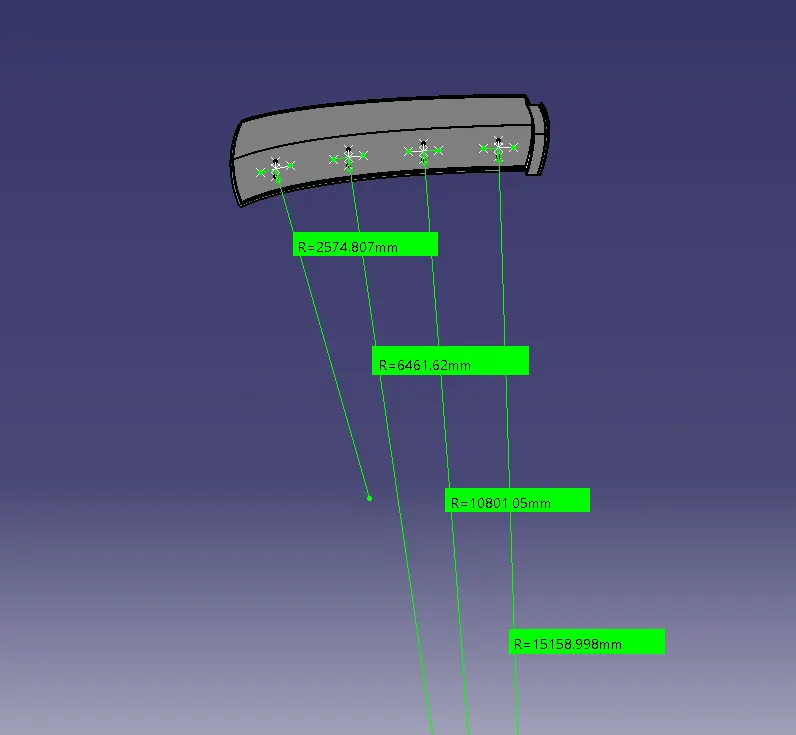
Ry values:
the radius of curvature of the roof component along the Y-axis is given below:
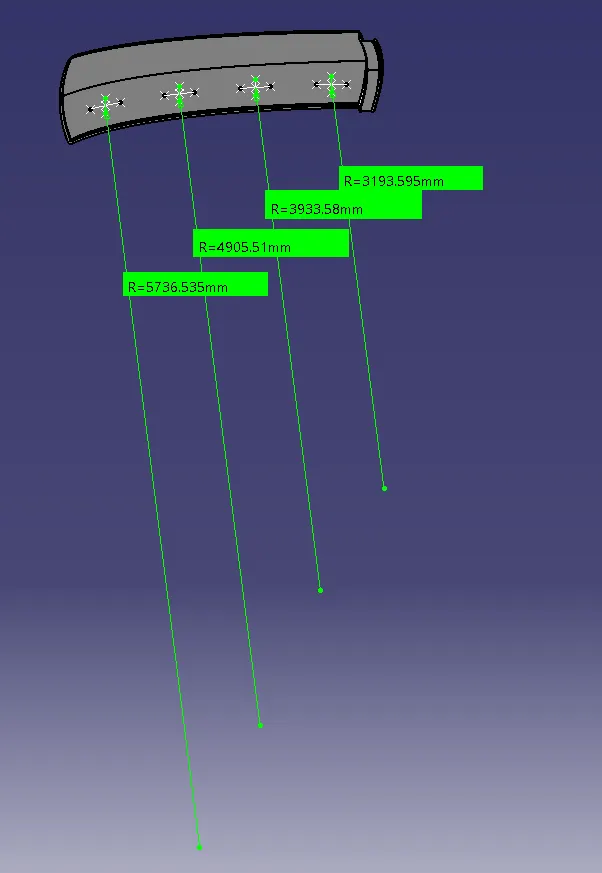
Calculations are done and tabulated in the given table below:
| ROOF | Rx(mm) | Ry(mm) | R(mm) | l(mm) | L(mm) | R^2/t(mm) | t(mm) | W(mm) | Status |
| FR & BW1 | 5763.53 | 2574.80 | 3554.28 | 405.92 | 2153.4 | 1684x10^4 | 0.75 | 1.7 | OK |
| BW & CR | 4905.55 | 6461.62 | 5577.07 | 419.09 | 2153.4 | 4147x10^4 | 0.75 | 2.2 | OK |
| CR & BW2 | 3933.58 | 10801.05 | 5766.90 | 443.50 | 2153.4 | 4434x10^4 | 0.75 | 2.3 | OK |
| BW2 & RR | 3193.59 | 15158.99 | 5275.64 | 328.25 | 2153.4 | 3710x10^4 | 0.75 | 2.0 | OK |
From the above 'W' values, the judgement is correct for all the rails position, Which is less than 2.7 for the Bow roof distance prediction.
Snow Load Criteria :
The roof of an automobile must be able to withstand load espesially snow which results in heavy load acting on the roof. If the roof is not able to withstand it, there will be deformation of the roof, to prevent that snowed criteria calculation help us to determine wheather the roof design will withstand with snow load.
Snow criteria predicted formula:
| Qr=Iy*t^2/α*s*[(Rx + Ry)/2]^2*10^-8 |
Where,
| α=My*Lx^2*10^-12 |
My=Y(Ly-Y)
judegment condition, Qr>3.1
Iy=Geometrical moment of inertia of roof bow.
t= Thickness of plate
Y=distance between bow roof centers.
Ly=length of the roof in 0-Y section
Lx=width of the roof
S=distance for which roof bow bears divided load
S=L1/L2 + L2/2
Rx Value:
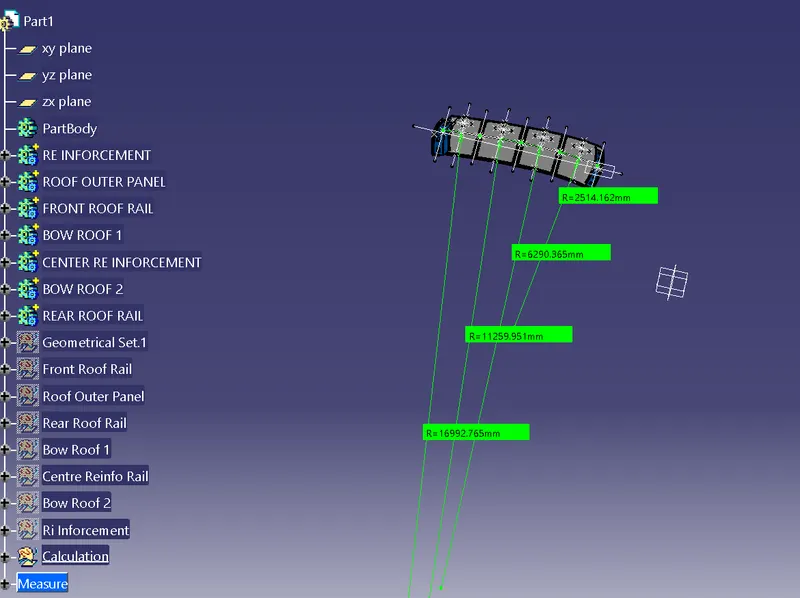
Ry Value:
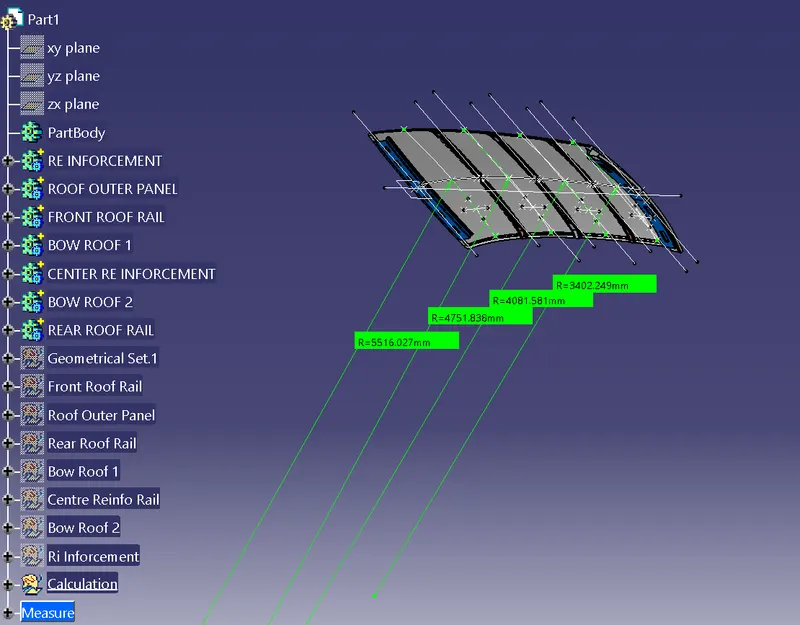
BOW ROOF RAIL 1:
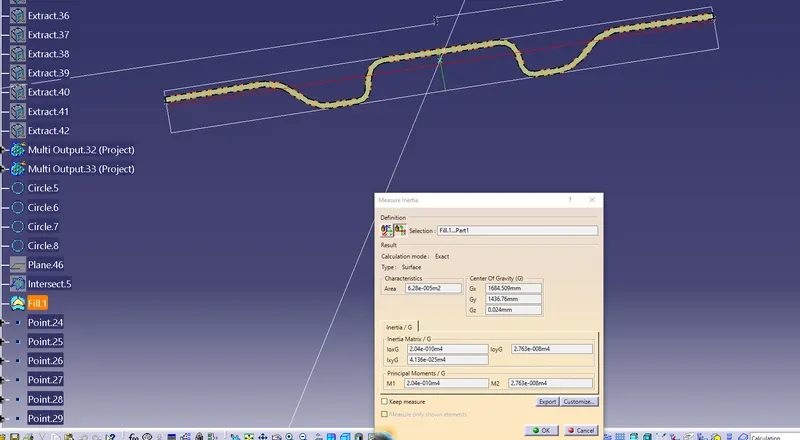
CENTRE ROOF RAIL:
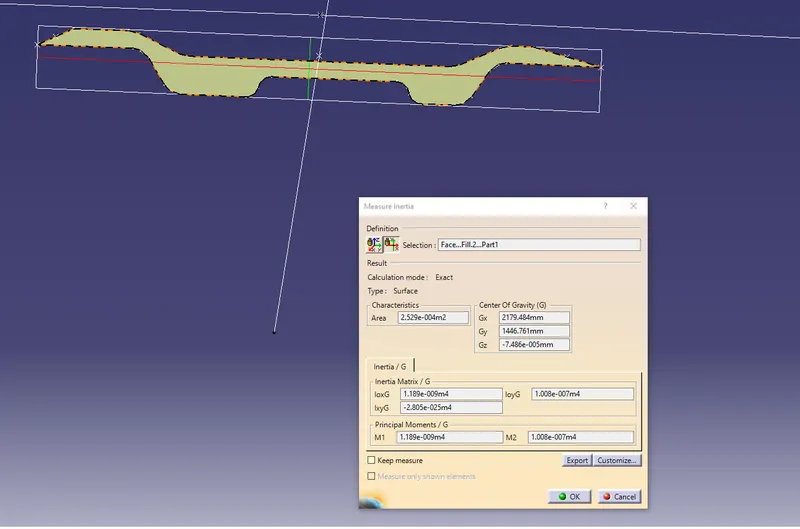
BOW ROOF RAIL 2 :
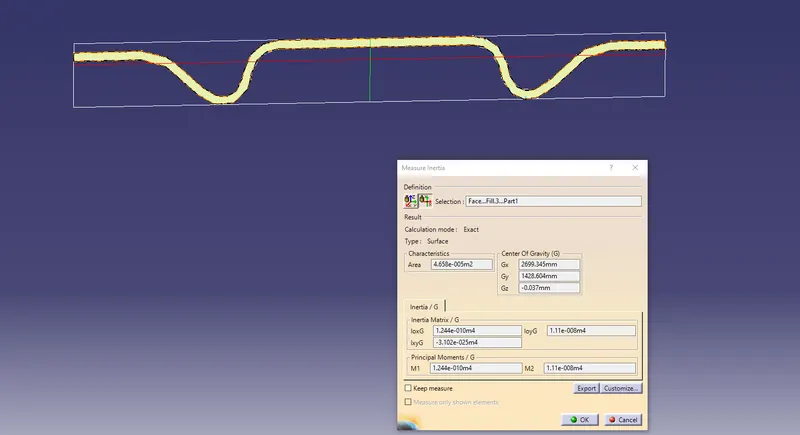
Calculations are done and tabulated in the given table below:
| Position | Iy(mm^4) | Alpha | Lx | Ly | Y | My | L1 | L2 | S | Rx | Ry | t | Qr | Status |
| FRR & BR1 | 204.0 | 0.80 | 1104.81 | 2028.82 | 410.21 | 663716.24 | 496.3 | 496.3 | 249.15 | 2514.16 | 5516.02 | 0.75 | 3.57 | OK |
| BR1 & CRR | 1189 | 0.78 | 1079.10 | 2028.82 | 419.15 | 674693.18 | 496.3 | 518.42 | 260.15 | 6290.11 | 4751.8 | 0.75 | 10.7 | OK |
| CRR & BR2 | 124.4 | 0.75 | 1047.25 | 2082.82 | 444.31 | 704002.23 | 518.42 | 461.76 | 232.2 | 11259.5 | 4081.58 | 0.75 | 0.69 | NG |
| BR2 & RRF | 0.67 | 1104.50 | 2082.82 | 328.84 | 559021.42 | 461.76 | --- | 0 | 16992.0 | 3402.24 | 0.75 | 0 | NG |
From the above table we found that, the snow load criteria is passed for Front roof rail to bow roof rail 1 and bow roof rail 1 to centre roof rail, it means that the curvature of roof is good for the snow load.And from centre roof rail to bow roof rail 2 and bow roof rail2 to rear roof rail,the curvature of roof is not good and is not passed with snow load criteria condition which is Qr>3.1 . Hence reinforcement will be done on the outer roof panel.
There fore the Embosses are made on the roof to increase the strenth of roof to sustain the snow load acting on it.And this criteria is done only in the snowy area like sweden and switzerland where snow fall is stable at all the time, but not for indian marketing.