Roof challenge
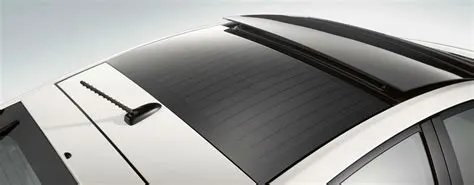
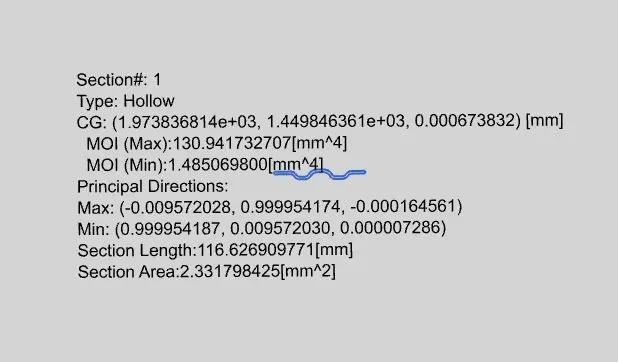
For the Given Roof styling, Develop the essential flanges and reinforcements, Provide appropriate dimensions and check for Draft analysis, and submit your Section Inertia report on the 0-Y section.
Start with the creation of a roof ditch area the tool opening angle is only 3 degrees.
Do a curvature study on the roof and perform calculations to determine the position of the Bow-roof

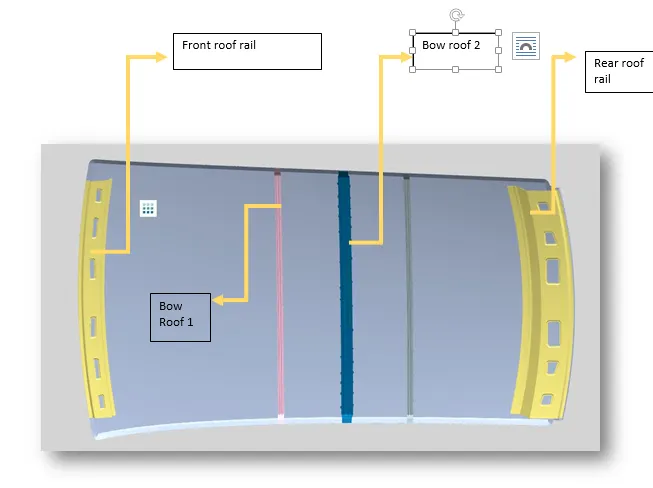
Front roof rail
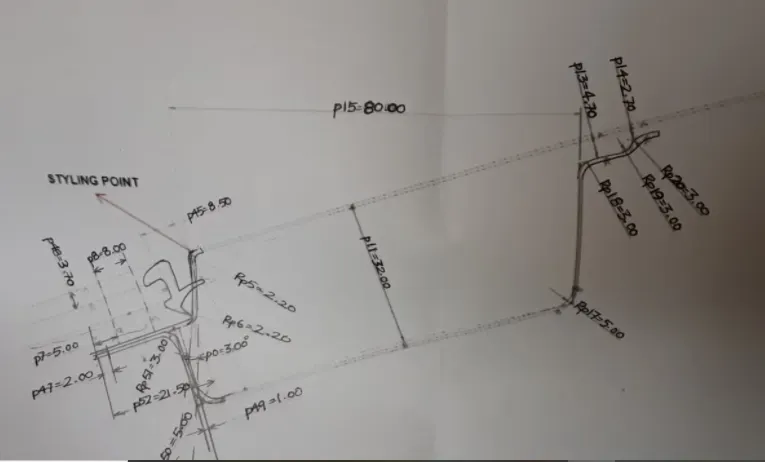
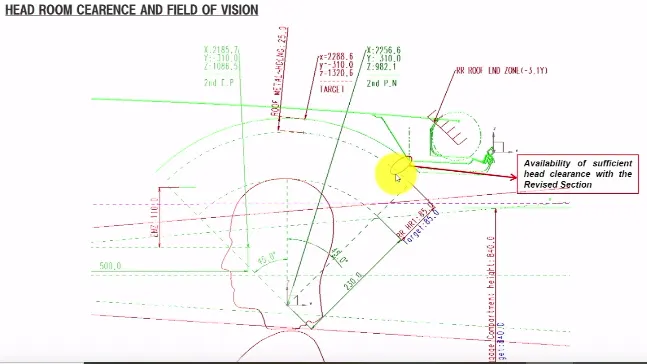
TYPICAL SECTIONS - ROOF RAIL RR LWR
Approach:
Removal of surface and maintain surface similar to roof side rail
Increase strength
Smooth area connection with PLR RR INR
Effective material usage
TYPICAL SECTIONS - REINFORCEMENT ROOF CTR
Approach:
Addition of mastic bead area in reinforced roof center
Increase strength.
Since mastic bead added -> possibility to reduce bow roof 1
Thickness reduced from base (2.3 >> 1.5) mass reduction
Usage of high tensile material > increase in strength
COMMENTS USED
Extract geometry
Wave link
Offset surface
offset curve in face
trim sheet
project curve
studio surface'
emboss
bridge curve
face blend
edge blend
sew
thicken
mirror geometry
Section inertia
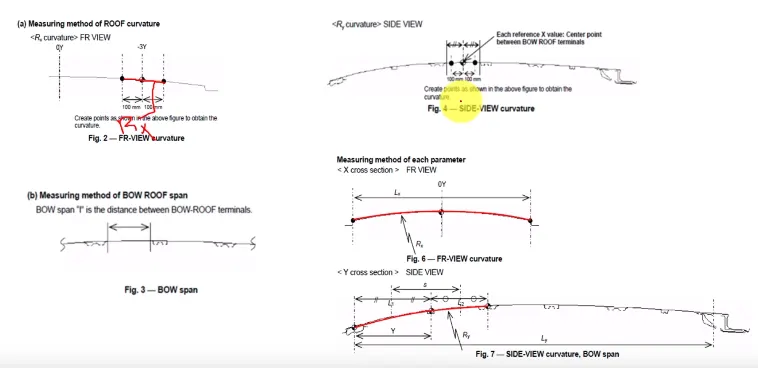
Bow–roof prediction Formula
W = [1.73 x 10^(-3) x L] + [1.85 x 10^(-8) x (R^2)/t] + [ 1.10x10^(-3) x l] - 2.68
Judgement Condition : OK< 2.7> 3.1
Where
L = Roof Length in X-Direction[mm](Roof dimension in 0-Y)
R = Roof curvature
R = 2(Rx*Ry)/(Rx+Ry)
Rx = X curvature
Ry = Y curvature
t = Roof plate thickness [mm]
l = Bow Roof Span [mm]
Snow load Prediction formula
Qr = [Iy x t2] / [α x s x [(Rx + Ry)/2]2 x 10-8]
Note: The Qr value given over here is correct. There was a typo error in the formula given in the video.
Where
α = My x Lx2 x 10-12 , My = Y(Ly-Y)
Judgement condition = Qr ≥ 3.1
250 ≤ s ≤ 380
t = Roof plate thickness [mm]
Ly = Distance between the front and rear roof Rails on the Vehicle along with 0Y[mm]
Length of Roof panel with the center point between Roof rail Front /Rear as the front and rear reference point.
Lx = Distance between the Left and Right end of the roof on the Roof BOW [mm]
Width of the roof panel exposed on the surface.
Y = Distance front Front Roof Rail to Roof BOW[mm]
s = Distance for which Roof BOW bears divided load [mm]
s = L1/2 + L2/2
Iy = Geometrical moment of inertia of Roof BOW (Y cross-section )[mm4]
Rx = Lateral direction curvature radius of roof panel Y cross-section on Roof BOW [mm]
Roof panel curvature Radius of the Length Lx in Front view
Ry = Longitudinal Direction curvature radius of the Roof panel X cross-section on Roof BOW [mm]
Roof panel X curvature radius of length s in Side view
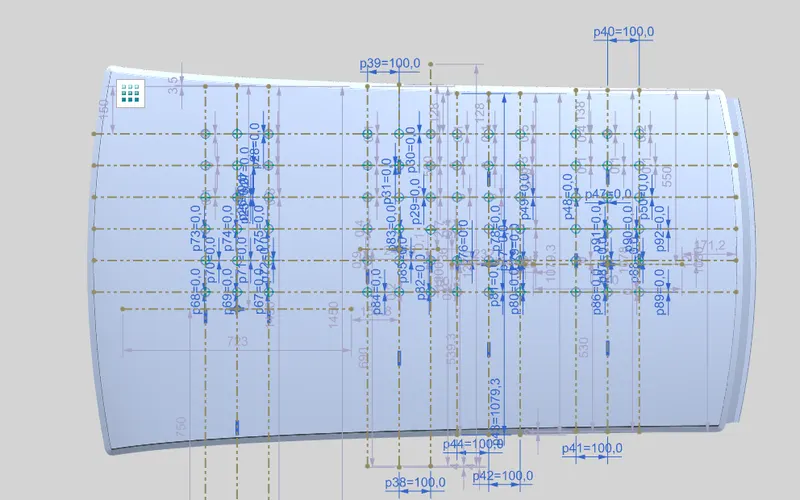

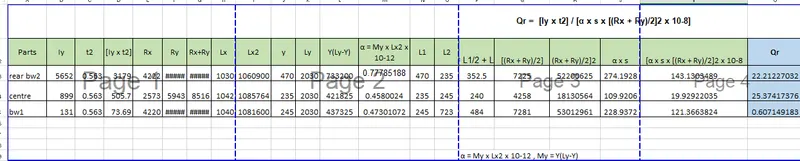
The heat disortion has been passed and the snow load is not
In the snow load calculation bow 1 has been failed.the curvature can be increased and modified to pass
 Bow roof 1
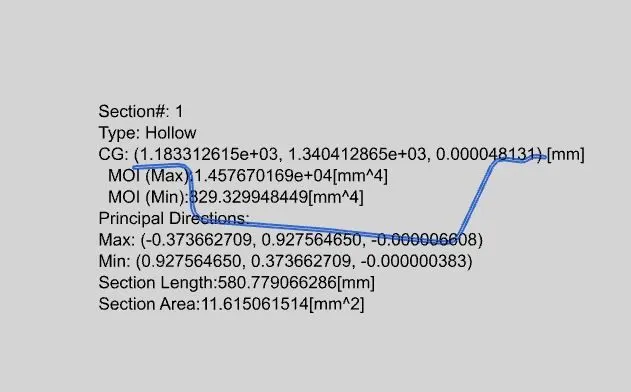 Front roof rail
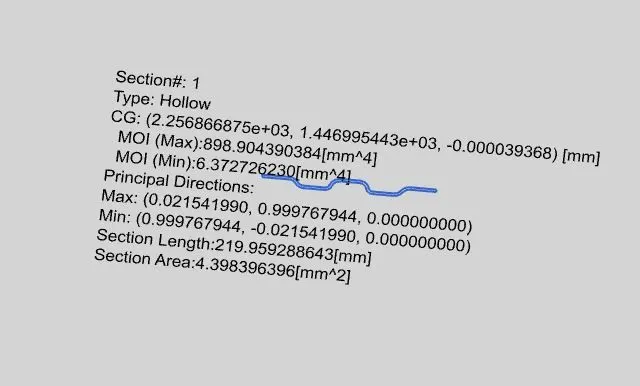 centre rail reinforcement
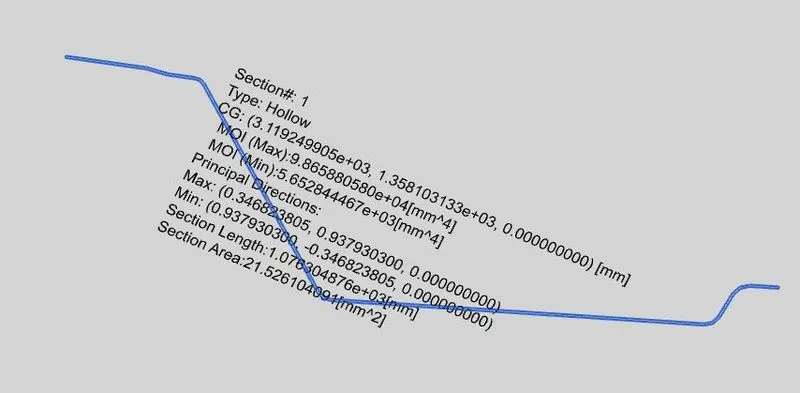 rear roof rail
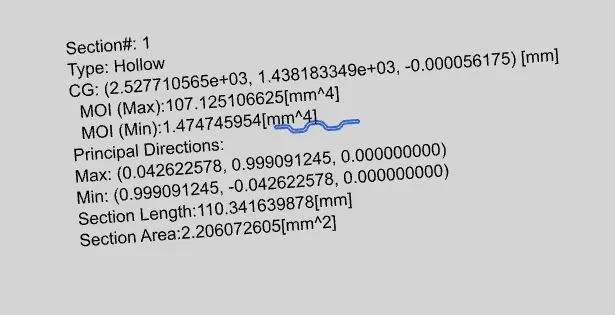 bow roof 2
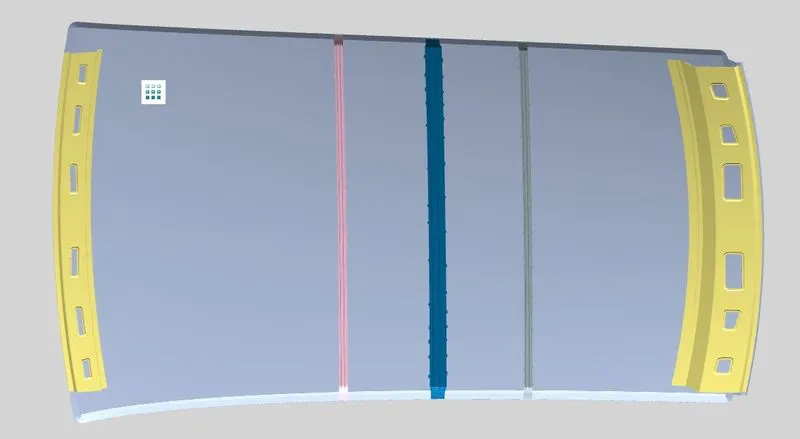
Thus the rood design is done with the components and optimized for heat disortion and snow load.