Roof challenge
CAR ROOF DESIGN AND ANALYSIS
Introduction:
An automobile roof or car top is the portion of an automobile that sits above the passenger compartment, protecting the vehicle occupants from sun, wind, rain, and other external elements. Because the earliest automobiles were designed in an era of of horse-drawn carriages early automobile roofs used similar materials and designs.
In later years, many variations on the automobile roof developed. These include:
Design Consideration of Roof:
- Visibility criteria
- Head clearance
- Curvature Study
- Heat Distortion and Snow load Criteria
Roof Crush Test:
Therefore, passenger safety is also a very important parameterin front of OEMs. Fof this reason, strength is a very important criteria for designing a vehicle roof.
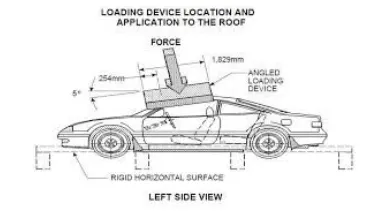
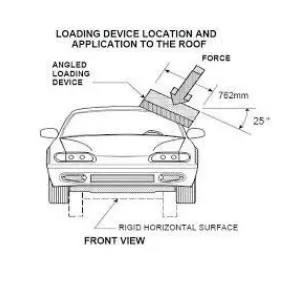
The strength of the roof structure to occupant the protection in real world crashes , requiring the maximum moving distance of the roof structure should be less than 127mm when the induced load is 1.5 times the vehicle weight.
For the test, the passenger car shall be rigidly placed or positioned on horizontal surface with the doors locked and the window closed.
This test can be conducted on either side of the roof structure, the front left or front right side but not on both sides in one single test and still meet the requirements of the test. The rigid plate shall not move faster than 0.5 inches/second and the force applied on the plate shall not exceed the lesser of 1.5 times the unloaded vehicle weight (UVW) expressed in kilograms multiplied by 9.8 or 5000lbs
Also, the direction of the forces shall be downward and perpendicular to the lower surface of the rigid plate and such that moves in a straight line without rotation . The duration of the test shall not exceed 120 seconds. The longitudinal axis of the plate is pitched forward at a 5° angle as viewed from the side of the passenger car as shown in below fig
Rollover accidents of a car are the most occurring accidents that we see in our daily lives. The passengers experience major injuries like neck, head and spine injuries. So, to reduce the injuries of a passenger from major fatalities it is important to provide safety in the car. Though safety is provided by seat belts and airbags during accidents, the passenger must have sufficient space for survival in the car during accidents. The roof of the car must have high strength to resist the crush force to avail the passenger some space for survival. Therefore, in this project, we have carried out roof crush test using Federal Motor Vehicle Safety Standards (FMVSS216) standards in LS dyna software. We have used Hypermesh software to mesh the model and to apply boundary conditions to it. And the rigid plate is used to crush the car roof as specified by FMVSS216 standards. The rigid plate is oriented on the car roof as specified by Insurance institute of highway safety (IIHS). And an alternate material is used to the car roof structure to the baseline model to check the crashworthiness of new material. The outcome of test results of the new material's strength to weight ratio (SWR) was compared to baseline model and the new material is proposed for the roof (B-pillar) which is found to be more crashworthy.
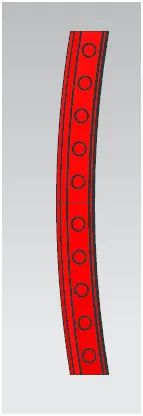
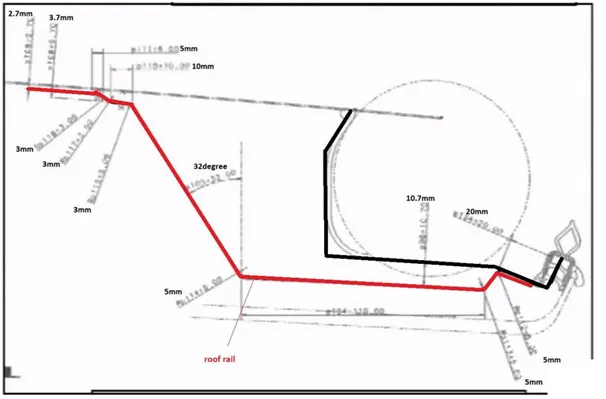
Master section of Front roof rail:
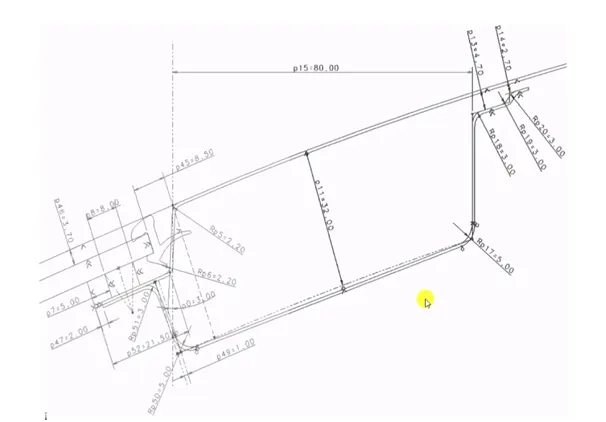
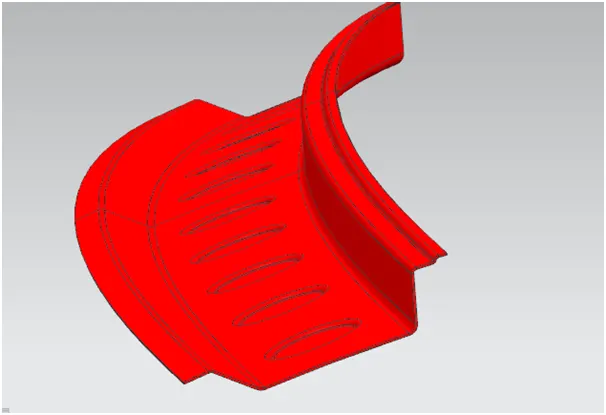
Master section of Rear roof rail:
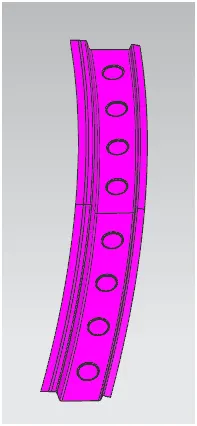
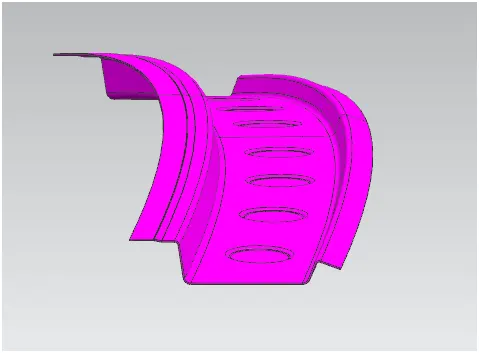
Bow Roof-1
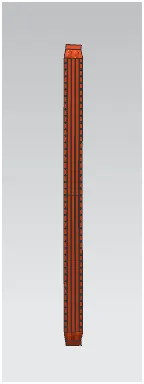
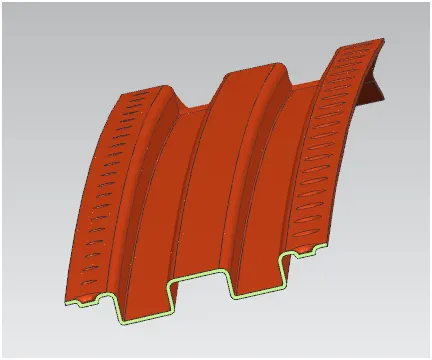
Centre Roof rail:
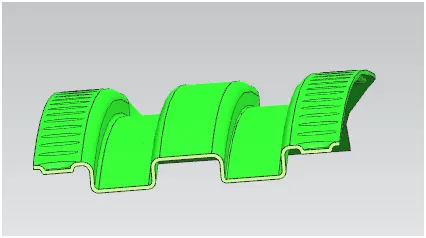
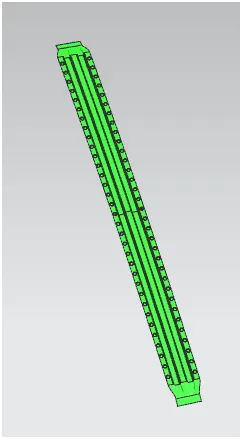
Bow roof rail-2
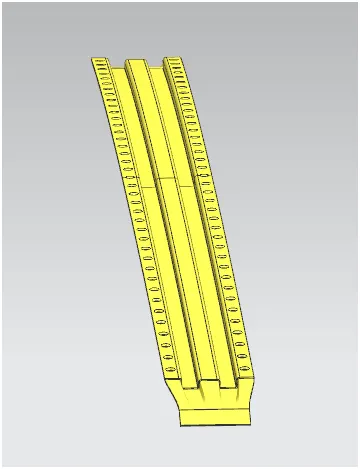
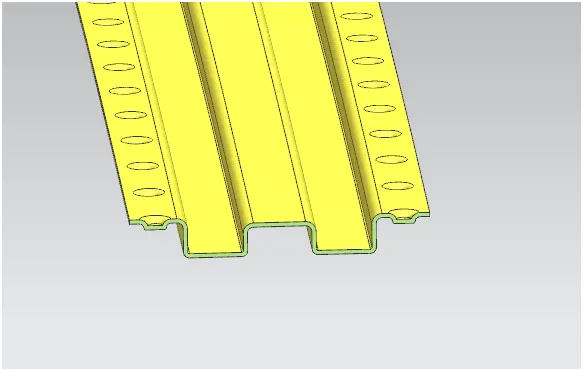
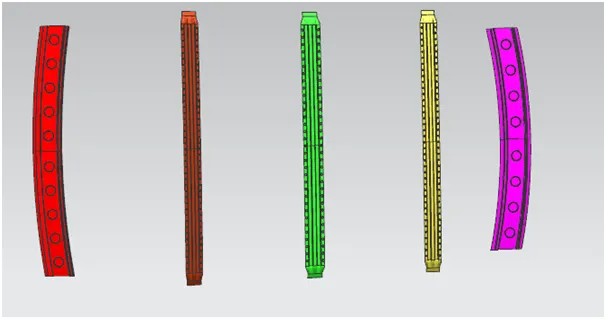
Rooof rails:
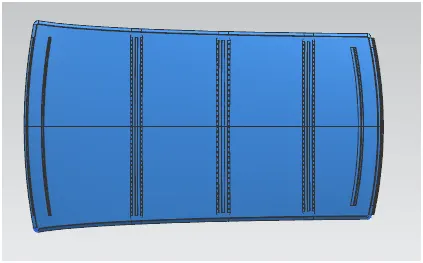
Roof outer panel:
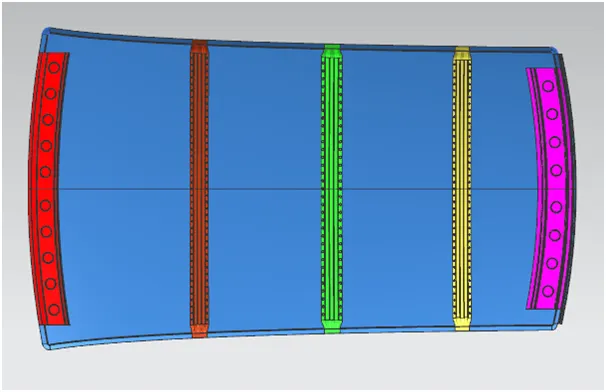
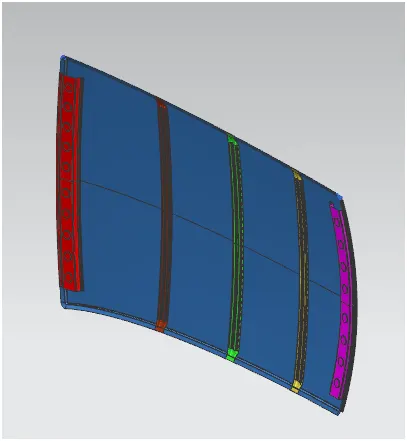
Curvature study on the Roof:
Heat Distortion Criteria:
W= [1.73*10^(-3)*L]+[1.85*10^(-8)*(R^2)/t]+1.10*10^(-3)*l]-2.68
Judgement condition: OK<2.7>3.1
Where,
L = Roof length in X-direction [mm](Roof dimension on 0-Y)
R= Roof curvature
R=2(Rx*Ry)/(Rx+Ry)
Rx=X curvature
Ry= Y curvature
t= Roof plate thickness (mm)
l= Bow roof span (mm)
Thickness of the Roof:
Roof outer panel-0.75 mm
Front Roof Rail – 1.00 mm
Bow Roof Rail 1 – 1.00 mm
Centre Roof Rail – 1.00 mm
Bow Roof Rail 2 – 1.00 mm
Rear Roof Rail – 1.00 mm
Calculation:

Snow Load Criteria:
Qr = [Iy*t^2]/ ∝*s*[(Rx+Ry)/2]*10^-8
Note: The Qr value given over here is correct. There was a type error in the formulae given in the video.
Where,
∝= My*(Lx^2)*[10^(-12)],
My= Y(Ly-Y)
Judgement condition = Qr ≥3.1
250≤ s≤ 380
t= Roof plate thickness (mm)
Ly = Distance between the front and rear roof rails on the vehicle along with OY (mm)
Length of Roof panel with the centre point between Roof rail Front/Rear as the reference point of the front and the rear
Lx = Distance between the left and right end of the roof on the roof BOW (mm)
Width of the roof panel exposed on the surface.
Y = Distance from Front Roof Rail to BOW Roof (mm)
S = Distance for which Roof BOW bears divided load (mm)
S=L1/2+L2/2
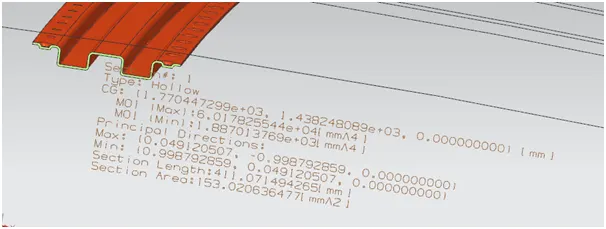
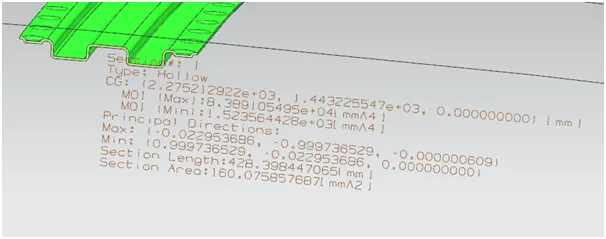
Iy = Geometrical moment of inertia of Roof BOW (Y cross-secction) (mm4)
Rx = Lateral direction curvature radius of roof panel Y cross-section on roof BOW (mm)
Roof panel curvature Radius of the Length Lx in front view
Ry = Longitudinal direction curvature radius of the roof panel X cross- section on Roof BOW (mm)
Roof panel X curvature radius of lengths in side view
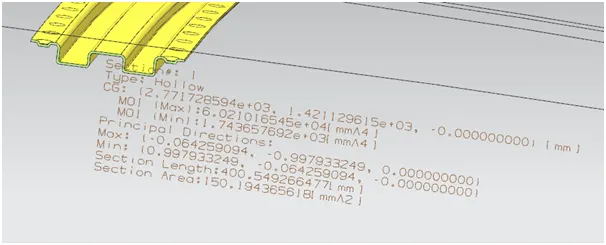
Moment of Inertia of BOW Roof 1
Moment of Inertia of Center Roof
Moment of Inertia of BOW Roof 2
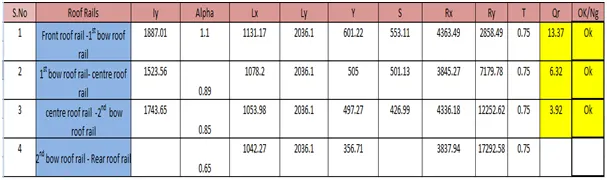
Calculation Table:
Conclusion:
Thus from calculations made the heat distortion criteria and snow load condition criteria was satisfied and the positioning of the BOW Roofs were determined