Project - Position control of mass spring damper system
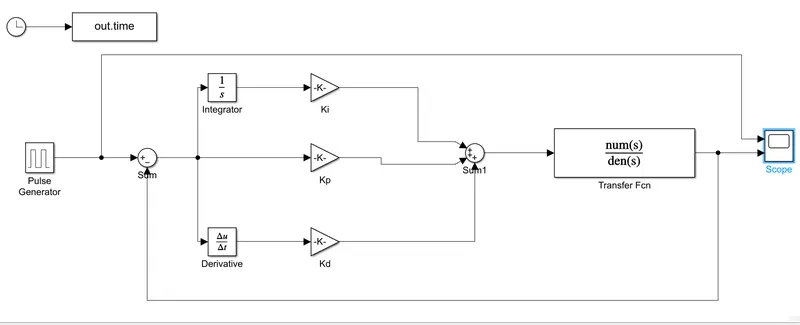
1.Obtain the transfer function of a mass spring damper system and use it in the model. Add a PID controller to adjust the force on mass so that its position follows a reference signal.
The mass-spring-damper model consists of discrete mass nodes distributed throughout an object and interconnected via a network of springs and dampers. This model is well-suited for modelling object with complex material properties such as nonlinearity and viscoelasticity. Packages such as matlab may be used to run simulations of such models. As well as engineering simulation, these systems have applications in campuer graphics and computer animation.
The springs allow the wheels to move up to absorb bumps in the road and reduce jolting, while the dampers prevent bouncing up and down. Various mechanical links keep the wheels in line.
The Mass-Spring-Damper model is one of the most common models used by engineers to model kinematic systems. From human tissue to bridges, this straightforward model features three mechanisms and can be summarized as the following second-order differential equation: mx + c ˙x + kx
Given Data
m = 3.6 kg
k = 400 N/m
c = 100 Ns/m
Simulation Code
clc
clear all

%Given Parameters
m = 3.6; %kg
k = 400; %N/m
c = 100; %Ns/m

%Matrix
A=[0 1;-k/m -c/m]
B=[0;1/m]

%Pole placement design
fn=1.0;  %freqency
wn=2*pi*fn;
zeta= 0.8  %for under-damped
P1=-zeta*wn+wn*sqrt(zeta^2-1);
P2=-zeta*wn-wn*sqrt(zeta^2-1);
P=[P1;P2];

K=place(A,B,P)
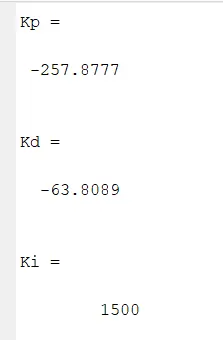
Kp=K(1)
Kd=K(2)
Ki=1000
Where
Simulink Model:
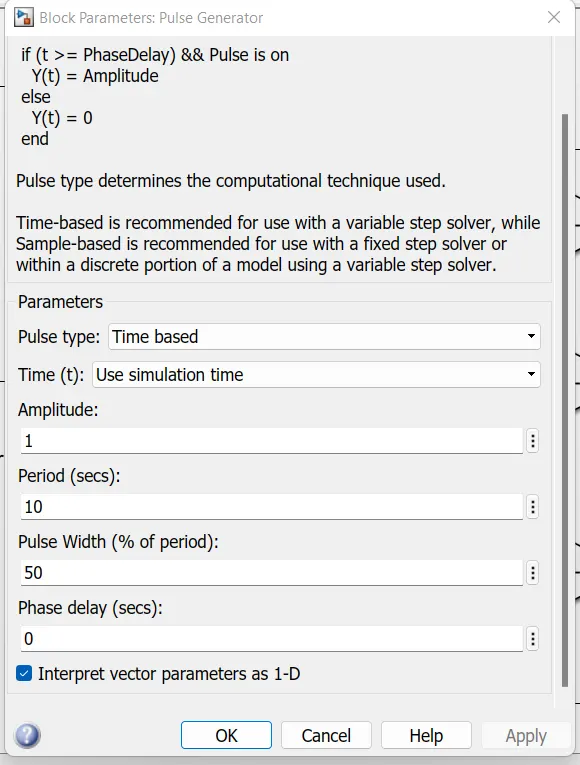
Pulse Generator:
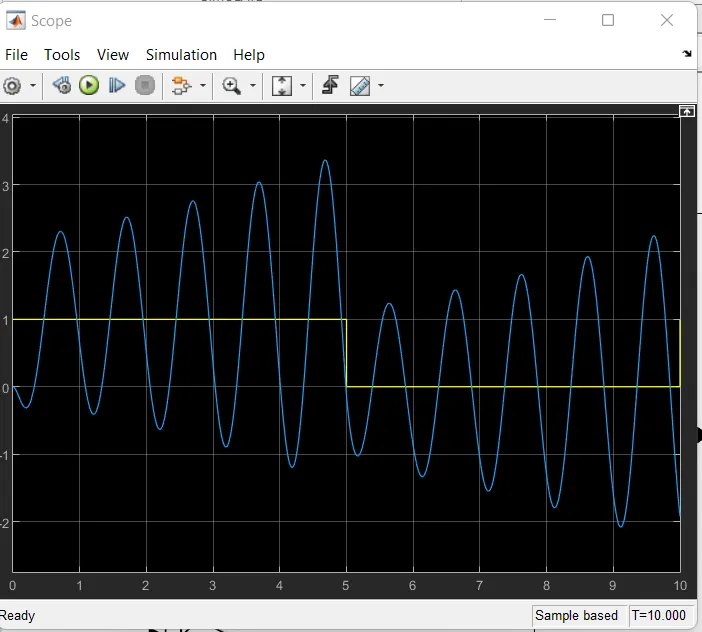
Output:
Conclusion:
Thus. the Position control of mass spring damper system transfer function of a mass spring damper system has been found