Project on Concrete Mix Design for various grades of Concrete
AIM : To Calculate the Concrete Mix Design for M35 grade concrete with fly ash & M50 grade concrete without Fly ash.
INTRODUCTION : Concrete mix design is the method of finding the precise proportion of cement, sand and aggregates for concrete to achieve the target strength in structures, therefore concrete mix design can be stated as concrete mix in terms of cement: sand: aggregates. The design is done according to the requirements of concrete strength. So, we can achieve the desirable properties of concrete either it is in fresh stage or in hardened stage. The fresh concrete properties like workability, setting time and hardened concrete properties like compressive strength, durability etc. are attained surely by this method. Use of additives like admixtures, retarders etc. other than basic ingredients are used to improve the properties of mix. This project consist of two parts, the first part deals with the design of M35 grade cement with fly ash as a part of it and second part is the design of M50 grade concrete without fly ash.
OBJECTIVE : The objective of this project is to produce a mix design for M35 grade concrete containing fly ash and M50 grade concrete. The mix will be prepared as per IS METHOD: Concrete mix proportioning guidelines from IS 10262:2009 and recommented guide lines from IS 10262:1982.
EQUATIONS USED :
1)Target mean strength
f’ck =fck + 1.65s
Where,
* f'ck = target average compressive strength at 28 days,
* fck = characteristics compressive strength at 28 days, and
* s = standard deviation
2)Cement content
Cement content = water content / water-cement ratio
3) Volume Calculations
(a) Volume of concrete
(b) Volume of cement = [Mass of cement] / [Specific Gravity of Cement] x 1/1000
(c) Volume of water = [Mass of water] / [Specific Gravity of water] x 1/1000
(d)Volume of chemical admixture = [Mass of admixture] / [Specific Gravity of admixture] x 1/1000
(e) Volume of all in aggregate =[a-(b+c+d)]
(f) Mass of coarse aggregate= e x Volume of Coarse Aggregate x Specific Gravity of Fine Aggregate x 1000
(g) Mass of fine aggregate= e x Volume of Fine Aggregate x Specific Gravity of Fine Aggregate x 1000
** PART : I ** : To Calculate the Concrete Mix Design for M35 grade concrete with fly ash:
M35 grade concrete with fly ash
* STEP 1 : Stipulations for concrete mix design
| Grade | M35 |
| Type of cement | OPC 43 Grade confirming to IS 8112 |
| Type of mineral admixture | Fly ash confirming to IS 3812 (Part 1) |
| Maximum nominal size of aggregate | 20 mm |
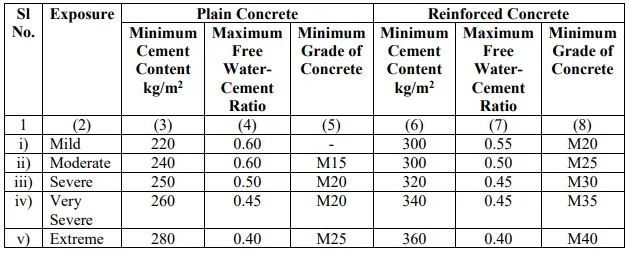
| Minimum cement content | 320 kg/m^3 (Table 5 of IS 456:2000- Exposure Condition) |
| Maximum water - cement ratio | 0.45 (Table 5 of IS 456:2000- Exposure Condition) |
| Workability | 100 mm (Slump value for Pumpable concrete ) |
| Exposure Condition | Severe (For Reinforced Concrete) |
| Method of Concrete Placing | Pumping |
| Degree of Supervision | Good |
| Type of aggregate | Crushed Angular Aggregate |
| Maximum cement content | 450 kg/m^3 |
| Chemical Admixture Type | Super Plasticizer |
* STEP 2 : TEST DATA FOR MATERIALS
| Cement used | OPC 43 Grade conforming IS 8112 |
| Specific gravity of cement | 3.15 |
| Fly ash | confirming to IS 3812 (Part 1) |
| Specific gravity of fly ash | 2.2 |
| Chemical admixture | Super Plasticizer conforming to IS 9103 |
| Specific gravity of coarse aggregate | 2.74 |
| Specific gravity of fine aggregate | 2.74 |
| Water absorption of coarse aggregate | 0.5 % |
| Water absorption of fine aggregate | 1 % |
| Free surface moisture of Coarse aggregate | Nil |
| Free surface moisture of Fine aggregate | Nil |
| Sieve analysis: Coarse aggregate | Conforming to Table 2 of IS 383 |
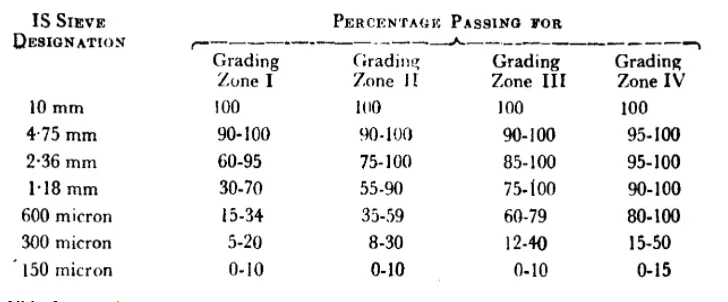
| Sieve analysis: Fine aggregate | Conforming to Grading Zone II of Table 4 of IS 383 |
* STEP 3 : TARGET STRENGTH FOR MIX PROPORTIONING
f’ck =fck + 1.65s
Where,
* f'ck = target average compressive strength at 28 days,
* fck = characteristics compressive strength at 28 days, and
* s = standard deviation
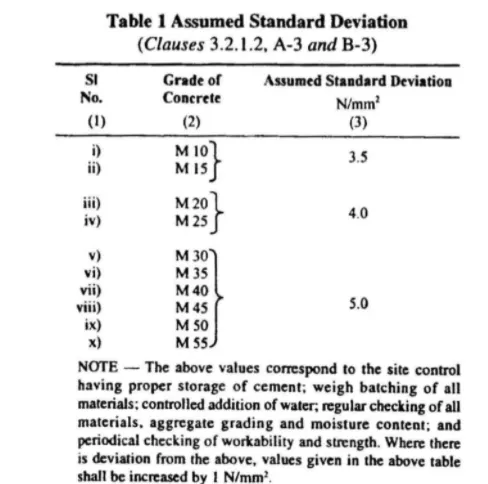
From Table I of IS 10262:2009, Standard Deviation, s = 5 N/mm2.
Therefore,
f'ck = fck + 1.65s
f'ck = 35 + (1.65 * 5)
f'ck = 35 + 8.25
f'ck = 43.25 N/mm^2.
Target Mean Strength = 43.25 N/mm^2.
* STEP 4 : SELECTION OF WATER-CEMENT RATIO
The maximum water-cement ratio to design M50 grade concrete can be found from Table 5 of IS 456-2000 is - Maximum W/C ratio =0.45.
Based on experience adopted water cement ratio is 0.44.
0.44<0.45, hence ok
Adopted W/C ratio=0.44.
* STEP 5 : SELECTION OF WATER CONTENT
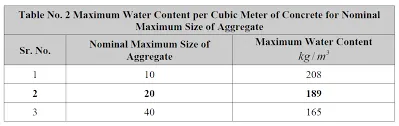
* From Table 2 of IS 10262:2009, maximum water content for 20 mm aggregate - 186 litre (for 25 to 50 mm slump range)
* Clause 4.2 suggests increasing of 3% of water content for every extra 25mm slump from 50mm slump. So a 6% is to be added to it,
186+ (6/100)*186 = 197 litre.
* Estimated water content for 100 mm slump
Based on trials with Super plasticizer water content reduction of 20% has been achieved, Hence the arrived water content is ,
197*0.8 = 158 litre
(Note: If Super plasticizer is used, the water content can be reduced up to 20% and above.)
Water required 158 litres
* STEP 6 : CALCULATION OF CEMENT AND FLY ASH REQUIRED
* Adoted water- cement ratio - 0.44
* Total cementitious (Cement + fly ash)requirement = Water content/ Water Cement ratio = 158/0.44 = 359 kg/m3
* The cementitious content has to be increased in order to attain good workability and strength. The increment required is determined on the basis of experience and research. Here we are increasing cementitious content by 10%.
* Final cementitious content = 359 X 1.10 = 395 kg
* From Table 5 of IS 456, Minimum cement content for ‘Severe’ exposure conditions = 320 kg
Therefore,
395 kg/m3 > 320 kg/m3 hence ok.
* Cementitious material content = 395
* New water cement ratio = 158/395 =0.4
* Fly ash content is taken as 30% of the total cementitious content = 395 X .3 = 118.5 kg/m3
* Cement required = 395 – 118 = 277 kg/m3
* Cement quantity saved due to fly ash addition = 350-277 = 73 kg/m3
Cementitious material, cement and fly ash required is 395 kg/m3 , 277 kg/m3and 118 kg/m3 and the new water-cement ratio is 0.4 respectively
* STEP 7 : VOLUME OF COARSE AGGREGATE AND FINE AGGREGATE CONTENT
* From Table 3 of (IS 10262:2009) Volume of coarse aggregate corresponding to 20 mm size aggregate and fine aggregate (Zone II) for water-cement ratio of 0.50 is 0.62.
* In the present case water-cement ratio is 0.44. Therefore, volume of coarse aggregate is required to be increased to decrease the fine aggregate content. As the water-cement ratio is lower by 0.06. The proportion of volume of coarse aggregate is increased by 0.02 (at the rate of -/+ 0.01 for every ± 0.05 change in water-cement ratio).
* Therefore, corrected proportion of volume of coarse aggregate for the water-cement ratio of 0.44 is 0.632.
* For pumpable concrete these values should be reduced up to 10%.
Therefore, volume of coarse aggregate
= 0.632 x 0.9
=0.568.
* Volume of fine aggregate content is,
1 – 0.568 =0.431
Volume of fine aggregate and coarse aggregate is 0.431 and .568
* STEP 8: MIX CALCULATIONS
The mix calculations as per unit volume of concrete shall be as follows:
a) Volume of concrete is = 1 m3
b) Volume of cement = [Mass of cement] / [Specific Gravity of Cement] x 1/1000
= (277/3.15) X (1/1000)
=0.087m3
c) Volume of fly ash = [Mass of fly ash] / [Specific Gravity of fly ash] x 1/1000
= (118/2.2) X (1/1000)
= 0.053
d) Volume of water = [Mass of water] / [Specific Gravity of water] x 1/1000
= (158/1) X (1/1000)
= 0.158m3
e) Volume of chemical admixture = [Mass of admixture] / [Specific Gravity of admixture] x 1/1000
= (7.6/1.145) X (1/1000)
= 0.006 m3
f) Volume of total aggregate = [a-(b+c+d+e)]
= [1-(0.087+0.053+0.158+0.006)]
= 0.696m3
g) Mass of coarse aggregate = f x Volume of Coarse Aggregate x Specific Gravity of Fine Aggregate x 1000
= 0.696x 0.568 x 2.74 x 1000
= 1077 kg/m3
h) Mass of fine aggregate = f x Volume of Fine Aggregate x Specific Gravity of Fine Aggregate x 1000
= 0.696x 0.431x 2.74 x 1000
= 822 kg/m3
* STEP 9: MIX PROPORTIONS
| Cement | 277 kg/m3 |
| Fly ash | 118 kg/m3 |
| Water | 158 l/m3 |
| Fine aggregate | 822 kg/m3 |
| Coarse aggregate 20mm | 1077 kg/m3 |
| Chemical admixture | 7.18 kg/m3 |
Water-cement ratio (lowest W/C ratio is selected) = 0.4
Mix Proportion By weight = 1:2.08:2.72
* STEP 10 : The slump shall be measured, the water content and dosage of admixture shall be adjusted for achieving the required slump on trial. The mix proportion shall be reworked for the actual water content and checked for durability requirements.
* STEP 11: Two more trials having variation of 10% of water-cement ratio shall be carried out and a graph between three water- cement ratios and corresponding strengths shall be plotted to work out the mix proportions for the given target for field trials. However, durability shall be met.
** PART II ** :To Calculate the Concrete Mix Design for M50 grade concrete without fly ash:
M50 grade concrete without Fly ash
* STEP 1: Stipulations for Concrete design mix
| Grade designation | M 50 |
| Type of cement | OPC 53 Grade confirming to IS BIS 12269 - 1987 |
| Maximum nominal size of aggregate | 20 mm |
| Minimum cement content | 320 kg/m3 (Table 5 of IS 456:2000- Exposure condition) |
| Maximum water-cement ratio | 0.45 (Table 5 of IS 456:2000 Exposure condition) |
| Workability | 100 mm (slump value for pumpable concrete) |
| Exposure condition | Severe (For Reinforced Concrete) |
| Method of concrete placing | Pumping |
| Degree of supervision | Good |
| Type of aggregate | Crushed Angular Aggregates |
| Maximum cement content | 450 kg/m3 |
| Chemical admixture type | Super Plasticizer |
* STEP 2: TEST DATA FOR MATERIALS
| Cement used | OPC 53 Grade conforming IS 12269-1987 |
| Specific gravity of cement | 3.15 |
| Chemical admixture | Super Plasticizer conforming to IS 9103 |
| Specific gravity of coarse aggregate | 2.74 |
| Specific gravity of fine aggregate | 2.64 |
| Water absorption of coarse aggregate | 0.5 % |
| Water absorption of fine aggregate | 1 % |
| Free surface moisture of Coarse aggregate | Nil |
| Free surface moisture of Coarse aggregate | Nil |
| Sieve analysis: Coarse aggregate | Conforming to Table 2 of IS 383 |
| Sieve analysis: Fine aggregate | Conforming to Grading Zone II of Table 4 of IS 383 |
* STEP 3: TARGET STRENGTH FOR MIX PROPORTIONING
* f’ck =fck + 1.65s
Where,
* f’ck = target average compressive strength at 28 days
* fck = characteristics compressive strength at 28 days, and
* s = standard deviation
* From Table I of IS 10262:2009, Standard Deviation, s = 5 N/mm2.
f’ck = fck + 1.65s
f'ck = 50 + 1.65 x 5
f'ck = 58.25 N/mm2
Target mean strength = 58.25 N/mm2
* STEP 4: SELECTION OF WATER-CEMENT RATIO
*The maximum water-cement ratio to design M50 grade concrete can be found from Table 5 of IS 456-2000 for severe exposure.
Based on experience adopted water cement ratio is 0.44
0.44<0.45, hence ok
Adopted W/C ratio=0.44
* STEP 5: SELECTION OF WATER CONTENT
* From Table 2 of IS 10262:2009, maximum water content for 20 mm aggregate is = 186 litre (for 25 to 50 mm slump range).
* Clause 4.2 suggests increasing of 3% of water content for every extra 25mm slump from 50mm slump. So a 6% is to be added to it.
Estimated water content for 100 mm slump = 186+ (6/100)*186 = 197 litre.
(Note: If Super plasticizer is used, the water content can be reduced up to 20% and above.)
* Based on trials with Super plasticizer water content reduction of 20% has been achieved, Hence the arrived water content
= 197 X 0.8 = 158 litre
Water required 158 litres
* STEP 6 : CALCULATION OF CEMENT REQUIRED
* Adopted w/c Ratio = 0.44.
* Cement Content = 158/0.44
= 359 kg/m3.
* From Table 5 of IS 456, Minimum cement content for ‘Severe’ exposure conditions = 320kg/m3
* 359 kg/m3 > 320 kg/m3 hence ok.
* Cement required is 359 kg/m3
* STEP 7 : VOLUME OF COARSE AGGREGATE AND FINE AGGREGATE CONTENT
* From Table 3 of (IS 10262:2009) Volume of coarse aggregate corresponding to 20 mm size aggregate and fine aggregate (Zone II) for water-cement ratio of 0.50 is = 0.62.
* In the present case water-cement ratio is 0.44. Therefore, volume of coarse aggregate is required to be increased to decrease the fine aggregate content. As the water-cement ratio is lower by 0.06. The proportion of volume of coarse aggregate is increased by 0.02 (at the rate of -/+ 0.01 for every ± 0.05 change in water-cement ratio).
* Therefore, corrected proportion of volume of coarse aggregate for the water-cement ratio of 0.44 = 0.632.
* For pumpable concrete these values should be reduced up to 10%. Therefore, volume of coarse aggregate = 0.632 x 0.9 =0.568.
* Volume of fine aggregate content = 1 – 0.576 =0.431.
* Volume of fine aggregate and coarse aggregate is 0.431 and .568 respectively.
* STEP 8: MIX CALCULATIONS
* The mix calculations per unit volume of concrete shall be as follows:
a) Volume of concrete = 1 m3
b) Volume of cement = [Mass of cement] / [Specific Gravity of Cement] x 1/1000
= (359/3.15) X (1/1000)
=0.114m3
c) Volume of water = [Mass of water] / [Specific Gravity of water] x 1/1000
= (158/1) X (1/1000)
= 0.158m3
d) Volume of chemical admixture = [Mass of admixture] / [Specific Gravity of admixture] x 1/1000
= (7.6/1.145) X (1/1000)
= 0.006 m3
e) Volume of all in aggregate = [a-(b+c+d)]
= [1-(0.114+0.158+0.006)]
= 0.722 m^3
f) Mass of coarse aggregate = e x Volume of Coarse Aggregate x Specific Gravity of Fine Aggregate x 1000
= 0.722x 0.568 x 2.74 x 1000
= 1123 kg/m3
g) Mass of fine aggregate = e x Volume of Fine Aggregate x Specific Gravity of Fine Aggregate x 1000
= 0.722x 0.431x 2.64 x 1000
= 821 kg/m3
* STEP 9: MIX PROPORTIONS
| Cement | 359 kg/m3 |
| Water | 158 l/m3 |
| Fine aggregate | 821 kg/m3 |
| Coarse aggregate 20mm | 1123 kg/m3 |
| Chemical admixture | 7.18kg/m3 |
| Water-cement ratio | 0.44 |
| Mix Proportion By weight | 1:2.28:3.12 |
* STEP 10 : The slump shall be measured, the water content and dosage of admixture shall be adjusted for achieving the required slump on trial. The mix proportion shall be reworked for the actual water content and checked for durability requirements .
STEP 11: Two more trials having variation of 10% of water-cement ratio shall be carried out and a graph between three water- cement ratios and corresponding strengths shall be plotted to work out the mix proportions for the given target for field trials.
** RESULTS :
* Mix Proportion by weight of M35 grade of concrete with fly ash is 1:2.08:2.72 and its water-cement ratio was found to be 0.4.
* Mix Proportion by weight of M50 grade of concrete without fly ash is 1:2.28:3.12 and its water-cement ratio was found to be 0.44.
** APPENDIX :-
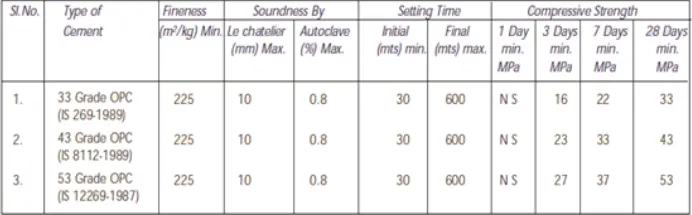
1) PHYSICAL CHARACTERSTICS OF DIFFERENT TYPES OF OPC CEMENT
2) Table – 5 Minimum Cement Content, Maximum Water-Cement Ratio and Minimum Grade of Concrete for Different Exposures with Normal Weight Aggregate of 20 mm Nominal Maximum Size IS: 456-2000
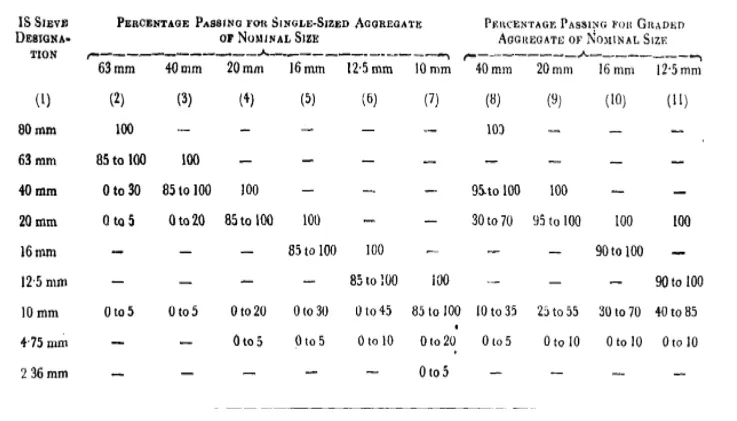
3) Table 2 of IS 383: Grade size distribution for different nominal sizes of coarse aggregate
4) Table 4 of IS 383: Grading of fine aggregate
5) Table I of IS 10262:2009: Assumed standard deviations
6) Table 2 of IS 10262:2009: maximum water content for 20 mm aggregate