Project 7
Padding:
Problem with Simple Convolution Layers
- For a gray scale (n x n) image and (f x f) filter/kernel, the dimensions of the image resulting from a convolution operation is (n – f + 1) x (n – f + 1).
For example, for an (8 x 8) image and (3 x 3) filter, the output resulting after convolution operation would be of size (6 x 6). Thus, the image shrinks every time a convolution operation is performed. This places an upper limit on the number of times such an operation could be performed before the image reduces to nothing thereby precluding us from building deeper networks.- Also, the pixels on the corners and the edges are used much less than those in the middle.
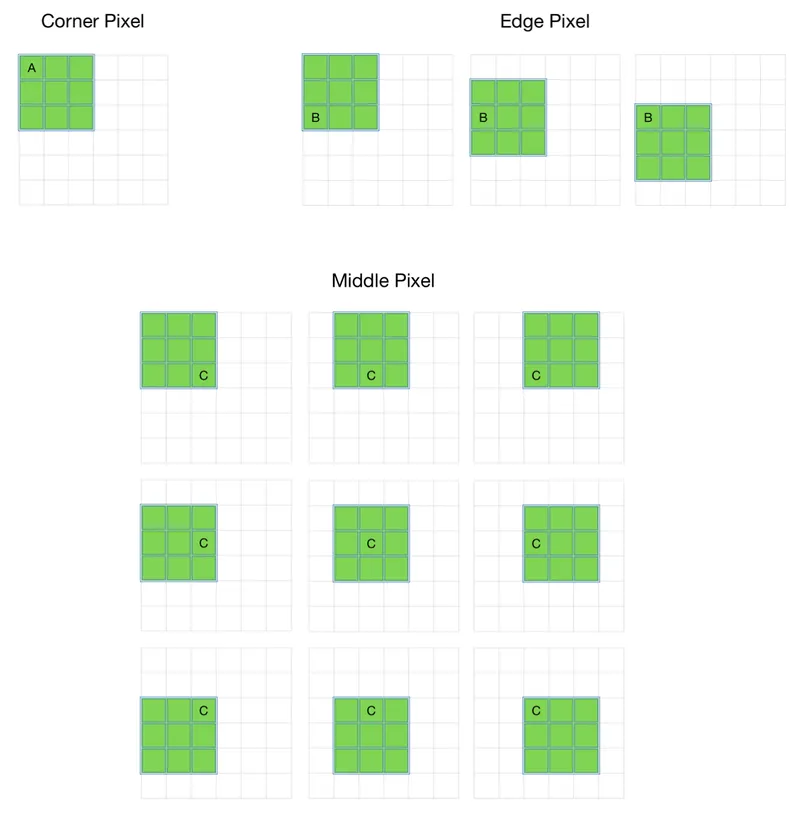
For example,
- Also, the pixels on the corners and the edges are used much less than those in the middle.
-
- Clearly, pixel A is touched in just one convolution operation and pixel B is touched in 3 convolution operations, while pixel C is touched in 9 convolution operations. In general, pixels in the middle are used more often than pixels on corners and edges. Consequently, the information on the borders of images is not preserved as well as the information in the middle.
Padding Input Images
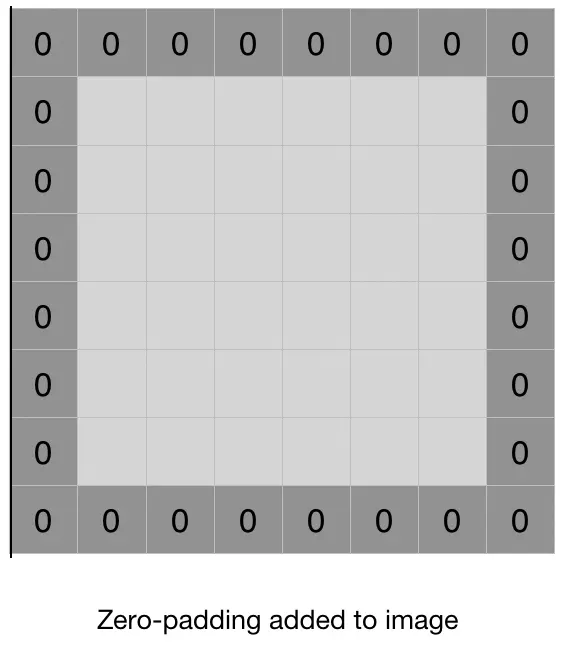
Padding is simply a process of adding layers of zeros to our input images so as to avoid the problems mentioned above.
- This prevents shrinking as, if p = number of layers of zeros added to the border of the image, then our (n x n) image becomes (n + 2p) x (n + 2p) image after padding. So, applying convolution-operation (with (f x f) filter) outputs (n + 2p – f + 1) x (n + 2p – f + 1) images. For example, adding one layer of padding to an (8 x 8) image and using a (3 x 3) filter we would get an (8 x 8) output after performing convolution operation.
- This increases the contribution of the pixels at the border of the original image by bringing them into the middle of the padded image. Thus, information on the borders is preserved as well as the information in the middle of the image.
- Valid Padding: It implies no padding at all. The input image is left in its valid/unaltered shape.
-
-
- So,
[(n x n) image] * [(f x f) filter] —> [(n – f + 1) x (n – f + 1) image]
-
where * represents a convolution operation.
- Same Padding: In this case, we add ‘p’ padding layers such that the output image has the same dimensions as the input image.
So, -
[(n + 2p) x (n + 2p) image] * [(f x f) filter] —> [(n x n) image]
-
which gives p = (f – 1) / 2 (because n + 2p – f + 1 = n).So, if we use a (the 3 x 3) filter the 1 layer of zeros must be added to the borders for the same padding. Similarly, if (5 x 5) filter is used 2 layers of zeros must be appended to the border of the image.
-
-
- Strided:
Assume we have an image with dimensions of n x n. If it is convoluted with an f x f filter, then the dimensions of the image obtained are .
Stride is a component of convolutional neural networks or neural networks tuned for the compression of images and video data. Stride is a parameter of the neural network's filter that modifies the amount of movement over the image or video. For example, if a neural network's stride is set to 1, the filter will move one pixel, or unit, at a time. The size of the filter affects the encoded output volume, so stride is often set to a whole integer, rather than a fraction or decimal.
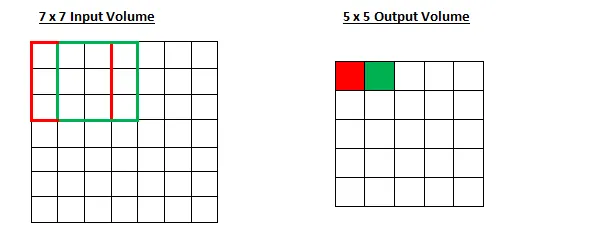
Imagine a convolutional neural network is taking an image and analyzing the content. If the filter size is 3x3 pixels, the contained nine pixels will be converted down to 1 pixel in the output layer. Naturally, as the stride, or movement, is increased, the resulting output will be smaller. Stride is a parameter that works in conjunction with padding, the feature that adds blank, or empty pixels to the frame of the image to allow for a minimized reduction of size in the output layer. Roughly, it is a way of increasing the size of an image, to counteract the fact that stride reduces the size. Padding and stride are the foundational parameters of any convolutional neural network.
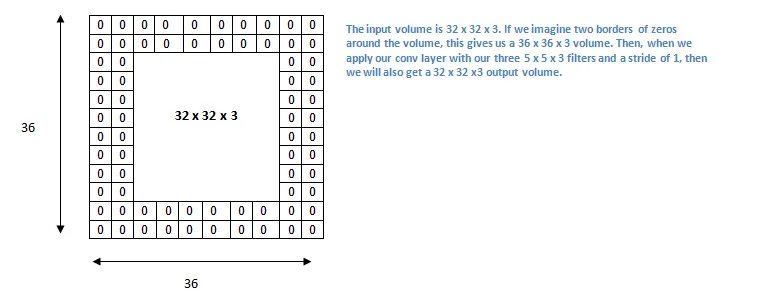
If you have a stride of 1 and if you set the size of zero padding to

where K is the filter size, then the input and output volume will always have the same spatial dimensions.
The formula for calculating the output size for any given conv layer is

where O is the output height/length, W is the input height/length, K is the filter size, P is the padding, and S is the stride.