Project 2 Thermal modeling of battery pack
Objective: To prepare a model of 10 cells connected in series and simulate it at different temp. and charge-discharge current values and analyze the result.
Layout:
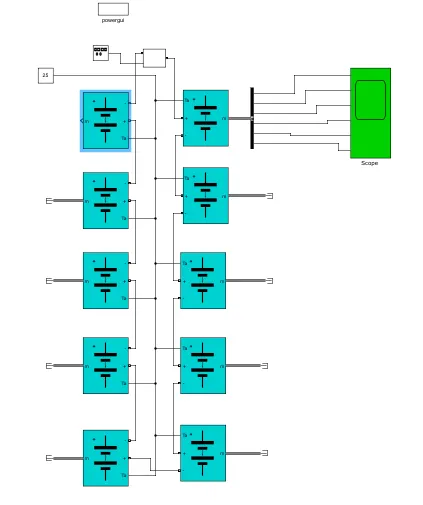
figure 1
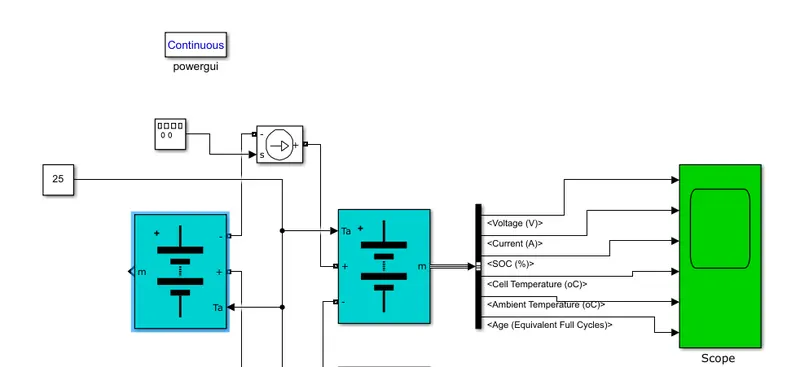
As shown in the figure a generic battery model from the specialized power source is used in the model and 100 such batteries are connected in series for the supply of the charge-discharge current a controlled current source is used which gets its signal from a square wave generator, and a constant block representing ambient temperature is connected to the temperature port of each battery. And a buselector is connected to the output port of one of the batteries and output signals of terminal voltage, Charge-Discharge CUrrent, SOC, Cell Temperature, Ambient temperature, and age cycle are selected from the bus selector to be plotted in the scope from comparison.
Battery parameter:
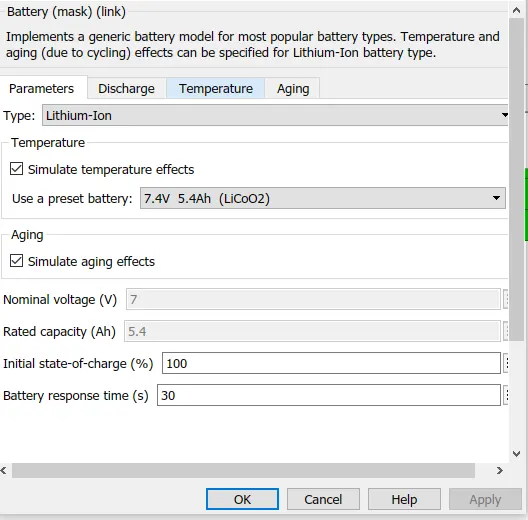
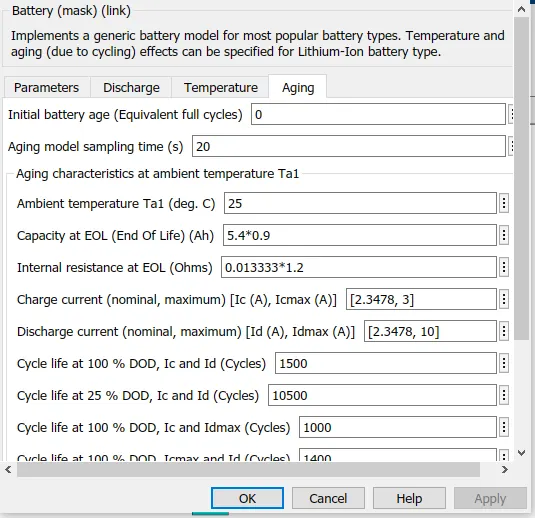
The battery parameters used in this model are as shown in the figures above. In this model, a preset battery of 7.4V 5.4Ah LiCoO2 battery is used and no changes are made in this preset battery except the aging model sampling time is changed from 10e6secs to 20secs to reduce the time for the simulation.
Situation 1:
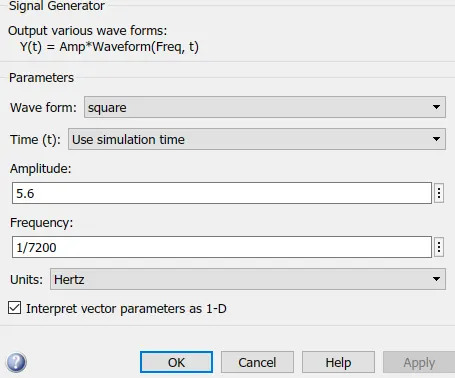
In this situation, the ambient temperature of all the cells is 25 deg. celsius and the charge-discharge current supplied to the battery is 5.6A which is a 1C rate.
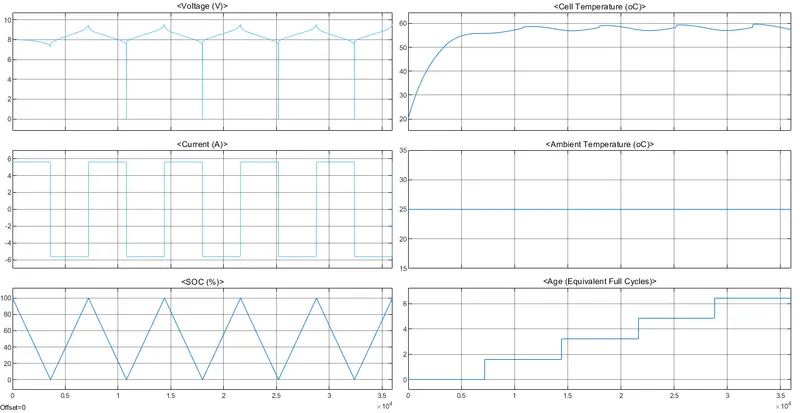
The simulation is carried out for 10 hours and as the current is supplied at a 1C rate the SOC of charge reduces from 100 to 0 in one hour and the terminal voltage of each cell reached 9.5 V at 100% SOC and reduces to about 7.8V at a fully discharged state and the cell temperature cycles between 55 to 60 deg. celsius reaches this state from its initial temperature of 20 deg. celsius exponentially. Over here the value of the age cycle is 1.8.
Situation 2:
In this situation, the ambient temperature of all the cells is 10 deg. celsius and the charge-discharge current supplied to the battery is 5.6A which is a 1C rate.
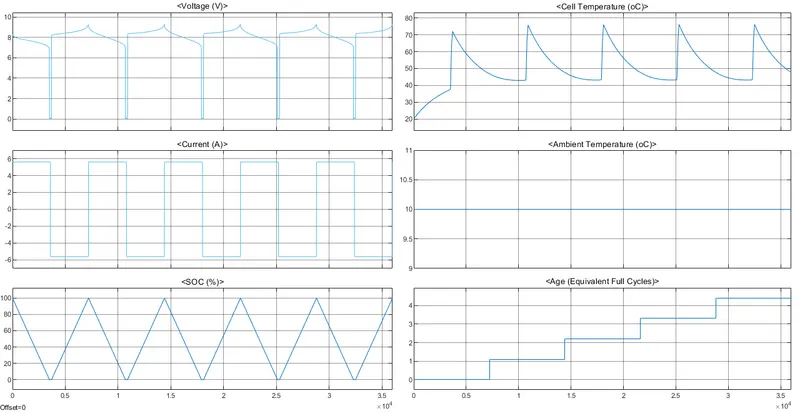
In this situation, the terminal and other parameters of the cells remain the same as situation but there is a change in the temperature of the cells as the cells are kept at 10 deg. celsius ambient temperature the cells would reach 70 deg. celsius during the charging cycle which is higher than the cells at 25 deg. celsius ambient temperature and during the discharge of the cells the temperature of the cells would drop to about 42 deg. celsius. At 10 deg. celsius ambient temperature the value of the age cycle is 1.2 which implies that the life of these cells is longer than the cells operating at 25 degrees ambient temperature.
Situation 3:
In this situation, the ambient temperature of all the cells is 25 deg. celsius and the charge-discharge current supplied to the battery is 2.8A which is a 0.5C rate.
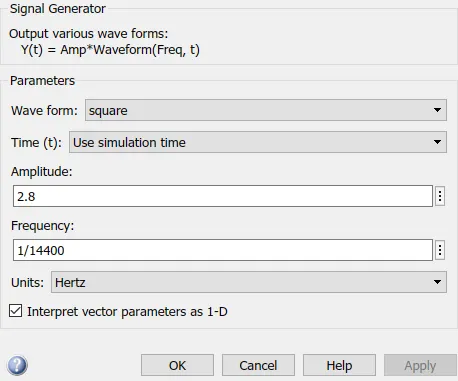
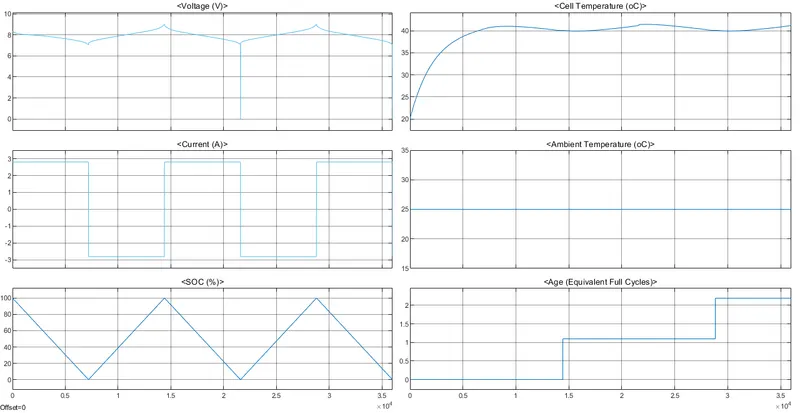
Here as the charge-discharge current is at a 0.5C rate so to fully charge or discharge the battery would 2 hours. And the voltage would remain as in all the above situations that is at 9.5V. But a significant change is the cell temperature which reaches 42 deg. celsius which is around 20 degrees less than when the current is at a 1C rate. And also the life cycle of these cells is longer than the cells charging and discharging at a 1C rate.