Project 2 - Measuring the distance of an object using ultrasonic sensor and also smoothen the sensor data using moving average filter
AIM:
To implement the code for “Measuring distance of an object using ultrasonic distance sensor (28015 Ping) and also smoothen the sensor data using moving average filter”.
COMPONENTS REQUIRED:
- BREADBOARD
- ARDUNIO
- OSCILLOSCOPE
- FUNCTION GENERATOR
- CAPACITOR
- RESISTOR
- ULTRASONIC DISTANCE SENSOR
- CONNECTING WIRE
CODE:
/* The circuit:
- +V connection of the PING))) attached to +5V
- GND connection of the PING))) attached to ground
- SIG connection of the PING))) attached to digital pin 7
// this constant won't change. It's the pin number of the sensor's output:
*/
const int pingPin = 7;
void setup()
{
// initialize serial communication:
Serial.begin(9600);
}
void loop()
{
// establish variables for duration of the ping, and the distance result
// in inches and centimeters:
long duration, inches, cm;
// The PING))) is triggered by a HIGH pulse of 2 or more microseconds.
// Give a short LOW pulse beforehand to ensure a clean HIGH pulse:
pinMode(pingPin, OUTPUT);
digitalWrite(pingPin, LOW);
delayMicroseconds(2);
digitalWrite(pingPin, HIGH);
delayMicroseconds(5);
digitalWrite(pingPin, LOW);
// The same pin is used to read the signal from the PING))): a HIGH pulse
// whose duration is the time (in microseconds) from the sending of the ping
// to the reception of its echo off of an object.
pinMode(pingPin, INPUT);
duration = pulseIn(pingPin, HIGH);
// convert the time into a distance
inches = microsecondsToInches(duration);
cm = microsecondsToCentimeters(duration);
Serial.print(inches);
Serial.print("in, ");
Serial.print(cm);
Serial.print("cm");
Serial.println();
delay(100);
}
long microsecondsToInches(long microseconds)
{
// According to Parallax's datasheet for the PING))), there are 73.746
// microseconds per inch (i.e. sound travels at 1130 feet per second).
// This gives the distance travelled by the ping, outbound and return,
// so we divide by 2 to get the distance of the obstacle.
return microseconds / 74 / 2;
}
long microsecondsToCentimeters(long microseconds) {
// The speed of sound is 340 m/s or 29 microseconds per centimeter.
// The ping travels out and back, so to find the distance of the object we
// take half of the distance travelled.
return microseconds / 29 / 2;
}
Circuit Diagram:
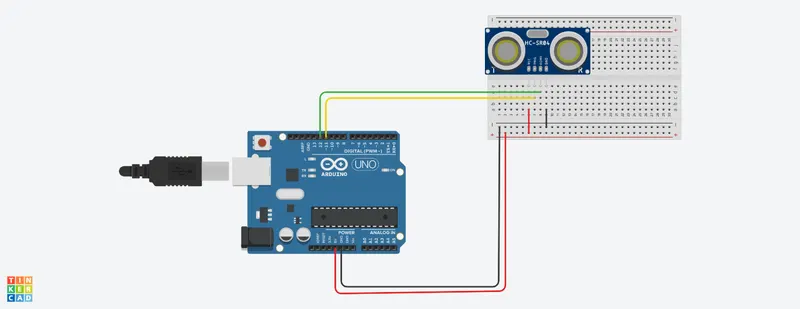
Code:

int trigPin = 11; // Trigger
int echoPin = 12; // Echo
long duration, cm, inches;
long sum=0;
long avg;
int i;

void setup()

{
        //Serial Port begin
        Serial.begin (9600);
        //Define inputs and outputs
        pinMode(trigPin, OUTPUT);
        pinMode(echoPin, INPUT);
}

void loop()

{
        // The sensor is triggered by a HIGH pulse of 10 or more microseconds.
        // Give a short LOW pulse beforehand to ensure a clean HIGH pulse:
        digitalWrite(trigPin, LOW);
        delayMicroseconds(5);
        digitalWrite(trigPin, HIGH);
        delayMicroseconds(10);
        digitalWrite(trigPin, LOW);

       // Read the signal from the sensor: a HIGH pulse whose
       // duration is the time (in microseconds) from the sending
      // of the ping to the reception of its echo off of an object.
        pinMode(echoPin, INPUT);
        duration = pulseIn(echoPin, HIGH);

     // Convert the time into a distance

        cm = (duration/2) / 29.1; // Divide by 29.1 or multiply by 0.0343
        inches = (duration/2) / 74; // Divide by 74 or multiply by 0.0135
        for (i=0; i<5; i++)
        {
               sum=sum+inches;
               avg = sum/5;
        }
        Serial.print(avg);
        Serial.print("Avg, ");
        Serial.print(cm);
        Serial.print("cm");
        Serial.println();
        Serial.print(inches);
        Serial.print("in");
        Serial.println();

        delay(250);
}