Project
AIM :- Carry out a system-level simulation of an all-terrain BAJA vehicle
OBJECTIVES :- To make a techinical report on the model properties and analyze the results obtained
INTRODUCTION
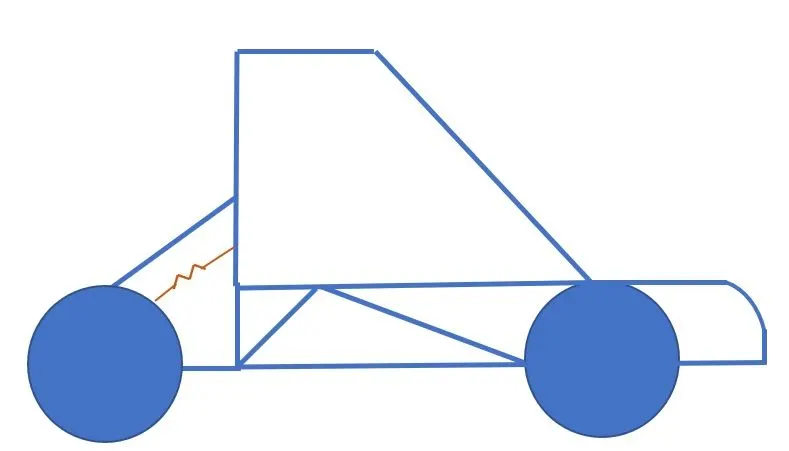
All Terrain Vehicle :-
- An all-terrain vehicle (ATV), also known as a light utility vehicle (LUV), a quad bike, or simply a quad, as defined by the American National Standards Institute (ANSI)
- It is a vehicle that travels on low-pressure tires, with a seat that is straddled by the operator, along with handlebars for steering control.
- As the name implies, it is designed to handle a wider variety of terrain than most other vehicles. Although it is a street-legal vehicle in some countries, it is not street-legal within most states, territories, and provinces of Australia, US and Canada
Continious Veariable Transmission :-
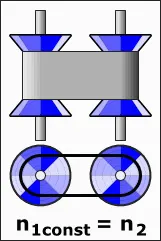
- A continuously variable transmission (CVT) is an automatic transmission that can change seamlessly through a continuous range of gear ratios.
- This contrasts with other transmissions that provide a limited number of gear ratios in fixed steps.
- The flexibility of a CVT with suitable control may allow the engine to operate at a constant RPM while the vehicle moves at varying speeds.
Analysis of simulink model of BAJA with CVT :-
Model :-
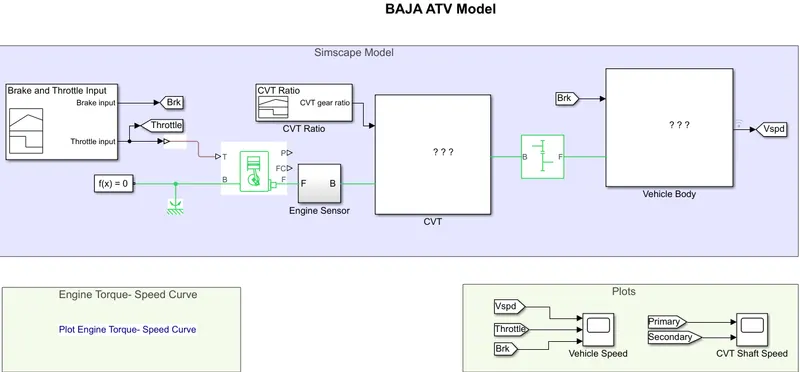
This model shows the general layout of the BAJA ATV Model in simulink, we'll further explore the model components and results in detail.
CVT Model :-
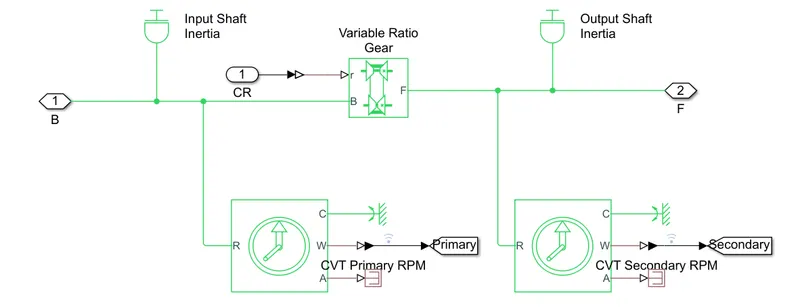
Blocks used :-
- Ideal Rotational Motion Sensor :- The block represents an ideal mechanical rotational motion sensor, that is, a device that converts an across variable measured between two mechanical rotational nodes into a control signal proportional to angular velocity or angle
- Variable Rator Transmission :- Represents a variable ratio gearbox such as implemented by mechanical belt CVT, electric, or hydraulic transmissions.
- Inertia Block :- The block represents an ideal mechanical rotational inertia
- Mechanical Rotational Reference :- This block represents a mechanical rotational reference point, that is, a frame or a ground.
- Double Shoe Brake :- Represents a brake arranged as two pivoted rigid shoes symmetrically installed inside or outside a drum and operated by one actuator.
- Tired(Magic Formula) :- Represents the longitudinal behavior of a highway tire characterized by the tire Magic Formula. The block is built from Tire-Road Interaction (Magic Formula) and Simscape Foundation Library Wheel and Axle blocks.
- Vehicel Body :- Represents a two-axle vehicle body in longitudinal motion. The block accounts for body mass, aerodynamic drag, road incline, and weight distribution between axles due to acceleration and road profile. The vehicle can have the same or a different number of wheels on each axle.
- PS-Simulink Converter :- Converts the input Physical Signal to a Simulink output signal.
- Gain Block:- Constiuent a element-wise gain of a constant factor.
Vehicel Body model :-
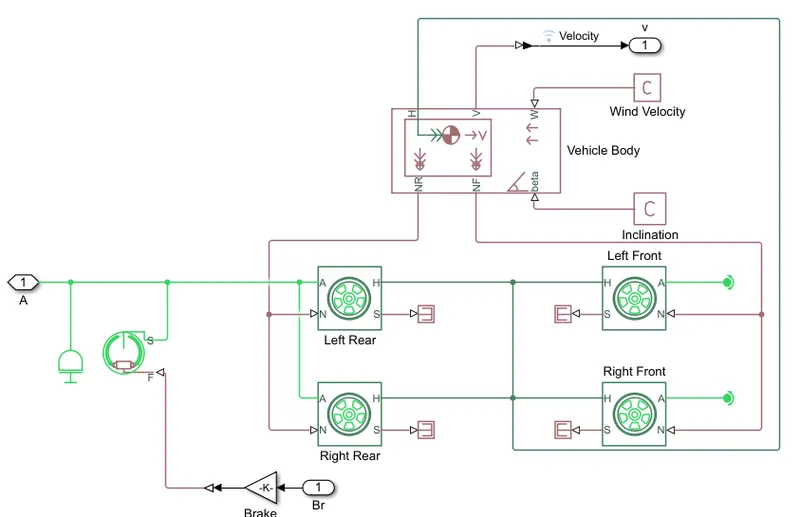
Results :-
Input SIgnal :-
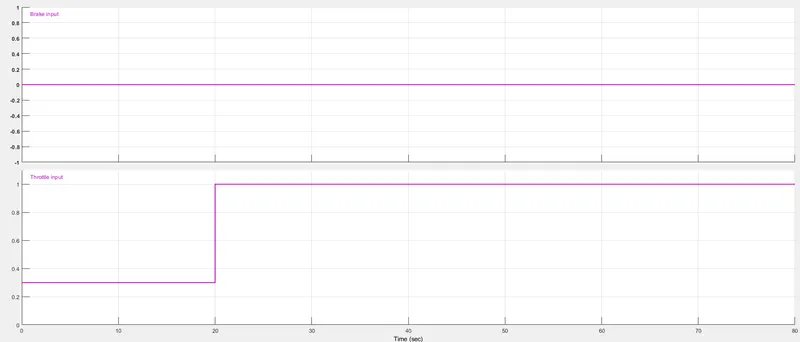
For a given signal generated by signal builder following resulta are obatined :-
For vehicle speed
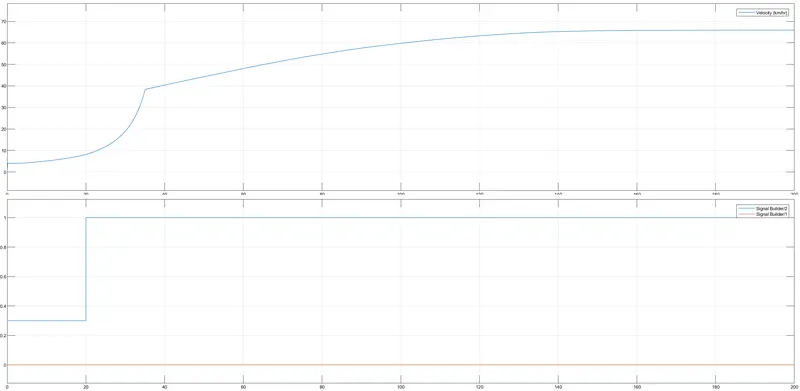
- The velocity vs time diagram shows that due to change in inclination, wind velocity and inertia the velicity increases more initially upto 35 seconds
- After 35 seconds the velocity increases gradually and remains almost constant at the end of the simulation time.
- And the below diagram shows the brake and throttle input respectively.
For CVT Shaft Speed:-
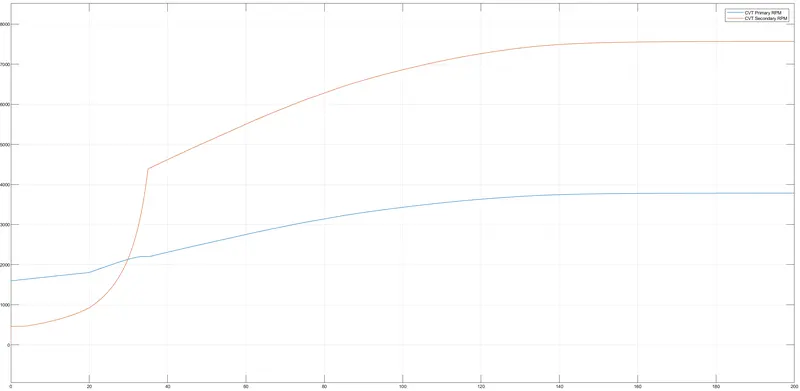
This Plots shows the variation in CVT Primart RMP and Secondar RPM w.r.t for the duration of 200 seconds
Engine Torque vs Speed Curve :-
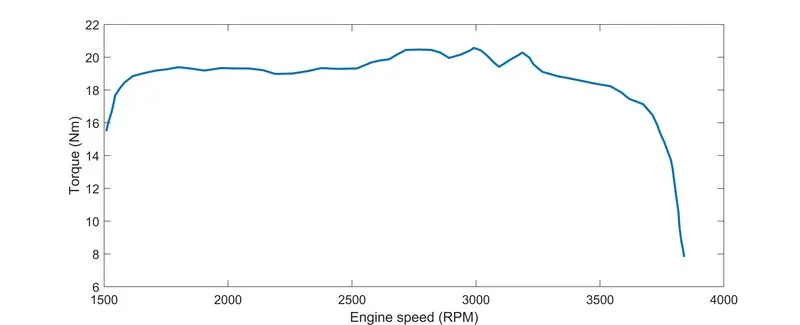
- This plot shows the variation in the Torque in N-m w.r.t the engine speed in RPM
- The torque remains almost steady with the increase in RPM upto certain limit, then the torque gradually starts decreasing
Lookup Table Visualisation :-
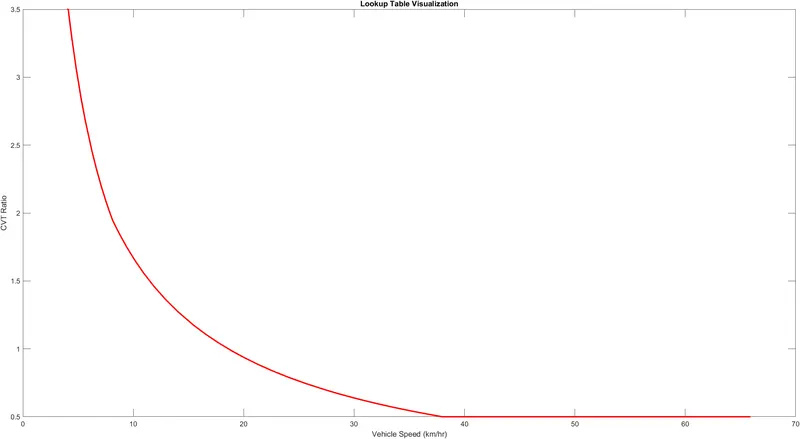
The plot shows that the CVT ratio decreases continiously w.r.t the vehicle upto certain threshold speed and then it remains constant there after.
Analysis of simulink model of BAJA with CVT using Dashboard:-
This model shows the BAJA Atv with control settings to observe change in the real time simulation :-
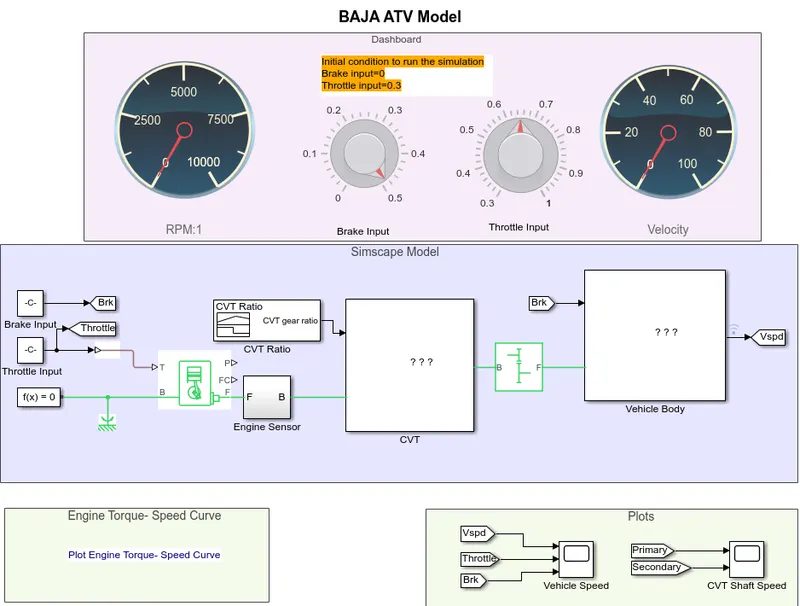
Blocks Added :-
Circular Gauge :- To display the velocity and the RPM input
Knob :- To change to input parameters. (Brake Input and Throttle Input)
Output :-
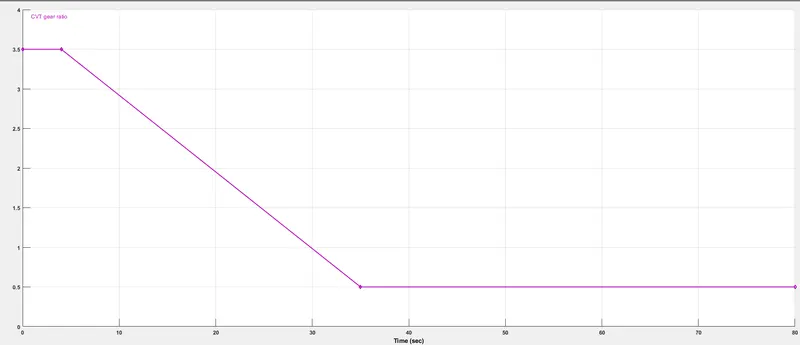
For a given input signal forCVT gear ratio :-
vehicle speed
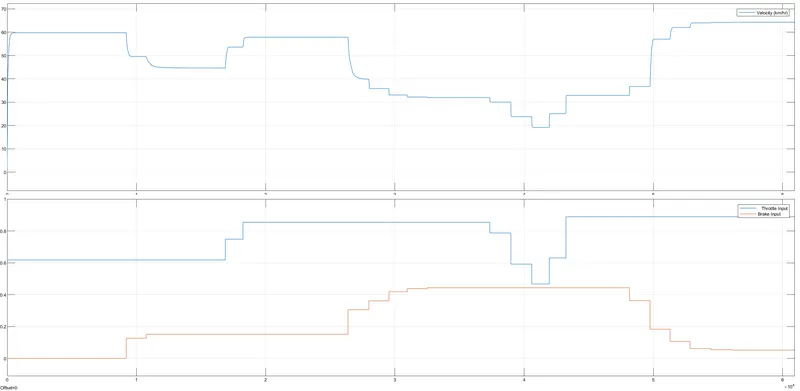
This shows the real time simulations of the vehicle in real life conditions.
the change in the brake input and throttle input w.r.t the time and its effect on the vehicle speed could be seen in the above figure
CVT Shaft Speed :-
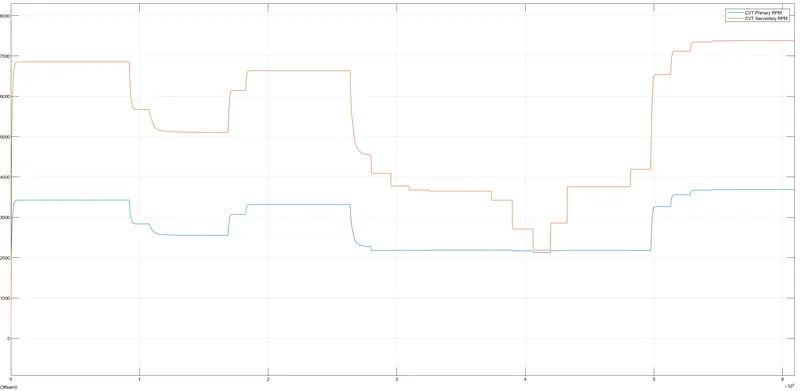
The difference in the primary and secondary RPM is observed with difference in the phase and the variation in secondary RPM is less according to the change in inputs compared with the Prmary RPM.
Conclusion :-
- The analysis of the simulation helps in understanding the varaition in concerned parameters w.r.t the given inputs for various cases
- Simulink helps us to analize various simulation without writing the code and just by knowing the logical working
- The analysis of the ATV BAJA Vehicle helps to examine the performance of the vehicle parameters like RPM, vehicle speed, Torque, gear ratio, etc.