Project 1 - Simulating a BTMS
Project 1 - Simulating a BTMS
OBJECTIVES:
The main objectives are as follows :
• Excel Calculator for Volumetric heat generation source.
• Run the case for different mesh sizes - 12,8,6 and 4 mm.
• Effect of element length on the accuracy of results.
EXCEL CALCULATOR: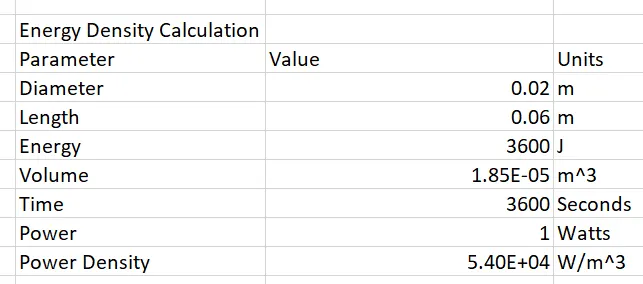
Since an Amp Hour (Ah) is a measure of charge (measured in "Coulombs") whereas a Joule is a measure of energy, you can't convert mAh to Joules without first knowing the voltage (Volts) a which the charge was transferred.
Given that voltage the conversion is just:
Charge (C) x Voltage (V) = Energy (1) and,
Current (A) x time (seconds) Charge (C)
To find the mAh to Joule conversion we first find the charge in a mAh.
mA means 1/1000 of an Amp for an hour and there are 60 x 60 = 3600 seconds per
hour. So,
ImAh = 0.001 Amps x 3600 seconds = 3.6 Coulombs of charge.
Choosing 1 Volt for the voltage, we can now convert mAh to Joules.
3.6 (C) x 1 (V) 3.6 (1) We say at 1 Volt, ImAh of charge equals 3.6 Joules of energy.
mAh to Joule conversions :
For any voltage, mAh X voltage x 3.6 - Joules of energy. For example. A 7.2 Volt battery that delivers 100 mAh of charge has been delivered.
100 x 7.2 x 3.6-2592 Joules of energy.
As we saw above, since a mAh is 1/1000 of an Ah, to convert Ah (amp hours) to Joules
just use 1000 x 3.6-3600 as the conversion factor instead of 3.6.
An Amp Hour (Ah) is a measure of charge (measured in "Coulombs") whereas a Watt Hour (Wh) is a measure of energy. The two are related by voltage. So a 36 V battery stores twice the energy (Wh) of an 18 V battery.
When only an Ah specification is given it is understood that the voltage that determines the energy this represents is that of the battery (storage device). In summary, the energy (measured in "Joules") stored in a 36 V. 15 Ah (15,000 mAh) battery is 36x15 540 "Volt-Amp-hours" or Watt-hours. Where a Volt-Amp-hour (Wh) is 3600 Joules (J). So our battery has stored 1,944,000 Joules of energy!
That's pretty close to the -2.110.000 Joules in a stick of dynamite? respect storage batteries!
BATTERY THERMAL MANAGEMENT SYSTEM SIMULATION-CASE 1
Now for the simulation of BTMS, we have to follow these steps
• Geometry
• Setup
• Results
Geometry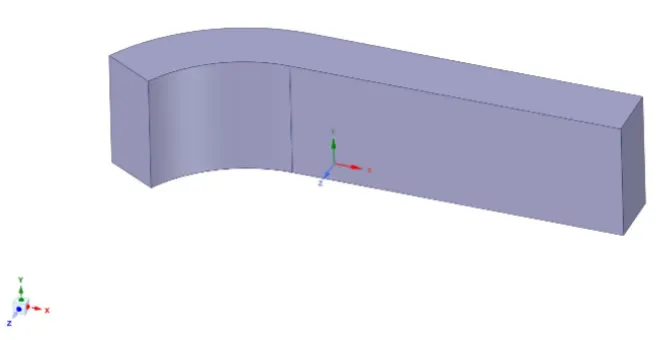
This is the CAD model of a made-up BTMS which contains 5 cells that are enclosed in the fluid volume and air is cooling fluid that is being circulated around the battery.
Setup
1. Solver-Density solver
2. Solver state - Steady state
3. turbulence Model - K-Epsilon Model
4. Inlet Velocity=4m/s
5. Volumetric Heat source = 30000 W/m^3
6. Outlet Pressure = 0 Pascals
While simulating the BTMS, it is not fine to use any solid material because the battery manufacturer would have specified the material that is being used for the battery cells. But for the simulation purpose, it should be seen that the material should have certain thermal properties to conduct the heat easily to the cooling liquid in the battery pack.
During the previous derivation of the 1D heat energy balance equation, we see the terms like thermal conductivity and heat generation term.
Results
Temperature Contour of Cells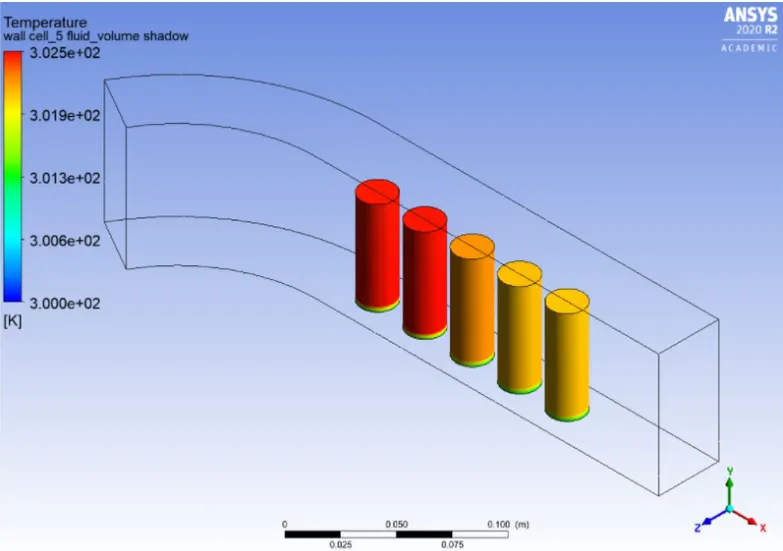
SIMULATION ACCURACY
When we compare all 4 cases of the residual plot and various contour plots,
we can observe that if we refine the mesh to the fine level we see an increase in the accuracy of the results. But after a certain mesh size, the accuracy almost remains constant.
CONCLUSION
1. The flow over a BTMS is performed.
2. The heat generation source term was derived based on battery specifications.
3. The mesh size was varied and we see that there is a slight improvement in the
results and plots.