Project-1: Powertrain for aircraft in runways
PART :-A
QUESTION:-1Here is a list of the total weight of various types of aircraft:
- Airbus A380 - 560,000 kg
- Boeing 747-8 - 447,700 kg
- Boeing 777-300ER - 351,500 kg
- Boeing 787-9 Dreamliner - 254,000 kg
- Airbus A350-1000 - 308,000 kg
- Airbus A320neo - 73,500 kg
- Boeing 737 MAX 9 - 82,190 kg
- Cessna Citation X - 7,731 kg
- Bombardier Challenger 350 - 11,430 kg
- Gulfstream G650 - 45,500 kg
- Embraer E190-E2 - 56,000 kg
- Antonov An-225 Mriya - 640,000 kg
- Lockheed C-5 Galaxy - 381,000 kg
- Sikorsky CH-53E Super Stallion - 33,500 kg
- Bell Boeing V-22 Osprey - 27,443 kg
QUESTION:-2 there is a difference between ground speed and air speed.
Ground speed refers to the speed of an aircraft relative to the ground. It is the actual speed at which the aircraft is moving over the surface of the Earth. Ground speed takes into account the aircraft's true air speed and the direction and speed of the wind.
Air speed, on the other hand, refers to the speed of an aircraft relative to the air through which it is moving. It is the speed at which the air is flowing over the wings of the aircraft. Air speed is measured by instruments on board the aircraft and is used by pilots to control the aircraft during flight.
The difference between ground speed and air speed is caused by the effect of wind. If an aircraft is flying with a tailwind (wind blowing in the same direction as the aircraft), its ground speed will be higher than its air speed. Conversely, if an aircraft is flying with a headwind (wind blowing in the opposite direction to the aircraft), its ground speed will be lower than its air speed.
Therefore, it is important for pilots to consider both ground speed and air speed when planning and executing flights.
QUESTION:-3 It is generally not recommended to use aircraft engine power to move an aircraft on the ground at an airport because it can be unsafe and cause damage to the aircraft and airport infrastructure.
Firstly, moving an aircraft using its engine power can be dangerous, as it increases the risk of accidents and collisions with ground vehicles, other aircraft, or airport facilities. In addition, it can be difficult to control an aircraft on the ground using only the engine power, especially in strong winds or when taxiing on slippery surfaces.
Secondly, using the engine power to move the aircraft on the ground can cause damage to the engines and other aircraft systems. This is because the engines are designed to operate in the air, and not on the ground where there is a different airflow and cooling system. In addition, excessive use of engine power can lead to overheating and premature wear and tear of the engines, reducing their lifespan and increasing maintenance costs.
Finally, using engine power to move an aircraft on the ground can cause damage to airport infrastructure, such as taxiways, runways, and tarmac surfaces. This is because the engine exhaust can cause erosion of the ground surface and create debris, which can damage the aircraft and other ground vehicles.
Therefore, it is generally recommended to use specialized ground vehicles, such as tugs or towbars, to move aircraft on the ground at an airport. This ensures safe and efficient ground operations, and helps to minimize the risk of accidents and damage to aircraft and airport infrastructure.
QUESTION:-4 When an aircraft is ready to take off, it is usually pushed back from the gate or parking position using a specialized ground vehicle called a pushback tug. This is typically done to position the aircraft in the correct orientation for takeoff and to provide clearance for the engines and wings.
The pushback tug is typically operated by ground crew, who connect the tug to the aircraft and use it to push the aircraft back from the gate or parking position. The tug is attached to the aircraft using a towbar or other specialized equipment that is compatible with the specific aircraft type.
Once the aircraft is in the correct position, the ground crew disconnects the tug and the aircraft's engines are started. The aircraft is then taxied to the runway using its own power, with the pilot controlling the speed and direction of the aircraft using the rudder and brakes.
During taxiing, the pilot follows the instructions of ground controllers, who use visual signals or radio communication to direct the aircraft to the correct runway and taxiway. Once the aircraft reaches the runway, it is lined up for takeoff, and the pilot accelerates the engines to achieve takeoff speed and lift off the ground.
Overall, the pushback tug is an essential tool for safe and efficient ground operations at airports, and helps to ensure that aircraft are positioned correctly for takeoff and landing.
QUESTION:-5 Take Off Power: Take off power is the maximum amount of power that an aircraft's engines can produce during takeoff. It is calculated based on a number of factors, including the weight of the aircraft, the air temperature, and the altitude of the airport. During takeoff, the pilot must apply the appropriate amount of power to achieve the required takeoff speed and lift the aircraft off the ground.
Tyre Design: The design of aircraft tyres is critical for safe and efficient operations during takeoff, landing, and taxiing. Aircraft tyres are typically designed to be lightweight and durable, with high load-carrying capacity and low rolling resistance. They are also designed to withstand the high stresses and temperatures that occur during takeoff and landing, and to provide good traction and braking performance on wet or icy runways.
Rolling Resistance: Rolling resistance is the force that opposes the movement of an aircraft's wheels as it rolls along the ground. It is caused by various factors, including the friction between the tyres and the runway surface, the deformation of the tyres under load, and the aerodynamic drag of the wheels. Rolling resistance is an important consideration during takeoff and landing, as it affects the aircraft's acceleration and braking performance.
Tyre Pressure: Tyre pressure is a critical parameter for safe and efficient aircraft operations. The correct tyre pressure ensures that the tyre maintains its shape and load-carrying capacity, and provides good traction and braking performance on the runway. The tyre pressure must be carefully monitored and adjusted based on various factors, including the weight of the aircraft, the air temperature, and the altitude of the airport.
Brake Forces when Landing: During landing, the aircraft's brakes are used to slow down and bring the aircraft to a stop on the runway. The amount of brake force required depends on various factors, including the weight of the aircraft, the speed at which it is landing, and the length of the runway. The brakes are typically operated by the pilot using the rudder pedals, and can generate high forces that can cause the tyres to heat up and wear out quickly. Therefore, it is important to carefully monitor the brake forces and temperature during landing, and to take appropriate measures to ensure safe and efficient brake performance.
PART:-B
QUESTION:-6 A Calculating the force and power required to push or pull an aircraft by a towing vehicle involves several factors and assumptions, including the weight of the aircraft, the coefficient of friction between the tires and the ground, the angle of the incline, and the efficiency of the transmission system. Here is a general procedure for making the calculations:
- Determine the weight of the aircraft in Newtons (N) or pounds (lbs).
- Assume a coefficient of friction between the aircraft tires and the ground. For example, assume a value of 0.04 for a dry, flat runway.
- Determine the angle of the incline, if applicable. Assume a value of 0 degrees for a flat surface.
- Calculate the force required to move the aircraft using the formula: F = m x µ x cos(θ), where F is the force in N or lbs, W is the weight of the aircraft, µ is the coefficient of friction, and θ is the angle of the incline in radians.
- Calculate the power required to move the aircraft using the formula: P = F x V, where P is the power in watts or horsepower, F is the force calculated in step 4, and V is the velocity of the aircraft in meters per second or feet per second.
Here is an example calculation:
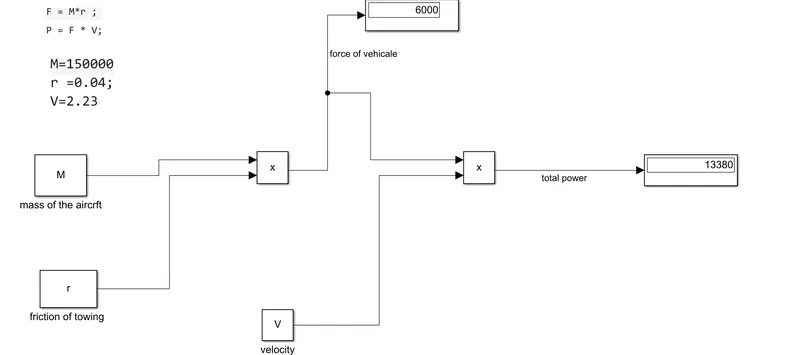
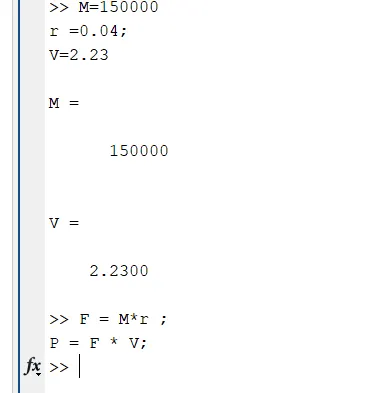
Assume the weight of the aircraft is 150,000 lbs, the coefficient of friction is 0.04, and the angle of the incline is 0 degrees. Using the formula from step 4:
F = m x µ x cos(θ) = 150,000 x 0.04 x cos(0) = 6,000 lbs
Assuming a towing speed of 5 mph (2.23 m/s),
required power
P = F x V = 6,000 x 2.23 = 13,380 watts or 17.9 horsepower.
Question:-6B;
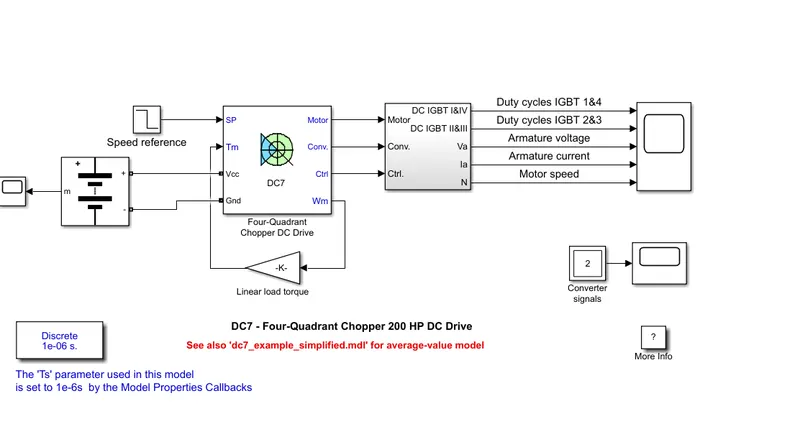
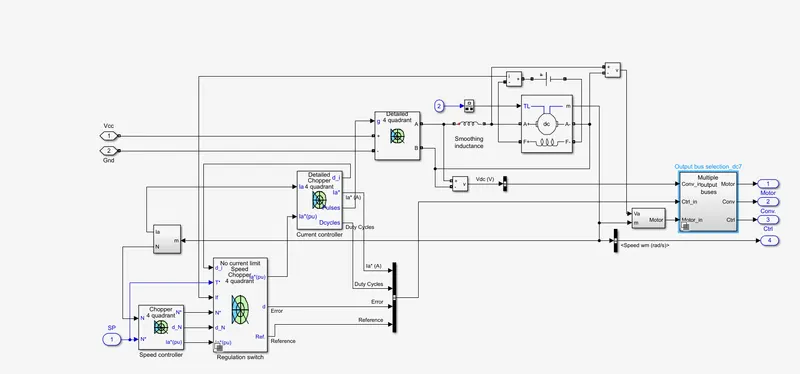
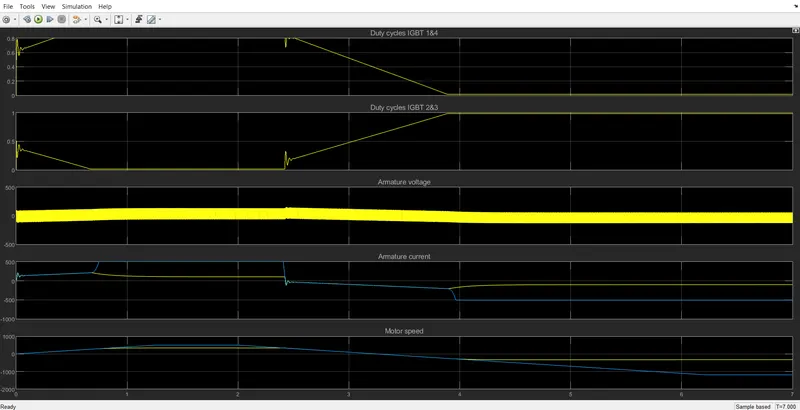
Question:-7 Dc 7 blocks are edited a battery and scope and the dc7 block are the normaly called the four queadrent choppers and same works on the forwordinng and revershing motor than its called the four queadrent choppers if given the more diteailed the this ic using the converter and using the desireble speed of motor.